

The secret to getting a good score even with random guessing.
According to this teacher, one of the biggest problems candidates often face is poor time management during exams, resulting in lower scores than their actual abilities.
Many candidates make the mistake of not allocating their time appropriately between sections, spending too much time on some difficult questions while rushing, making mistakes, or missing easy questions that are within their capabilities.
To overcome this problem, in the final week, students need to develop exam strategies that match their abilities and target scores, while not limiting their chances of achieving higher scores. The core of this is to create a reasonable time management plan to apply during the exam.
Specifically, the current physics exam consists of 40 questions, each with 4 options A, B, C, and D. Therefore, the probability of randomly choosing an answer to any given question correctly is 1/4. This means that, even without prior knowledge, students can still achieve an average physics score of 0.25 x 40 x 1/4 = 2.5 points simply by choosing randomly.

Mr. Nguyen Thanh Nam, lecturer at the Military Technical Academy, physics teacher on VTV7 channel (Photo: Ha Le).
If a candidate is capable of answering N questions correctly (knowing how to do them, doing them correctly, and doing them within the time limit), they only need to randomly choose the remaining (40 - N) questions. Then, the average score the candidate can achieve is D = 0.25xN + 0.25x(40-N)x1/4 = 0.1875xN + 2.5. From this formula, we can deduce that to achieve the desired score D, one needs to proactively answer at least N = (D - 2.5)/0.1875 questions correctly in the exam and randomly guess the remaining (40 - N) questions. Based on this formula, we can create the data table below.

The question sheet requires active participation and accurate answers to achieve the desired score.
You can use this table to develop a suitable test-taking strategy for yourself. First, each person needs to determine the target score for the physics exam. Then, based on the data in the table, determine the number of questions that need to be answered proactively and correctly. Finally, based on the total number of questions that need to be answered correctly, the candidate should allocate their time accordingly.
To allocate time effectively for the questions we actively aim to answer correctly, we divide the exam questions into four categories: the first 15 questions are category 1 (H1); questions 16 to 30 are category 2 (H2); questions 31 to 35 are category 3 (H3); and the last 5 questions are category 4 (H4). Based on this, we can construct the time allocation table below, based on desired scores and question categories.

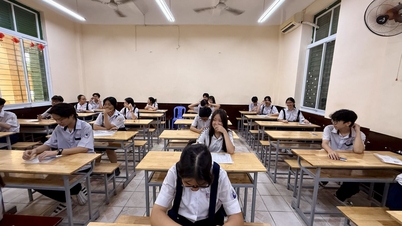
How to "randomly circle answers" and still get a score (Photo: Manh Quan).
According to this table, each score level has two columns: the left column shows the number of questions that need to be actively answered and answered correctly, and the right column shows the total time spent on a question category and the average time per question within that category. For example, to achieve 8 points, a candidate needs to actively answer 29 questions correctly, including 15 questions in H1 and 14 questions in H2, and randomly guess the remaining 11 questions in the exam.
The time allotted to answer the 15 H1 questions is 20 minutes, averaging 80 seconds per question, and the time allotted to answer the 14 H2 questions is 30 minutes, averaging 128 seconds per question. Randomly guessing the remaining 11 questions can be done within one minute.
Note that candidates don't need to memorize the entire table; they only need to remember the time frame based on their target score. If your goal is 8 points, remembering "15 questions in 20 minutes and 14 questions in 30 minutes" is sufficient. After determining the numbers, students should apply the time frame during practice tests.
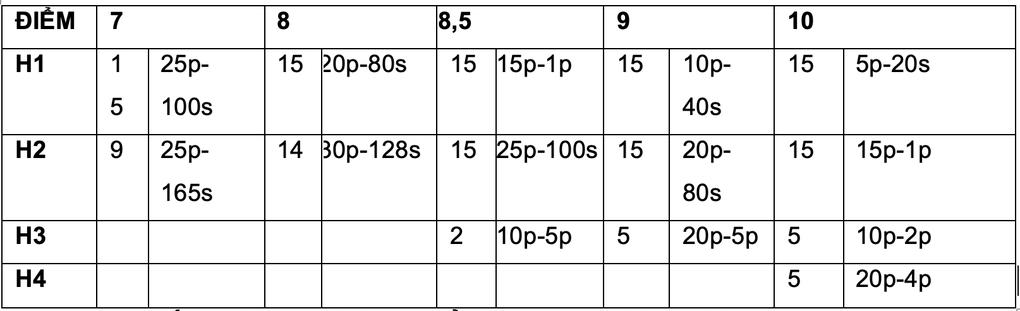
Time allocation table by point level and question rank.
During the exam, candidates need to manage their time carefully to ensure that the total time spent on each question category does not exceed the allotted time, and that the time spent on a single question does not exceed the average time calculated plus any time saved on previous questions. They must work cautiously but also strive to complete the questions as quickly as possible to save time for the remaining questions.
After completing all possible questions, in the last two minutes before the end of the exam, randomly guess the questions you couldn't answer according to the following principle: on the answer sheet, among columns A, B, C, and D, there is usually one column with the fewest options. Randomly guess all the remaining questions into that column to maximize your chances of guessing correctly. In case there are multiple columns with an equal number of options, you can choose any column.
The purpose of creating a time limit is to make it easier to manage and prevent the time allocated for earlier questions from encroaching on the time allocated for later questions.
Source: https://dantri.com.vn/giao-duc/cach-gianh-diem-mon-vat-ly-ngay-ca-khi-khoanh-bua-20240622102515873.htm



![[Photo] General Secretary and President To Lam presides over a meeting on preparations for the review of one year of operation of the three-tiered government system.](https://vphoto.vietnam.vn/thumb/1200x675/vietnam/resource/IMAGE/2026/06/02/1780391821195_a1-bnd-4595-9717-jpg.webp)

























































































Comment (0)