

In the subconscious of many consumers, washing machines are devices that are constantly in contact with water and soap, so they will always be clean. However, from a mechanical and biological perspective, this is a harmful misconception.
In reality, a washing machine drum consists of two layers: an inner perforated stainless steel drum that holds the clothes and an outer plastic drum. The space between these two drums is a blind spot invisible to the naked eye. During operation, excess detergent residue, minerals from hard water, dead skin cells, lint, and mud are constantly pushed out and stick to the outer drum walls.
Combined with the constantly damp environment, this layer of dirt quickly becomes an ideal breeding ground for mold and millions of anaerobic bacteria. As a result, clothes after washing not only don't smell fresh but also retain a musty odor, show gray stains, and, more seriously, cause irritation and itching for the sensitive skin of young children.
Instead of incurring the expense of hiring a professional for regular cleaning and maintenance, you can completely eliminate this buildup of grime by utilizing basic chemical reactions from environmentally friendly kitchen ingredients.
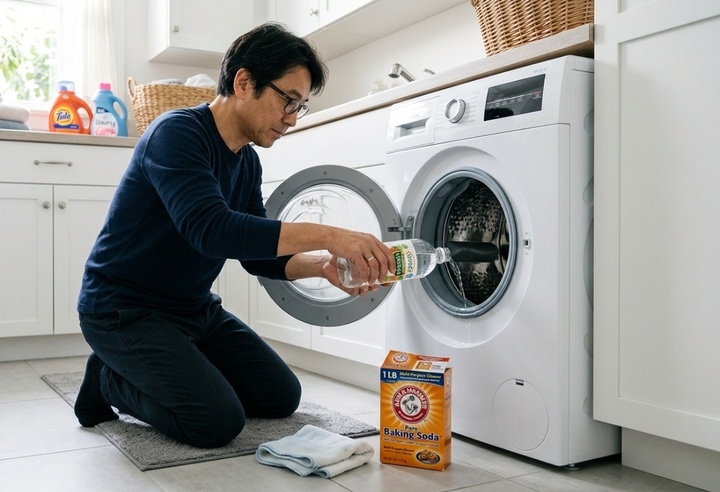
Cleaning your washing machine at home doesn't require a technician if you know how to apply natural chemical principles. Photo: IT
How to clean a washing machine
For a thorough cleaning process, put away those industrial cleaning chemical bottles containing harmful chlorine. Instead, the combination of white vinegar (containing acetic acid) and baking soda (containing sodium bicarbonate), both alkaline, will be the optimal solution.
White vinegar acts as a solvent, dissolving mineral deposits and inhibiting bacterial growth. Meanwhile, baking soda acts as a mild abrasive and is extremely effective at neutralizing odors without damaging the stainless steel surface of the washing machine drum.
A 4-step process for cleaning your washing machine at home according to technical standards.
Below is a cleaning procedure applicable to both front-loading and top-loading washing machines, helping to clean them thoroughly from the outside in.
Step 1: Clean the detergent dispenser and the lint filter. These are the two most often overlooked parts.
Detergent dispenser tray: Press the safety latch to detach the tray from the machine. Use an old toothbrush to scrub away any hardened detergent and fabric softener residue under warm running water, then dry and reassemble.
Sediment filter (for front-loading washing machines): Located in the bottom right corner of the front of the machine. Open the cover and prepare a towel or shallow tray to catch any accumulated water. Turn the knob counterclockwise to remove the filter. Remove any lint, coins, or hairpins stuck inside, rinse thoroughly, and tighten it back in place.
Step 2: Process the rubber seal (applicable to front-door machines)
The rubber seal on the washing machine door is specifically designed to prevent water leaks, but it inadvertently becomes a channel where water collects, lint builds up, and black mold forms. Gently lift the folds of the rubber seal and use a damp cloth soaked in white vinegar to wipe along the grooves. For stubborn black mold stains, mix a little baking soda with water to form a paste, apply it to the rubber seal, let it sit for 15 minutes, and then wipe it off with a clean cloth.
Step 3: Break down plaque using white vinegar.
Pour about 2 to 3 cups of white vinegar directly into the washing machine drum or detergent dispenser. Turn on the machine, select a wash cycle with a high water temperature (around 60-90 degrees Celsius) and the longest wash time. The high temperature combined with the swirling water carrying acetic acid will penetrate the gaps between the two layers of the drum, gradually softening and breaking down the bonds of limescale buildup and killing stubborn mold spores.
Step 4: Neutralize and deodorize with baking soda.
After the vinegar wash cycle is complete, open the washing machine door and sprinkle about 1 cup of baking soda inside the drum. Close the door and run another quick wash cycle with warm water; there's no need to select a very hot water setting at this point.
The addition of baking soda at this stage helps neutralize any remaining acid, completely eliminating the sour smell of vinegar, while the tiny alkaline particles sweep away any softened buildup from step 3 through the drainpipe.
Notes on cleaning your washing machine
Deep cleaning like this should be done regularly, once every 1 to 2 months. In addition, to keep your washing machine running at its best, users need to change some daily habits:
The open door rule: Never close the washing machine door completely immediately after removing clothes. Always leave the door slightly ajar and gently pull the detergent dispenser out to allow air circulation, helping moisture evaporate completely and eliminating the breeding ground for mold.
Use the right amount of detergent: Overusing detergent/fabric softener won't make clothes cleaner; instead, it will prevent the machine from rinsing properly, creating a huge amount of sticky soap residue inside the drum. Use the recommended dosage and prioritize low-foaming (HE) detergents specifically designed for washing machines.
By understanding the physical and biochemical mechanisms at work inside the device, combined with scientific cleaning methods, you can not only save a significant amount on maintenance costs but also comprehensively protect the respiratory and skin health of every member of your family.
Source: https://vtcnews.vn/cach-ve-sinh-sau-cho-may-giat-ma-khong-can-goi-tho-ar1021257.html
![[Photo] Secretary of the National Assembly Party Committee, Chairman of the National Assembly presides over the meeting of the Standing Committee and Executive Committee of the National Assembly Party Committee.](https://vphoto.vietnam.vn/thumb/1200x675/vietnam/resource/IMAGE/2026/06/03/1780480353201_ndo_br_bnd-2585-jpg.webp)
![[Photo] General Secretary and President To Lam presides over a meeting with the Central Organizing Committee.](https://vphoto.vietnam.vn/thumb/1200x675/vietnam/resource/IMAGE/2026/06/03/1780482764658_a1-bnd-4741-3342-jpg.webp)
















































![[Video] Sunset at Lap An Lagoon – Where the sun sets over the fishing nets](https://vphoto.vietnam.vn/thumb/1200x675/vietnam/resource/IMAGE/2026/05/31/1780192137701_beach-landscape-sea-water-nature-grass-745871-pxhere-com.jpeg)





































Comment (0)