

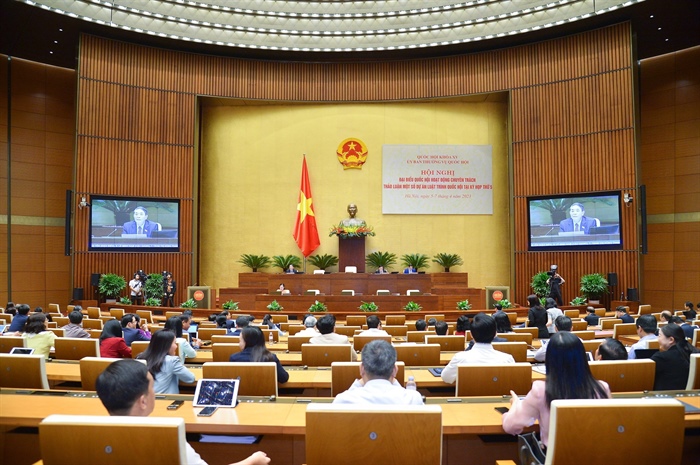
Conference of National Assembly Delegates on the morning of April 7th.
On the morning of April 7th, at the National Assembly building, the Conference of National Assembly Deputies specializing in this area continued to consider and give opinions on several major issues requiring input in the draft Law on Land (amended).
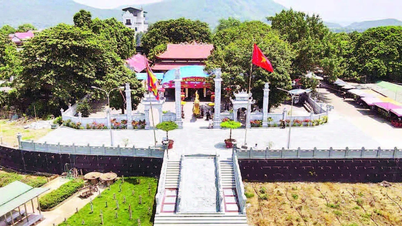
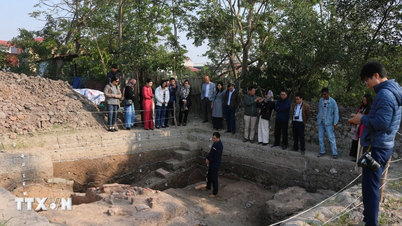
At the conference, delegate Tran Thi Hong Thanh ( Ninh Binh delegation) clearly stated that land with historical sites and heritage is extremely valuable because it is where historical sites and heritage of international, regional, and national significance are located.
These are precious gems in the treasure trove of the nation's traditional culture that need to be preserved, protected, and their value promoted in the process of national development in the context of strong globalization. To achieve this, the management and use of land for historical sites and heritage must be based on a complete, synchronized, and unified legal system, first and foremost the Land Law.
However, according to the delegates, in the current Land Law, this type of land has not been specifically defined or defined, but is classified as non- agricultural land.
This draft of the revised Land Law also lacks a definition of land designated as historical sites and heritage sites, and does not contain specific regulations on planning and land use for this particular type of land. Instead, it only sets out requirements for protecting and preserving historical and cultural relics and scenic landscapes.
Representative Tran Thi Hong Thanh proposed adding the concept of land containing historical and cultural relics, scenic spots, and natural heritage to Article 3 of the draft Law on definitions. In addition, separate regulations on land use planning and plans for this type of land are needed.
Land use planning needs to clearly define the core zone, the adjacent core zone, and the surrounding outer zone of the monument or heritage site in order to establish regulations for the protection of the monument or heritage site, integrated into the management and use of this type of land.
Specifically, for the core area of the monument/heritage site and the adjacent core area, any act of encroachment or misuse of land is strictly prohibited; the surrounding area outside the monument/heritage site may be used, but it must not affect the protection of the monument/heritage site.
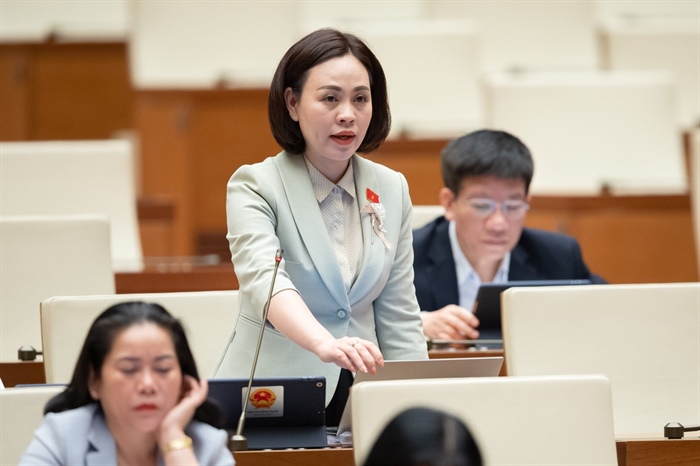
Representative Tran Thi Hong Thanh offered her opinion on the content regarding land for historical sites and heritage.
The delegates also pointed out that Ninh Binh currently has Trang An, a UNESCO World Heritage Site. This is the first mixed heritage site in Southeast Asia, encompassing both cultural and natural heritage. In reality, residents in the core area of the heritage site face difficulties with housing, especially those needing to separate their households for future generations. Delegates suggested that the revised Land Law should include more specific regulations regarding the land use history of households and individuals within the heritage area, allowing for the conversion of certain areas, such as garden and pond land, into residential land within the heritage site's concentrated residential areas. Furthermore, they proposed separate regulations for land in tourism and heritage areas to ensure a distinct land management and utilization regime tailored to the specific characteristics of this type of land.
Reporting and clarifying some issues of concern to National Assembly deputies, Deputy Prime Minister and Minister of Natural Resources and Environment Tran Hong Ha stated that at the conference, the deputies provided comprehensive and insightful opinions, demonstrating thorough research on the latest draft and practical experience, and made many relevant proposals. The Deputy Prime Minister emphasized that these are important contributions for the drafting committee to incorporate and refine the draft before submitting it to the National Assembly. Each issue raised by the National Assembly deputies will be fully explained.
The Deputy Prime Minister stated that, based on monitoring, over 50% of the issues raised by National Assembly deputies concerned land finance and land valuation. Emphasizing that this is the root cause of all problems, the Deputy Prime Minister argued that resolving this issue would also solve other problems, from land disputes to complaints and denunciations. Therefore, throughout the Land Laws from 1993 to the present, relevant agencies have persistently sought solutions to land finance and market-based pricing. The goal is to ensure that prices are consistent with market value.
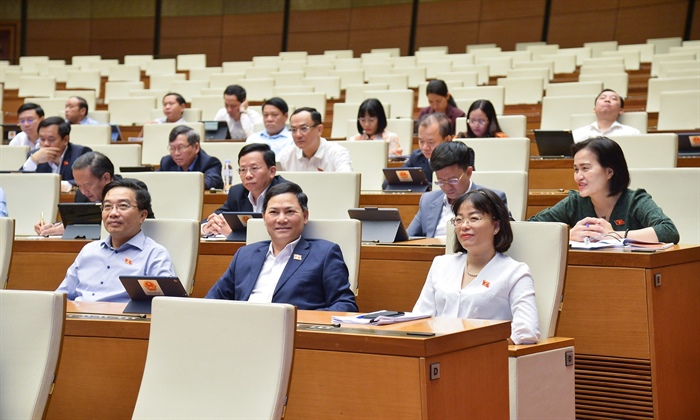
The Deputy Prime Minister stated that even with the four current calculation methods, an accurate price has never been achieved. The reason is the inaccurate input data. This time, the draft law aims to determine prices while not being absolute, but ensuring a scientific basis and accurate price collection. To achieve this, people need to conduct land transactions on the exchange, registering with the office at the correct price. Based on accurate input collected from the exchange and land database, people register to transfer ownership at the office to obtain the data and have the correct calculation method, using information from maps to determine the standard land price.
Regarding land allocation for ethnic minorities and people in remote areas, Deputy Prime Minister Tran Hong Ha agreed with the opinions of National Assembly deputies, emphasizing the need to focus on people in difficult areas whose livelihoods depend on forest land, including Kinh people in remote and particularly difficult areas, in order to determine the correct target groups for policy coverage. Regarding agricultural and forestry land, the Deputy Prime Minister stated that in the future, the State will reclaim inefficient agricultural and forestry farms to return them to localities, from which they can be allocated to ethnic minorities.
Concluding the discussion, Vice Chairman of the National Assembly Nguyen Duc Hai stated that 29 National Assembly deputies had spoken, and Deputy Prime Minister and Minister of Natural Resources and Environment Tran Hong Ha had clarified several issues of concern to the deputies. In particular, the Deputy Prime Minister affirmed many new viewpoints and approaches for the benefit of the people and businesses after their approval by the National Assembly.
Regarding land allocation for ethnic minorities and people in remote areas, the Deputy Prime Minister agreed with the opinions of National Assembly deputies, emphasizing the need to focus on people in difficult areas whose livelihoods depend on forest land, including Kinh people in remote and particularly disadvantaged areas, in order to determine the correct target groups for policy coverage. Regarding agricultural and forestry land, in the coming period, the State will reclaim inefficient agricultural and forestry farms to return them to localities for allocation to ethnic minorities.
Deputy Speaker of the National Assembly Nguyen Duc Hai emphasized that the Standing Committee of the National Assembly appreciates the contributions to the draft Land Law; and hopes that the Vietnam Fatherland Front Committee and political and social organizations, professional social organizations, scientific research agencies, experts, scientists, media, and press will continue to contribute their opinions to improve the draft Law, ensuring the quality and feasibility of the amended Land Law when it comes into effect.
TUNG QUANG; Photo: NATIONAL ASSEMBLY
Source
![[Photo] Delegation attending the 14th Congress of the Vietnam Trade Union visits the Mausoleum of President Ho Chi Minh.](https://vphoto.vietnam.vn/thumb/1200x675/vietnam/resource/IMAGE/2026/06/03/1780451842301_ndo_br_img-3824-jpg.webp)















































































Comment (0)