

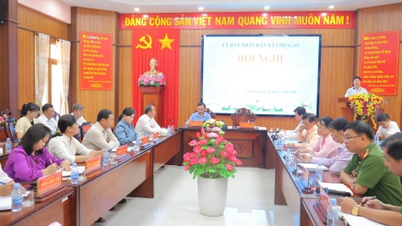
On the morning of May 26th, in Can Tho city, Politburo member and Prime Minister Le Minh Hung worked with the Standing Committee of the Can Tho City Party Committee on the socio-economic development situation, the "double-digit" growth target, disbursement of public investment capital, operation of the two-tiered local government, implementation of Resolution No. 57-NQ/TW of the Politburo, and many other key tasks.

Prime Minister Le Minh Hung works with the Standing Committee of the Can Tho City Party Committee. Photo: Nhat Bac.
Attending the working session were Central Committee members: Minister and Head of the Government Office Dang Xuan Phong, Minister of Home Affairs Do Thanh Binh, Minister of Agriculture and Environment Trinh Viet Hung, Minister of Construction Tran Hong Minh, Minister of Health Dao Hong Lan, Minister of Education and Training Hoang Minh Son, Secretary of the City Party Committee and Head of the National Assembly Delegation of Can Tho City Le Quang Tung, along with leaders of central and local ministries and agencies.
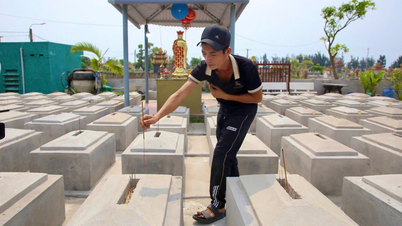
Prior to the working session, Prime Minister Le Minh Hung and the delegation offered incense and flowers to commemorate the heroic martyrs at the Can Tho City Martyrs' Cemetery.
According to the report presented at the meeting, in the first quarter of 2026, Can Tho's economy grew by 7.02%, ranking second out of five provinces in the Mekong Delta region. The economic structure continues to shift in a direction consistent with the local potential and competitive advantages, with the service sector accounting for over 44% of GRDP, industry and construction over 26%, and agriculture, forestry, and fisheries over 23%.

Prime Minister Le Minh Hung emphasized that Can Tho has a very important position and role in the development of the region and the whole country. Photo: Nhat Bac.
State budget revenue as of May 20th reached over 13.2 trillion VND, equivalent to 49.28% of the central government's projected target. Total social capital mobilization reached over 237 trillion VND, an increase of 3.02% compared to the end of 2025. The implementation of Resolution 57 on science and technology, innovation, and digital transformation; and the reduction and simplification of administrative procedures have been emphasized and achieved many positive results.
The organization and operation of the two-tiered local government model have been fundamentally smooth and stable; the civil servant workforce has been appropriately arranged and assigned, and key leadership positions have been strengthened.
However, the city currently has 130 long-standing stalled projects. Of these, 43 projects have been updated on the database system of the Steering Committee for resolving stalled projects, and 87 projects fall under the jurisdiction of the local authorities.

Secretary of the Can Tho City Party Committee and Head of the Can Tho City National Assembly Delegation, Le Quang Tung, speaks at the working session. Photo: Nhat Bac.
Of the 43 projects updated on System 751, 8 have been completed; the remaining 35 projects include 2 component projects of the Chau Doc - Can Tho - Soc Trang expressway, 20 projects currently under consideration for the application of special mechanisms according to Resolution No. 29 of the National Assembly and Decree No. 147 of the Government, and the remaining 13 projects are in the group of difficult and problematic projects under the jurisdiction of local authorities.
In his concluding remarks, Prime Minister Le Minh Hung acknowledged and commended the efforts and positive results achieved by the Party Committee, government, and people of Can Tho in the past period, contributing to the overall achievements of the whole country.
However, the Prime Minister also frankly acknowledged that the city's role and potential have not yet been fully exploited. The GRDP growth rate in the first quarter was still lower than the projected 9.52%; the economic restructuring has not met expectations; the disbursement of public investment remains a bottleneck; the quality of human resources is still limited, and the percentage of workers with degrees and certificates is still low.

Minister and Head of the Government Office Dang Xuan Phong speaks at the working session. Photo: Nhat Bac.
"The crucial year of 2026 is fast approaching. We must be determined and strive for breakthroughs, and that determination and effort must be even greater for Can Tho to achieve the set goals and achieve rapid, sustainable development. We still have room for growth and opportunities, but the key is how we organize and implement them," the Prime Minister emphasized.
The head of government stated that Can Tho needs to further innovate its thinking and working methods, focus on creating development, and boldly propose specific mechanisms to the central government to overcome difficulties and promote large-scale projects.
The Prime Minister requested the city to thoroughly understand and comprehensively implement the resolutions and conclusions of the Central Committee, the Politburo, the National Assembly, and the Government; and at the same time, strongly promote the role of the Standing Committee of the City Party Committee in concretizing tasks, developing detailed plans, assigning responsibilities, and monitoring the progress of implementation.
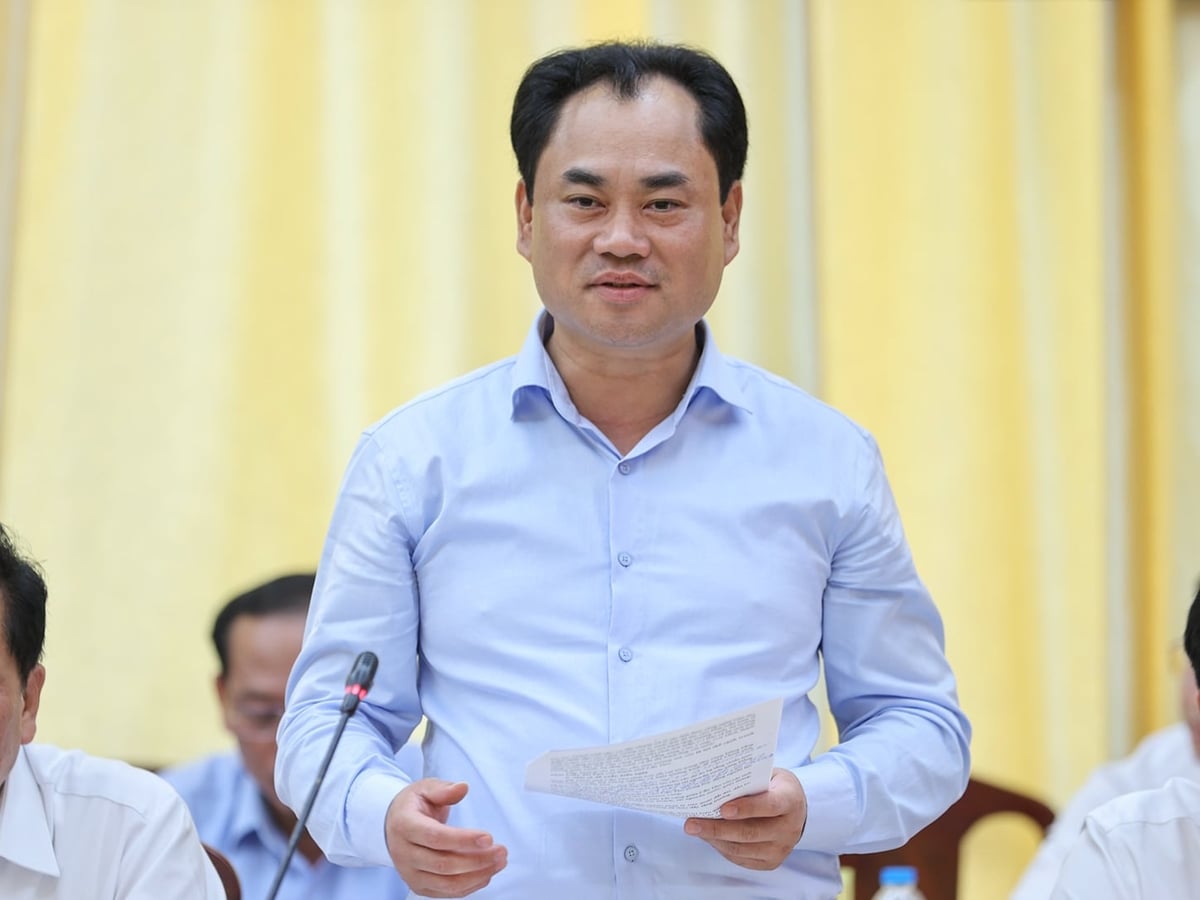
Minister of Agriculture and Environment Trinh Viet Hung speaks at the working session. Photo: Nhat Bac.
In particular, the city needs to urgently review and adjust its planning to ensure consistency with the approved Mekong Delta regional planning in April 2026, as a basis for implementing key projects.
Emphasizing that many projects in Can Tho are significant not only for the locality but also for the region and the whole country, the Prime Minister requested the acceleration of progress on key projects with regional connectivity along the North-South and East-West axes; and the development of energy, education, health, and soft infrastructure.
In addition, the city must focus on removing obstacles, accelerating the disbursement of public investment, reviewing construction material mines, and resolutely revoking projects that are implemented improperly in order to ensure the supply of raw materials for major construction projects.

Minister of Construction Tran Hong Minh speaks at the working session. Photo: Nhat Bac.
Regarding the handling of long-standing stalled projects, the Prime Minister emphasized: "The most difficult issues have been addressed by the Central Government, the National Assembly, and the Government. The remaining responsibility lies with the localities, which must urgently review and propose solutions so that the projects can resume implementation, operation, and effectiveness."
Regarding economic sectors, the Prime Minister requested Can Tho to attract investment in processing and manufacturing industries, high technology, large-scale projects, and offshore wind power projects. In the agricultural sector, it is necessary to promote the application of high technology and deep processing; while also strongly developing trade, services, and tourism.
The Prime Minister also noted that the city must ensure the smooth operation of the two-tiered local government model; focus on training and developing commune-level officials; and expedite the arrangement and management of surplus public assets and offices.
Simultaneously, there is a strong focus on reforming administrative procedures, improving the investment and business environment, developing the private economy, promoting entrepreneurship, innovation, and digital transformation.
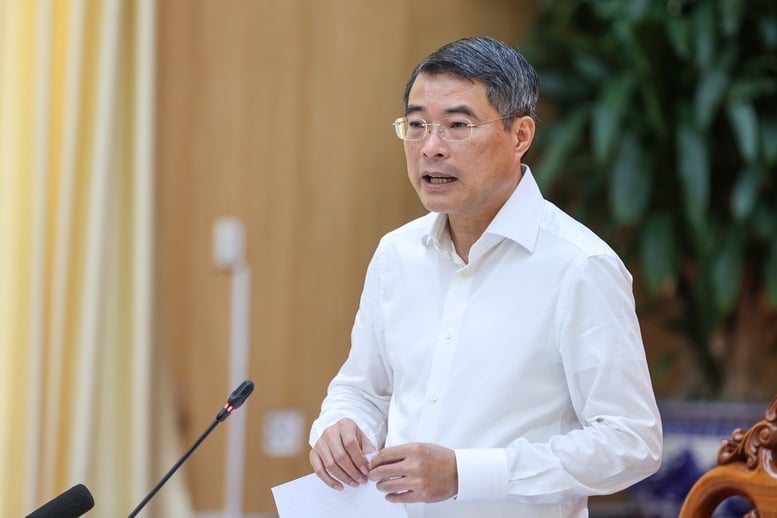
Prime Minister Le Minh Hung concludes the meeting. Photo: Nhat Bac.
In particular, the Prime Minister requested the effective implementation of Resolution 57 of the Politburo; focusing on developing high-quality human resources and science and technology at Can Tho University and other major higher education institutions in the region to serve the development needs of Can Tho and the Mekong Delta.
Regarding social welfare, the Prime Minister requested the effective implementation of free periodic health check-ups or screenings for citizens at least once a year; investment in the comprehensive development of Can Tho Central General Hospital and the healthcare system in the area; and the effective implementation of policies on ethnic minorities, religions, social housing, and long-term rental housing at reasonable costs.
During the meeting, leaders of ministries and sectors also gave their opinions on many proposals from Can Tho related to the Mekong tourism and resort urban area, power projects, land reclamation planning, flood and landslide prevention, urban beautification, the Ho Chi Minh City - Can Tho - Ca Mau railway line, and transportation connecting to Tran De seaport.
Minister of Construction Tran Hong Minh stated that the Can Tho 2 bridge project across the Hau River, combining road and railway functions on the Ho Chi Minh City - Can Tho - Ca Mau route, has been included in the medium-term public investment plan for the period 2026 - 2030.

Prime Minister Le Minh Hung and his delegation offered incense and flowers to commemorate the heroes and martyrs at the Can Tho City Martyrs' Cemetery. Photo: Nhat Bac.
Concluding the meeting, Prime Minister Le Minh Hung basically agreed in principle with the city's proposals, especially the transportation and renewable energy projects; and instructed ministries and agencies to continue researching, coordinating, and proactively implementing them within their authority, and promptly reporting to higher authorities on matters exceeding their jurisdiction.
Source: https://nongnghiepmoitruong.vn/can-tho-can-doi-moi-manh-me-tu-duy-no-luc-cao-hon-de-but-pha-d813391.html

![[Photo] Standing Committee member of the Party Central Committee Tran Cam Tu working with the Central Inspection Committee](https://vphoto.vietnam.vn/thumb/1200x675/vietnam/resource/IMAGE/2026/05/28/1779969579668_ndo_br_bnd-2495-jpg.webp)


















































Comment (0)