

Despite the saltwater intrusion affecting many localities in the Mekong Delta, the province has proactively managed water resources effectively through the flexible operation of its irrigation system. Since the beginning of the year, saltwater intrusion in the province has not significantly impacted agricultural production. However, some rice-growing areas still face difficulties with water supply and drainage, including the Bac Giong rice fields (Long Hiep commune).
 |
| In the rice fields of Long Hiep commune, the rice plants are beginning to flower. |
Many rice fields in Long Hiep commune are currently in the heading stage, promising a bountiful harvest. Along with expanding the high-quality rice production model, the local authorities are proposing investment in an electric pumping station system in the Bac Giong rice fields to ensure a reliable water supply and improve production efficiency for farmers.
For the 2025-2026 Winter-Spring rice crop, Long Hiep commune planted 4,312 hectares with key varieties such as OM576, OM5451, ST25, Dai Thom 8, and OM18. Of this, more than 3,696 hectares are in the heading stage; 415 hectares have begun to flower and are expected to be harvested in the next 30 days.
However, 128 hectares of rice fields have been affected by rice blast disease, and 87.4 hectares have been damaged by rats in scattered incidents; the commune is monitoring and guiding farmers to take timely control measures to minimize losses. The commune has 3 cooperatives participating in the model under the sustainable development project of 1 million hectares of high-quality rice, with 500 hectares and more than 300 households participating.
According to Mr. Nguyen Khanh Hoa , Chairman of the Long Hiep Commune People's Committee, the Bac Giong rice paddy area has 265 hectares of land for rice production, cultivated by local people three times a year. However, due to uneven elevation of the paddy fields, water supply and drainage for production still face many difficulties.
In the Ba Trach A and Ba Trach B hamlets, there are 195 hectares of rice paddies where, during the rainy season, the water level is often 30-40cm lower than the irrigation canal water level. Therefore, people use pumps to drain water into the canal to ensure timely planting. The Tra Sat C hamlet has 70 hectares of rice paddies producing three crops per year, but there are differences in elevation between areas. During the dry season, some areas are higher than the canal water level, making water supply difficult; while during the rainy season, they are lower than the canal water level, making flooding more likely.
Farmer Kim Vu Vane (Ba Trach B hamlet) said: "My family cultivates about 1 hectare of rice in the winter-spring season. In recent years, whenever there was heavy rain, we had to invest in a pump to drain the water into the canal to prepare for planting, which was both costly and time-consuming." Similarly, farmer Thach Khone (Tra Sat C hamlet), who is cultivating 1.4 hectares of ST25 rice, hopes to soon receive investment in an electric pumping station to ensure a reliable water supply. According to Mr. Khone, with a synchronized pumping and water regulation system, farmers can reduce production costs and have more convenience in caring for their rice crop.
 |
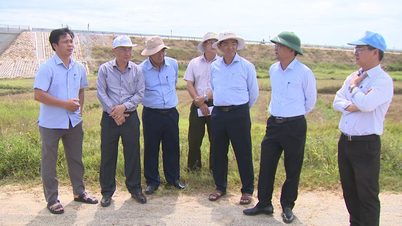
| The survey team is examining the irrigation canal in the Bac Giong rice field area, Ba Trach A and Ba Trach B hamlets, Long Hiep commune. |
Given the urgent need to proactively secure water resources for agricultural production, the Department of Agriculture and Environment has proposed that the Provincial People's Committee consider investing in an electric pumping station system for water supply and drainage to serve rice production in the Bac Giong rice fields in Ba Trach A, Ba Trach B, and Tra Sat C hamlets (Long Hiep commune).
Accordingly, the project is proposed to be included in the medium-term public investment plan for the period 2026-2030, with an estimated budget of 24 billion VND. In the Ba Trach A and Ba Trach B areas, the investment will be approximately 15 billion VND for a surface water drainage pumping station combined with an internal drainage system. In the Tra Sat C hamlet area, the investment will be approximately 9 billion VND for two electric pumping stations for water supply and drainage, along with an internal drainage system and asphalt paving of 1.5 km of canal banks.
According to the provincial meteorological and hydrological station's forecast, salinity intrusion at river mouths will fluctuate but will be lower than the same period in 2025. Irrigation works in the province are currently being operated flexibly to proactively draw water for production. On the Co Chien River branch, the Lang The and Cai Hop sluice gates are opened 1-2 times to draw water into the fields on days with low salinity. On the Hau River branch, the Rach Rum and Bong Bot sluice gates are opened to draw water as appropriate at different times.
According to the Southern Institute of Water Resources Science , the water security situation in the Mekong Delta in March 2026 is quite favorable. However, saltwater intrusion is predicted to penetrate deepest during the high tide period at the end of March, from March 18-22, with the 4‰ salinity boundary potentially reaching about 41-55km inland. This level remains within the control capabilities of the irrigation systems.
After surveying irrigation works, Vice Chairman of the Provincial People's Committee Chau Van Hoa affirmed that in the context of climate change and potentially complex saltwater intrusion, localities need to continue proactively developing response plans to ensure water resources for production and daily life of the people. The agricultural sector, project management units, and local authorities should strengthen monitoring of water levels and salinity on rivers and canals; proactively and flexibly operate irrigation systems, especially pumping stations and regulating sluices, to promptly supply water for production.
For the Bac Giong rice paddy area – a key rice-producing region of the locality – the commune continues to closely monitor water levels and proactively regulate irrigation systems to ensure stable water supply. Regarding the proposal to invest in an electric pumping station in this area, the local authorities need to continue conducting on-site surveys, assessing needs, and gathering public opinion to gain consensus before implementation.
Text and photos: MY NHAN
Source: https://baovinhlong.com.vn/kinh-te/nong-nghiep/202603/can-tro-luc-thuy-loi-cho-vung-lua-bac-giong-26866c9/

![[Photo] Secretary of the National Assembly Party Committee, Chairman of the National Assembly presides over the meeting of the Standing Committee and Executive Committee of the National Assembly Party Committee.](https://vphoto.vietnam.vn/thumb/1200x675/vietnam/resource/IMAGE/2026/06/03/1780480353201_ndo_br_bnd-2585-jpg.webp)

![[Photo] First session of the 14th Congress of the Vietnam Trade Union](https://vphoto.vietnam.vn/thumb/1200x675/vietnam/resource/IMAGE/2026/06/03/1780465947883_ndo_br_img-3852-jpg.webp)

![[Photo] General Secretary and President To Lam presides over a meeting with the Central Organizing Committee.](https://vphoto.vietnam.vn/thumb/1200x675/vietnam/resource/IMAGE/2026/06/03/1780482764658_a1-bnd-4741-3342-jpg.webp)
![[Infographic] Over 1.2 million candidates registered for the 2026 High School Graduation Exam](https://vphoto.vietnam.vn/thumb/402x226/vietnam/resource/IMAGE/2026/06/03/1780496872518_w_20260603205412.jpeg)








































![[Video] Sunset at Lap An Lagoon – Where the sun sets over the fishing nets](https://vphoto.vietnam.vn/thumb/1200x675/vietnam/resource/IMAGE/2026/05/31/1780192137701_beach-landscape-sea-water-nature-grass-745871-pxhere-com.jpeg)
































Comment (0)