


This could lead to a shortage of highly skilled human resources in science, engineering, and technology – the pillars of the digital economy .
The Paradox of Elective Courses
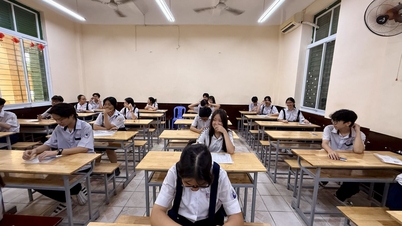
In high schools in Nghe An province, especially in mountainous and remote areas, the registration for elective subjects in the high school graduation exam is revealing an imbalance. Subjects considered the "backbone" of engineering fields, such as Physics, Chemistry, Biology, and Informatics, are experiencing a significant lack of candidates.
Out of 355 12th-grade students at Tuong Duong High School in the remote and disadvantaged Tuong Duong commune, only 11 chose Physics, 10 chose Chemistry, and the lowest number was for Informatics with only 5 candidates. Conversely, subjects like History, Geography, and Economics and Law dominated with 228, 188, and 206 registered students respectively.
The situation is similar for English. Ms. Nguyen Thi Trang, an English teacher at the High School, shared that although the number of students registering has doubled compared to last year, the number is still very modest. According to Principal Le Ngoc Hung, the language barrier for ethnic minority students (who account for over 80%) and the difficulty of science subjects lead them to choose subjects that are "easy to learn and memorize" in order to ensure graduation.
This situation is not unique to mountainous regions. Even top-tier schools like the Nghe An Ethnic Boarding High School No. 2 still exhibit this trend. Out of 263 12th-grade students, 213 chose History, while only 8 registered for Informatics. Ms. Truong Thi Thanh Thuy, the school's Vice Principal, believes that students are shifting towards a more pragmatic approach, aligning their choices with university admission criteria and the demands of the labor market.
This situation creates unprecedented pressure on management and teaching. At Le Viet Thuat High School, despite career guidance starting from grade 10, the percentage of students choosing science subjects remains low (less than 20% for Chemistry, Biology, and Informatics). As a result, the school faces difficulties in staffing. To meet teaching quotas, many science teachers have to take on additional subjects like Local Education or Experiential Activities.
Risk of a technical workforce crisis
Education experts attribute this "mismatch" to a preference for the "right path." Mr. Le Van Quyen, Principal of Thanh Chuong 3 High School in Cat Ngan commune, frankly pointed out that when given the choice of four subjects under the 2018 curriculum, students often prioritize subjects that are "easy to access," less stressful, and easier to score high marks in, for the sake of "safety." This choice is temporary and lacks strategic planning for future careers.
The biggest concern doesn't stop at the high school graduation exam. From a macro perspective, students turning away from natural sciences will lead to a serious imbalance in the national workforce structure. According to economic experts, Vietnam is entering a phase of accelerated industrialization and digital transformation. The demand for human resources in STEM fields (Science, Technology, Engineering, and Mathematics) is enormous. The current shortage of students entering the natural sciences is the foundation for a crisis of shortages of engineers, technology experts, and scientists in the next 5-10 years.
As the pool of applicants for engineering and technology fields shrinks, the quality of both incoming and outgoing graduates from these universities will be affected. This directly threatens Vietnam's economic competitiveness in attracting high-tech investments (such as semiconductors and clean energy), which require a workforce skilled in natural sciences. This situation not only poses challenges to teaching in high schools but also demands a long-term career guidance strategy to ensure a sustainable workforce structure.
To resolve this issue, Mr. Le Van Quyen believes that solutions are needed "early and proactively." Schools need to fundamentally change their career counseling practices, helping students understand the labor market landscape instead of just looking at their grades. Furthermore, the core issue lies in improving the quality of teaching and learning in natural science subjects. "Teachers need to innovate their methods, increase practical work and experiments, and connect knowledge with real-world applications to create enthusiasm among students," Mr. Quyen emphasized.
Mr. Cao Thanh Bao, Principal of Ha Huy Tap High School, emphasized the need for close connections between high schools, universities, and businesses. He stressed that science subjects should be taught in a way that reduces academic theory, increases practical application, and focuses on solving real-world problems. Universities need to diversify and be more flexible in their admission combinations, avoiding over-reliance on a few specific subjects, thereby motivating students to study all subjects comprehensively. Choosing exam subjects is a student's right, but guiding those choices to align with individual abilities and meet the needs of societal development is the responsibility of the education sector and the community. Fostering a passion for science instead of focusing solely on grades will be key to balancing the current educational landscape...

In response to this situation, the Nghe An Department of Education and Training has directed schools to innovate their teaching and learning methods. Specifically, they are shifting teaching methods to promote STEM (Science, Technology, Engineering, and Mathematics) education from the lower secondary level. Learning natural sciences must be linked to practical work and experiments instead of just solving problems on paper, thereby creating genuine interest for students.
Mr. Nguyen Van Khoa, Director of the Nghe An Department of Education and Training, emphasized: “Instead of just advising students to choose subjects that are easy to pass, schools need to organize more field trips to industrial parks and technology companies in the province (such as VSIP, WHA Nghe An) so that students can see the real needs and attractive income levels of engineering fields. When students see the career opportunities and attractive income levels of engineers and programmers, their thinking about choosing exam subjects will change.”
Nghe An province is also researching a scholarship policy specifically for Nghe An students enrolling in engineering and technology majors at key universities both domestically and internationally. Relevant parties are collaborating with major technology corporations to create a "recruitment" process for human resources from the moment students are in school. When students see a stable job future with high income, their choices will change. The province is also researching the establishment of a reward fund to honor young talents in the fields of creativity, science, and technology, to spread the spirit of "pride in pursuing challenging fields," and investing in modern equipment for key high schools. A learning environment with ample practical tools will help students feel more confident when choosing natural science subjects instead of just studying theoretically on paper.
Only when students see the appeal and practical applications of Physics, Chemistry, or Computer Science in daily life and the wide range of career opportunities will they have the motivation to break out of their "comfort zone." Without timely adjustments from both students' and parents' perspectives, and the schools' educational strategies, this imbalance will become an invisible barrier hindering the development of the knowledge- and technology-based economy that Vietnam is striving for.
Source: https://baotintuc.vn/giao-duc/canh-bao-tinh-trang-lech-phadang-ky-mon-thi-tot-nghiep-20260429153419180.htm


![[Photo] General Secretary and President To Lam presides over a meeting on preparations for the review of one year of operation of the three-tiered government system.](https://vphoto.vietnam.vn/thumb/1200x675/vietnam/resource/IMAGE/2026/06/02/1780391821195_a1-bnd-4595-9717-jpg.webp)




























































































Comment (0)