Earthquakes are ground-shaking phenomena caused by the collision and movement of tectonic plates within the Earth. When tectonic plates beneath the Earth's surface collide or slide past each other, energy is released in the form of seismic waves, causing tremors ranging from mild to strong.
Earthquakes occur most frequently in areas where tectonic plates meet, such as in the Pacific Rim – one of the most volcanic and earthquake-prone regions in the world .
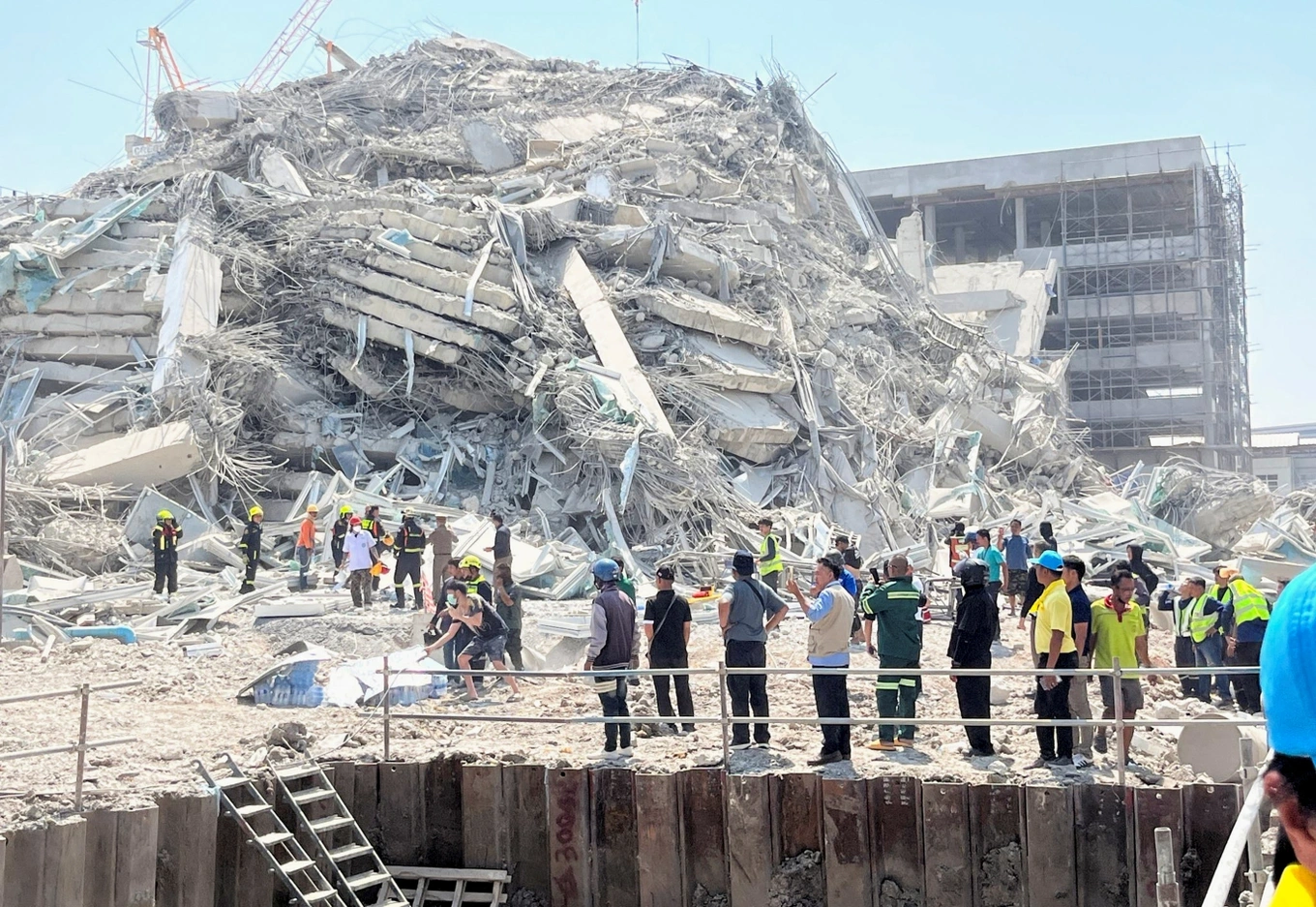
The 7.7 magnitude earthquake that struck Myanmar on the afternoon of March 28th is classified as extremely strong and has serious consequences (Photo: Reuters).
Despite scientists ' best efforts to find solutions and utilize artificial intelligence, they have yet to find an effective way to accurately predict the time, location, and intensity of earthquakes. As a result, major earthquakes cause significant damage to both people and property.
To assess the strength and impact of earthquakes, scientists have developed various scales. Among them, the Richter scale and the Mercalli scale are the two most commonly used systems.
Violent shaking at Mandalay Airport, Myanmar, during the earthquake ( Video : X).
Richter scale - Measuring earthquake magnitude
The Richter scale, invented by American seismologist Charles Francis Richter in 1935, was one of the first widely used scales for assessing the magnitude of earthquakes.
This scale measures the seismic energy released at the epicenter based on the amplitude of seismic waves recorded by seismometers.
The Richter scale is logarithmic, meaning that each increase of one unit corresponds to an increase in released energy of approximately 31.6 times. For example, a 6.0 Richter earthquake would be 31.6 times stronger than a 5.0 Richter earthquake in terms of released energy.
Below is a detailed table of the Richter scale used to illustrate the destructive power of earthquakes:

The strongest earthquake ever recorded in history occurred in the city of Valdivia, Chile, in 1960, reaching a magnitude of 9.5. This is the highest magnitude ever measured by modern equipment.
Theoretically, there is no limit to the magnitude of earthquakes. However, in practice, earthquakes exceeding 9.5 magnitude are rare because they depend on the energy released from geological faults, which have physical limits.
Mercalli Scale - Assessing Intensity Through Impact
The limitation of the Richter scale is that it cannot accurately represent earthquakes stronger than 8 magnitude and those occurring too far from the seismometer.
Therefore, many scientists today use the Mercalli scale to assess the strength of an earthquake.
The Mercalli scale was invented by the Italian geologist Giuseppe Mercalli in 1902, and was later improved into the Modified Mercalli Intensity Scale (MMI), which is widely used today.
Unlike the Richter scale, which focuses on physical energy, the Mercalli scale measures earthquake intensity based on the impact it has on people, buildings, and the environment.
The Mercalli scale divides earthquake intensity into 12 levels (from level I to XII) based on actual observations.
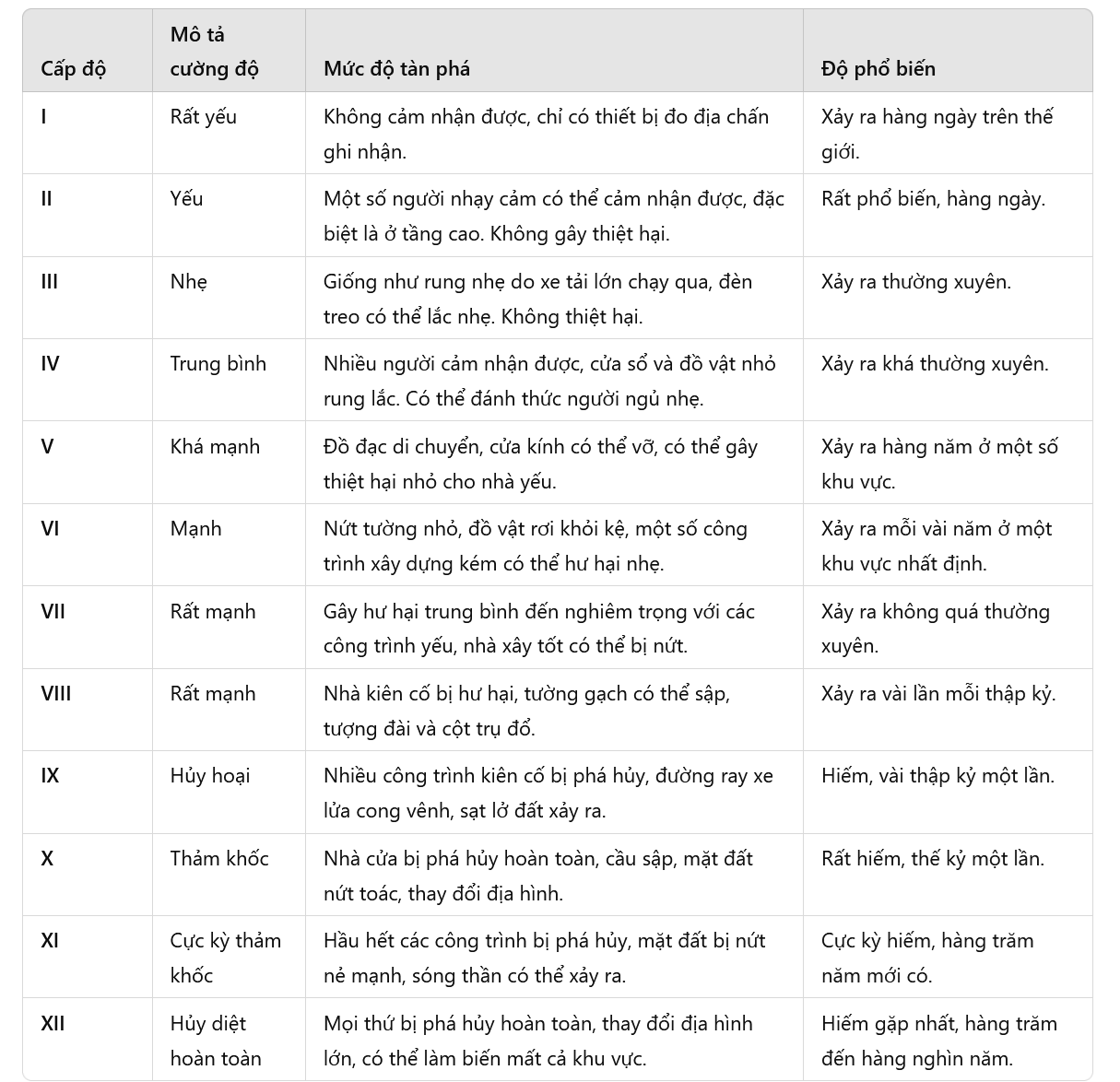
Detailed table of earthquake intensity levels according to the Mercalli scale.
The Mercalli scale reflects the level of impact in specific areas, even without measuring equipment, making it useful for mapping earthquake intensity. Furthermore, earthquakes of the same Richter magnitude can have different Mercalli levels depending on the extent of damage they cause.
***
The Richter scale and the Mercalli scale complement each other in studying earthquake intensity. While the Richter scale provides an accurate magnitude figure at the source, the Mercalli scale helps assess the actual impact on people and infrastructure.
Besides the Richter scale and the Mercalli scale, scientists today also use several other earthquake magnitude scales such as the moment magnitude scale, the surface wave magnitude scale, etc. In addition, some countries have developed their own earthquake magnitude scales.
Today, with the development of technology, scientists have combined multiple scales to provide accurate assessments of the intensity of earthquakes, as well as to respond more effectively to earthquakes, helping to reduce damage when disasters occur.
Source: https://dantri.com.vn/khoa-hoc/cap-do-dong-dat-toi-da-la-bao-nhieu-20250328165051393.htm
































































































Comment (0)