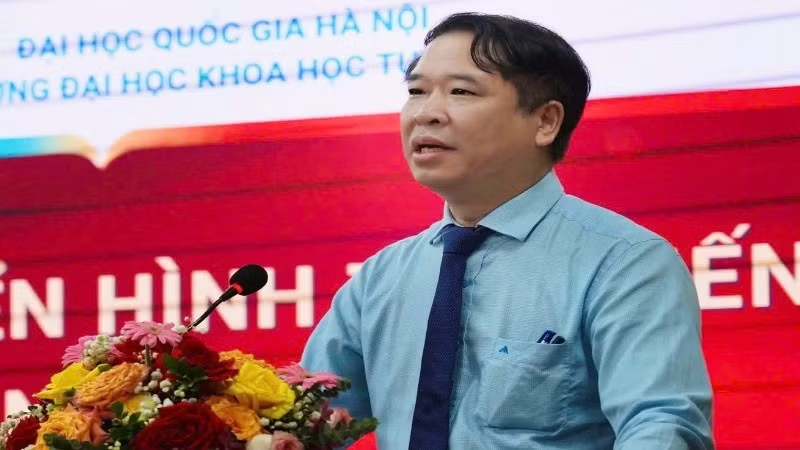
Professor, Doctor Le Thanh Son, Rector of the Faculty of Natural Sciences (Vietnam National University, Hanoi).
Regarding this issue, Professor, Dr. Le Thanh Son, Rector of the Faculty of Natural Sciences, Vietnam National University , Hanoi, shared solutions to attract and retain talented students pursuing fundamental scientific fields in the new context.
Reporter: The government has just issued Decree No. 179/2026/ND-CP stipulating scholarship policies for students studying basic sciences, key engineering fields, and strategic technologies. The Decree takes effect from July 15, 2026, and applies to students admitted from 2025 onwards; the scholarship awarding period starts from September 1, 2026. So, in your opinion, what is the significance of this scholarship policy for attracting and training human resources for basic sciences and strategic technologies in Vietnam?
Professor, Dr. Le Thanh Son: I believe this is a very important and strategic policy for higher education and the development of high-quality human resources in Vietnam. Implementing scholarships for key basic sciences, engineering, and strategic technologies demonstrates the State's strong priority orientation towards science, technology, and innovation.
This policy will contribute to attracting talented students to science, technology, engineering, and mathematics (STEM) fields, especially foundational areas such as Mathematics, Physics, Chemistry, materials science, AI, semiconductors, biotechnology, and robotics – fields that urgently need high-quality human resources for national development.
The fact that the Decree will take effect from July 15, 2026, and scholarships will begin to be awarded from September 2026, will have a positive impact right from the admissions season, helping to increase the attractiveness of science and engineering fields that typically have difficult and lengthy training periods.
In my opinion, this policy will bring many benefits, including: increasing educational opportunities for talented students from disadvantaged backgrounds; creating motivation for learning, research, and academic competition; contributing to the training of human resources for national strategic technologies; and affirming science and technology as the driving force for national development in the new era.
However, for the policy to be effective, it is necessary to ensure that the scholarship amount is sufficiently attractive, the awarding process is transparent, and it is linked to the research environment, businesses, and job opportunities after graduation.
Overall, this is a step in the right direction, and if implemented well from September 2026, it will create positive changes for science and technology training in Vietnam in the coming years.
In my opinion, with scholarships at the undergraduate level, a monthly allowance of 3.7-5.5 million VND can significantly reduce financial pressure for students, especially regarding tuition fees, materials, dormitory costs, and minimum living expenses. For postgraduate students and doctoral candidates, a maximum allowance of approximately 8.4 million VND per month is quite meaningful, given that many students need to dedicate a large portion of their time to research and participation in research groups at their universities and institutes.
Reporter: Many believe that, in order to attract and retain talented students pursuing basic science fields, in addition to scholarships, there needs to be more comprehensive policies such as a good learning and research environment, support for participation in scientific research, connections with businesses, and expanded career opportunities after graduation. What is your view on this issue?
Professor, Dr. Le Thanh Son : That's right, to truly attract and retain talented students, especially in basic sciences or specialized research fields, scholarship support for STEM students should be seen as an initial foundation. In reality, the cost of living in major cities is constantly increasing, while postgraduate students also need additional funding for research, scientific publications, foreign languages, and international integration.
Scholarships should not only be about financial value but also about being linked to a comprehensive support ecosystem, including: a good research environment, opportunities to participate in research projects, international exchanges, support for scientific publications, business connections, and career opportunities after graduation.
When these factors are combined, scholarships will effectively encourage learning, attract and nurture talent in the long term. If this scholarship policy is implemented consistently and over the long term, I believe it will have a very positive impact on both the quality of student intake and career orientation for students in key basic science and engineering fields.
Furthermore, to sustainably develop a workforce in natural sciences, in addition to scholarships for students in basic sciences and STEM fields, I believe the government and universities should also strengthen communication about the role and career opportunities of basic sciences, and implement policies on good salaries and benefits, as well as expand job opportunities for basic science professionals…
When society recognizes the true value of fundamental fields, career opportunities for those pursuing basic sciences will expand, sending a strong message about the country's strategy for developing its scientific and technological workforce.
Reporter: How will the Faculty of Natural Sciences (Vietnam National University, Hanoi) implement this scholarship policy for new students?
Professor, Dr. Le Thanh Son: As a leading university in basic sciences, the university is ready to implement this policy transparently and effectively for new students starting this academic year. Of course, this implementation still awaits official guidance from the Ministry of Education and Training and related agencies.
Among the 15 subject groups eligible for government-mandated support policies, the University of Science possesses most of the core, traditional, and cutting-edge disciplines such as: Mathematics, Statistics, Computer Science, Information Technology, Biology, Applied Biology, Material Sciences (including Physics, Chemistry, Materials Science), Earth Sciences, etc. New students in these fields at the university will be directly considered for and receive support according to regulations.
To ensure that scholarships reach deserving talents, the School plans to implement a selection process based on the groups stipulated in the Government Decree:
Group 1: Scholarships will be awarded to new students who have won medals in international Olympic competitions, national and international science and technology competitions; and students who have won first, second, or third prizes in the national excellent student competition.
Group 2: Based on the admission score to the school using the high school graduation exam results, the total score in Mathematics and two of the subjects Physics, Chemistry, Biology, and English from the high school graduation exam must be 22.50 or higher on a 30-point scale, excluding priority points and bonus points. Candidates must be among the top 30% of candidates with the highest admission scores for the same training program nationwide during the general admission period of the year.
In addition, postgraduate students and doctoral candidates are also considered in accordance with the provisions of Decree 179.
In addition to the STEM scholarship package, outstanding students of the University of Science also have the opportunity to receive additional academic achievement scholarships and scholarship packages from major partner corporations and businesses. In particular, they will be given priority in the elite training program: participating in scientific research at key laboratories from their first year, and being directly connected with leading professors and experts for guidance.
The school is committed to creating a top-tier academic environment so that new students passionate about basic sciences and STEM fields can not only study with peace of mind but also maximize their potential, becoming strategic human resources serving the development of the country.
Reporter: Thank you very much, Professor, Doctor Le Thanh Son!
Ha Linh (compiled)
Source: https://nhandan.vn/thu-hut-va-giu-chan-nguoi-gioi-cho-khoa-hoc-co-ban-post964736.html


![[Photo] The General Secretary, President and his wife begin their state visit to the Philippines.](https://vphoto.vietnam.vn/thumb/1200x675/vietnam/resource/IMAGE/2026/05/31/1780230559452_anh-man-hinh-2026-05-31-luc-19-28-11.png)

![[Photo] Admire the coral "masterpiece" amidst the million-year-old heritage of Dak Lak province.](https://vphoto.vietnam.vn/thumb/1200x675/vietnam/resource/IMAGE/2026/05/31/1780221235105_anh-man-hinh-2026-05-31-luc-16-53-27.png)

![[Photo] Solemn bathing ceremony and Buddha procession in Hue](https://vphoto.vietnam.vn/thumb/1200x675/vietnam/resource/IMAGE/2026/05/31/1780228263543_1-jpg.webp)
![[GALLERY] Summer mistakes that cause phone batteries to drain extremely quickly](https://vphoto.vietnam.vn/thumb/402x226/vietnam/resource/IMAGE/2026/05/31/1780231867344_sac-4-png.webp)












![[Video] Sunset at Lap An Lagoon – Where the sun sets over the fishing nets](https://vphoto.vietnam.vn/thumb/340x192/vietnam/resource/IMAGE/2026/05/31/1780192137701_beach-landscape-sea-water-nature-grass-745871-pxhere-com.jpeg)
![[Video] Mass fish deaths in the retention pond in Cau Giay cause serious environmental pollution.](https://vphoto.vietnam.vn/thumb/402x226/vietnam/resource/IMAGE/2026/05/30/1780155056587_dung01-10-30-33896still010-png.webp)





































![[Photo] Admire the coral "masterpiece" amidst the million-year-old heritage of Dak Lak province.](https://vphoto.vietnam.vn/thumb/402x226/vietnam/resource/IMAGE/2026/05/31/1780221235105_anh-man-hinh-2026-05-31-luc-16-53-27.png)
































Comment (0)