

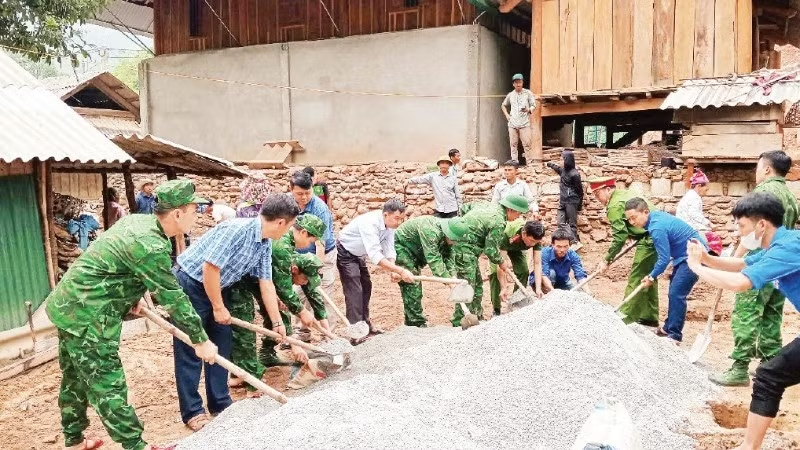
In March 1959, Border Guard Post 75 (the predecessor of Nam Can International Border Gate Border Guard Post) was established, responsible for a strategically important area on the Vietnam-Laos border.
Recalling his time working at Nam Can from 1972 to 1974, Major General Nguyen Sinh Xo, former Director of the Anti-Drug and Crime Department (Border Guard Command), recounted that the outpost had to be evacuated to near a stream, about 3km from its current location, to avoid enemy aircraft.
"Life was so difficult that the soldiers didn't dare eat new rice, saving it instead. Every day they cooked old, moldy rice, and each time they washed it, weevils would cover the surface of the water. Outside of duty, the soldiers took advantage of their free time to grow corn, pumpkins, chayote, and raise chickens and pigs to improve their living conditions," Major General Xô recalled.
Major General Xô remembers most vividly a freezing cold night on duty, inspecting a truck arriving from Laos. Under the tarp were the bodies of fallen soldiers who had died on the battlefield in that country.
"At first I was scared. But then I thought they were my comrades, so I went into the station to get incense to light for them, and then continued with the procedures," he recounted.
On another occasion, he and his comrades passed by a cave sheltering the local youth volunteer force. The scene inside the cave left him speechless.
After the bombing, all the men and women sheltering in the cave perished, their bodies mutilated. He and his comrades collected and prepared the remains of the fallen soldiers for burial.
The forests were teeming with venomous snakes and mosquitoes that transmitted malaria. During week-long journeys, the soldiers slept in bamboo huts, ate wild bamboo shoots, and drank stream water. Some who were healthy the day before would fall into a coma from malaria a few days later and die. In those hardships, the soldiers learned to live with the people, understand them, and rely on them to defend the border.
"Four together" with the people
From the very beginning, the officers and soldiers of Border Guard Post 75 have identified mass mobilization as a strategic and crucial task.
In a situation where over 90% of the population was illiterate, they simultaneously performed border protection duties, helped the people eradicate illiteracy, built schools, provided medical care, encouraged people to quit opium, and built a new way of life.
After each guard duty and border patrol, they diligently studied the Hmong, Thai, and Khmu languages. They went down to each village, working alongside the people to clear land for farming, provide medical care, build houses, and encourage people to abandon outdated customs.
"To gain the people's trust, the soldiers must first live like the people. Eat with the people, live with the people, learn their language, and understand their customs and traditions. They must truly consider the people as their own flesh and blood," Major General Xô concluded.
Back then, whenever the soldiers went into the villages, their supplies always included a few quinine tablets (a medicine for treating and preventing malaria), a bottle of antiseptic (used for disinfection), some dried rations, and sometimes a can of meat, to give to the villagers.
During the years of fighting against the Chau Pha bandits, the biggest lesson for him and his comrades was that to protect the border, they must win the hearts of the people. Soldiers only have two hands and two eyes, but the people have "a hundred hands and a thousand eyes."
Village elders and community leaders became the "eyes and ears" of the soldiers, helping them hunt down bandits and persuade those who had gone astray to return home.
There were people who had once sheltered rebels fighting against the revolution, but after being rescued by the army, cured of their illnesses, helped to build houses, and given their children an education, they became revolutionary cadres themselves, adopting soldiers as their sons. That spirit is still being continued by today's cadres.
Major Lo Van Hiep, of the Thai ethnic group, has been working in the Nam Can border region for nearly three years. As the leader of the community mobilization team, he regularly goes down to the villages to disseminate legal information, encourage people to maintain security and order, and participate in protecting border sovereignty .
Major Hiep shared: "To get the people to listen, first and foremost, officers must set an example in their speech and conduct." To help the people develop their economy , they have to independently research farming and livestock techniques, build model projects, and then guide the local people.
The unit maintained the "four together" principle as a regular practice. In Major Hiep's memory, there is a story that is both amusing and poignant.
On one occasion, the local authorities coordinated with the commune to raise awareness about preventing child marriage among H'Mông village chiefs and clan leaders, and they signed commitments to abide by the law. However, just a week later, local officials discovered that a young man, underage for marriage, had brought a 13-year-old girl, a seventh-grade student, to their home to prepare for their wedding.
The border guard station, in coordination with the commune police and women's association, went to the family's home to disseminate information and explain the law, urging them to halt the wedding.
A few days later, when they returned to visit, the boy's father recounted, "We raised two cows to pay for our son's wedding. Now we have to sell them all to compensate the bride's family. The cows are gone, and we still don't have a bride!" The story filled the men with both pity and joy. Pity because poverty and backwardness still persisted. But joy because the people had learned to respect the law and abandon outdated customs.
Defending the border relies on "the people's support."
The unit's base is located at an altitude of over 1,200 meters above sea level. After establishing a two-tiered local government, the outpost manages two border communes with 38 villages. The area is vast, with the furthest village more than 70km from the outpost, and transportation is difficult, while the community mobilization team consists of only four officers. To stay close to the people and the area, the unit maintains two "village-based" task forces.
Nevertheless, the spirit of "The outpost is our home, the border is our homeland, and the people of all ethnic groups are our brothers and sisters" continues to be upheld by today's soldiers through concrete actions. Currently, the unit sponsors 31 students from disadvantaged backgrounds and provides additional support to three others, including one Laotian student.
Lau Ba Trinh, a H'Mong boy from Huoi Poc village, has become an adopted child of the border post. Trinh lost his father at a young age, and his mother is frequently ill. In 2018, when he had just started first grade, Trinh was taken in by the officers at the border post for care. Now he has finished ninth grade and is preparing to take the entrance exam for tenth grade.
The house of Mrs. Va Y Mai, Trinh's mother, was also rebuilt with the joint efforts of border guards and local people, so that she would have a spacious and sturdy place to live.
According to Major Ho Tho, Political Officer of the Nam Can International Border Gate Border Guard Station, the unit mobilized 132 officers and soldiers, contributing 232 man-days, to the program to eliminate temporary housing in the area alone.
By the end of June 2025, all 126 temporary houses in the two communes of Nam Can and Muong Xen had been demolished. Assisting the people with rice harvesting, house repairs, disaster prevention and mitigation... were regular tasks for the officers and soldiers.
"Going down to the villages means being treated like family by the local people," Major Hiep shared. For them, guarding the border is not just about protecting each border marker and line, but also about preserving a peaceful and prosperous life for the local people.
Major Ho Tho believes that the most important factor in building a "people's defense posture" is the people's trust in the Party, the government, and the border guard forces: "When the people trust and love the soldiers, and voluntarily cooperate with the border guard forces to protect the border and boundary markers, then the people's defense posture in the border areas will always be strong."
From the former Border Guard Post 75 to the current Nam Can International Border Gate Border Guard Post, it's been a journey of over 60 years overcoming bombs, riots, and drug crimes, with countless difficulties.
On that front line, what remains after all is not just the markers of sovereignty, but the solid foundation of popular support built up over many generations.
Source: https://nhandan.vn/giu-vung-long-dan-noi-phen-giau-to-quoc-post965976.html
![[Image] Hanoi Police officially crowned champions of V-League 2025/2026](https://vphoto.vietnam.vn/thumb/1200x675/vietnam/resource/IMAGE/2026/05/31/1780244769054_ndo_br_039d561b692be875b13a-jpg.webp)
![[Photo] Solemn bathing ceremony and Buddha procession in Hue](https://vphoto.vietnam.vn/thumb/1200x675/vietnam/resource/IMAGE/2026/05/31/1780228263543_1-jpg.webp)

![[Photo] Admire the coral "masterpiece" amidst the million-year-old heritage of Dak Lak province.](https://vphoto.vietnam.vn/thumb/1200x675/vietnam/resource/IMAGE/2026/05/31/1780221235105_anh-man-hinh-2026-05-31-luc-16-53-27.png)
![[Photo] The General Secretary, President and his wife begin their state visit to the Philippines.](https://vphoto.vietnam.vn/thumb/1200x675/vietnam/resource/IMAGE/2026/05/31/1780230559452_anh-man-hinh-2026-05-31-luc-19-28-11.png)









![[Video] Sunset at Lap An Lagoon – Where the sun sets over the fishing nets](https://vphoto.vietnam.vn/thumb/340x192/vietnam/resource/IMAGE/2026/05/31/1780192137701_beach-landscape-sea-water-nature-grass-745871-pxhere-com.jpeg)
























































Comment (0)