

The stone bears the name Mai Hai, an official at the Institute of Han Nom Studies, who was used to fill in for people in line during the subsidy period. The "treasure" is the elephant-ear fan, a coveted item for those living during that era. The communal apartment building even had pigs raised for "pigs to feed people," with the grunting of the pigs. These artifacts and community anthropological films tell their own stories of Hanoi during the subsidy period. It is one of the most successful and renowned modern history exhibitions in recent decades.
Associate Professor Dr. Nguyen Van Huy, former Director of the Vietnam Museum of Ethnology, was the person in charge of that exhibition. He also shared his insights on how to create an engaging modern historical exhibition.
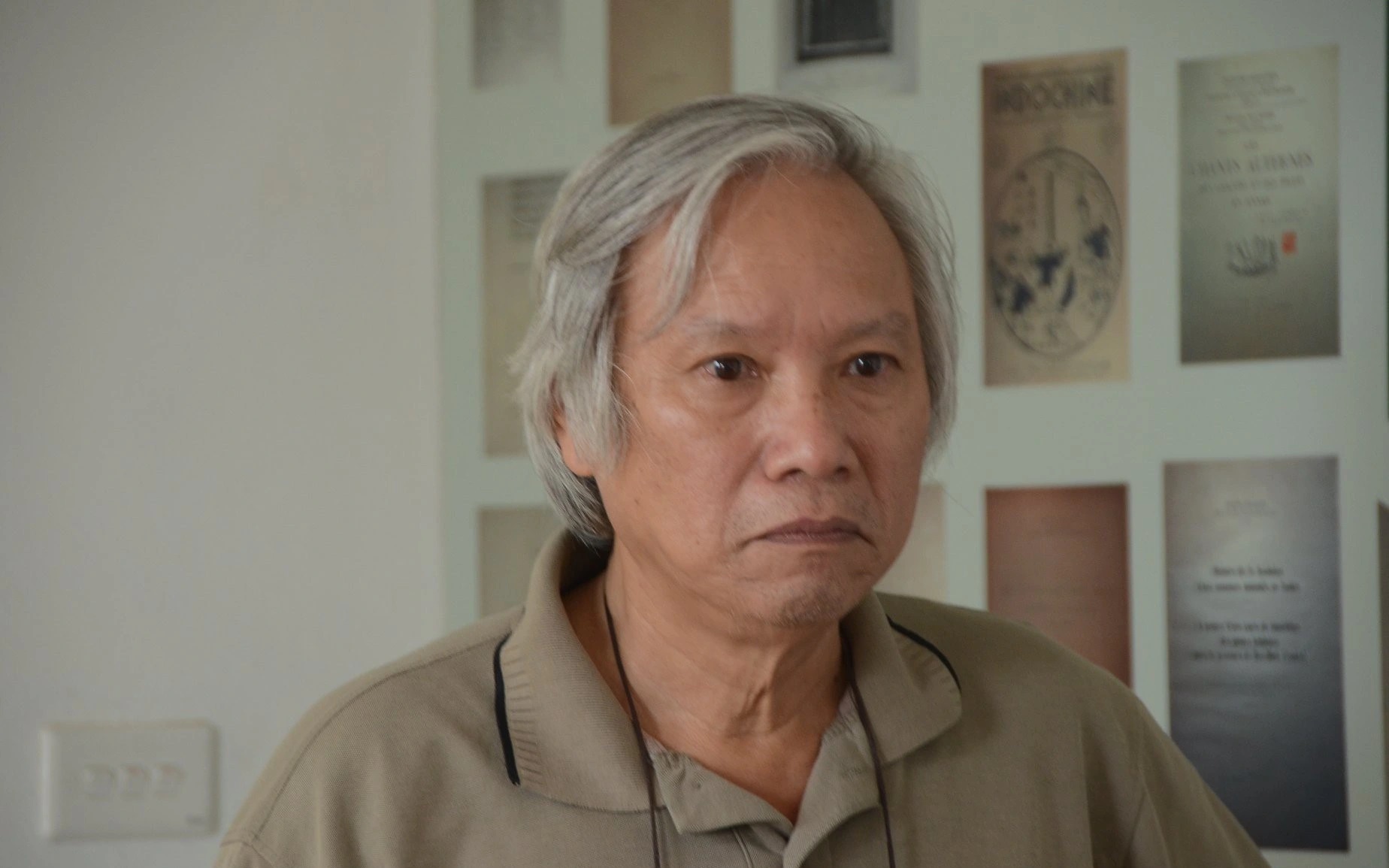
Associate Professor Dr. Nguyen Van Huy
Photo: Provided by the interviewee
The exhibition "Stories of Hanoi during the Subsidy Period " is still considered an honest and engaging exhibition about modern history. But at that time, were there any historians who opposed that exhibition, sir?
No one objected. Public opinion and researchers alike gave it a positive review. International scholars considered it a special event for Vietnam, wondering why such a well-designed historical exhibition about that period could exist at that time. The exhibition dared to tell the truth and told the story skillfully. But from that, we gained experience in creating successful exhibitions. The story of the subsidy period is essentially a historical exhibition, telling the story of the history and social life of a historical period from 1975 to 1980. It's a historical period, and the exhibition talks about the lives of the people of Hanoi at that time, about their struggle to ensure a minimum standard of living for their families, about the daily life of a family in a collective housing area, about their spiritual life… All aspects of social history are reflected and interpreted truthfully, placed in the right context, so the exhibition attracted many visitors.
The exhibitions about the subsidized economy have the advantage of offering anthropological and ethnographic perspectives. But not all museums have that advantage. So, in your opinion, how should they handle historical narratives?
In my opinion, every museum needs an anthropological approach. People are the central story of museums. History is intertwined with people. Heroes, soldiers, commanders, and generals are all human beings. War has an anthropological aspect. Therefore, we are reflecting the stories of these people. That is an anthropological approach. Modern historical museums are increasingly focusing on the social life of each era, so an anthropological perspective is even more necessary.
But when historical events unfold decades later, and witnesses are no longer lucid, where will we find people to fill the books, sir?
The problem is knowing how. There are many anthropological approaches. For example, when talking about the revolutionary and resistance periods, we need to thoroughly utilize the diaries and memoirs of the figures, as well as contemporary newspapers. Figures like Vo Nguyen Giap, Song Hao, Van Tien Dung, and Nguyen Chi Thanh wrote countless memoirs and research papers. We must carefully study them to extract the stories connected to the events we need to recount. Historians around the world consistently write that Vietnamese history always has something new to offer; they present so much new material, new perspectives, and new stories. Museum staff can approach anthropologically through the memoirs of the McNamara father and son (former US Secretary of Defense Robert McNamara has a memoir, *Recollections* , and his son Craig McNamara has a book , *Because Our Fathers Lied *) to help the public better understand the recent war.
When exhibiting the history of Vietnam during those years, we use different voices—the voices of Vietnamese leaders and the voices of American leaders—and the intelligence perspectives of both sides on an event. Because they both recount an event like the Gulf of Tonkin incident, explaining why it happened and how it occurred, an exhibition that presents such dialogues is sure to be interesting.
Many exhibitions and museums still lack artifacts. Based on the story "Hanoi during the Subsidy Period ," is there a formula for a successful modern historical exhibition, sir?
Many of our exhibitions are inadequate, overly ambitious, and especially fail to allow viewers to experience the context of each historical period on display. The exhibitions lack museological professionalism. Museum exhibitions, first and foremost, must ensure historical accuracy. Telling the story of history requires utmost honesty. Secondly, museum exhibitions are different from history books. Historians write the history of modern Vietnam, section by section, sometimes hundreds of pages long, but museums cannot simply copy history books. Instead, museums must rely on historical knowledge to create exhibitions, telling stories through documents and artifacts, allowing viewers to experience the context of events visually and through their senses. That is, they must create museological techniques. The important thing is to conduct in-depth research and creatively create contexts that are truthful to the historical period being discussed.
Source: https://thanhnien.vn/cau-chuyen-con-nguoi-la-trong-tam-cua-lich-su-185250913225921198.htm


![[Photo] Prime Minister Pham Minh Chinh attends the Conference on the Implementation of Tasks for 2026 of the Industry and Trade Sector](/_next/image?url=https%3A%2F%2Fvphoto.vietnam.vn%2Fthumb%2F1200x675%2Fvietnam%2Fresource%2FIMAGE%2F2025%2F12%2F19%2F1766159500458_ndo_br_shared31-jpg.webp&w=3840&q=75)




![[Photo] A lively Mid-Autumn Festival celebration at the Museum of Ethnology.](https://vphoto.vietnam.vn/thumb/402x226/vietnam/resource/IMAGE/2025/10/4/da8d5927734d4ca58e3eced14bc435a3)




































































Comment (0)