

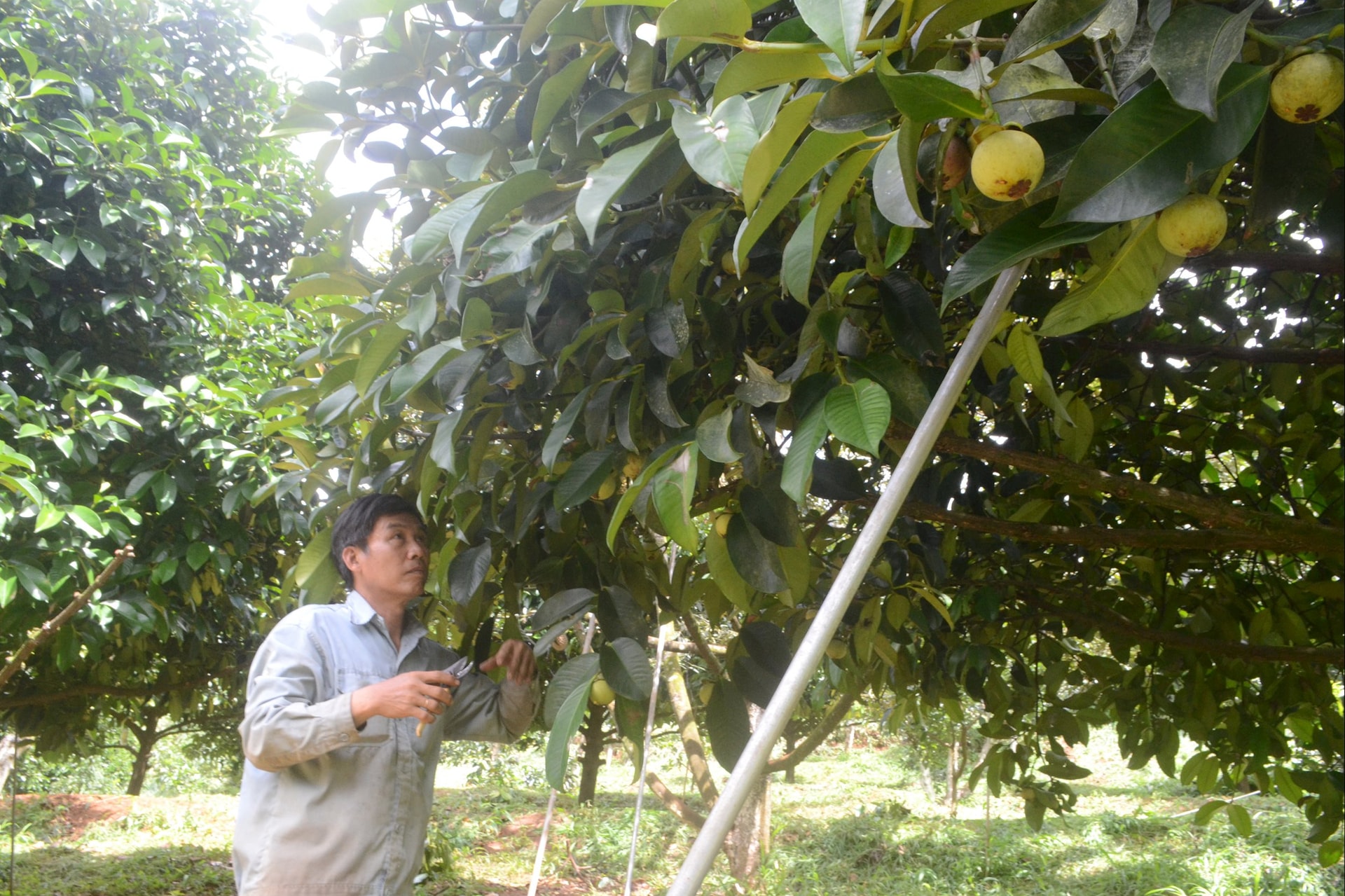
Gia An mangosteen farm in Dong Gia Nghia ward has achieved GlobalGAP (Good Agricultural Practices) certification. From July to September, the peak of the rainy season, is the busiest time for Gia An farm. This is because it's the period when they have to carry out regular tasks such as weeding, fertilizing, pruning, and harvesting the fruit. This year, the more than 10-hectare orchard has yielded a bountiful harvest of high-quality fruit, bringing great joy to the owner.
According to Mr. Tran Quang Dong, owner of Gia An mangosteen farm, his family has been developing mangosteen orchards for over 20 years. His experience in protecting fruit trees during the rainy and stormy season is to take care of and protect the trees before, during, and after the rainy season. Besides planning the planting plots to avoid wind directions, he also pays attention to the windbreak system around the orchards and fields.
When the trees begin to bear fruit, he uses a system of small, sturdy iron supports to prop up the main branches. Pruning and shaping the canopy are done by the family in a uniform, inverted cone shape to reduce wind damage. The rainy season is also a time of great concern for Mr. Pham Vinh San, from Dak Sak commune, because his family's 4-hectare avocado orchard is prone to fruit drop, especially for Booth avocados.
Mr. San believes he reduces fruit drop due to heavy rain by applying balanced fertilizer. The next step is soil care and nutrition. He improves the looseness of the avocado soil by applying organic fertilizer combined with chemical fertilizer in the correct dosage. During days of heavy, continuous rain, he regularly inspects the orchard to dig drainage ditches for the trees in low-lying areas.
Thanks to proper care, especially during the rainy season, by around October-November, his avocado orchard is ready for harvest, yielding uniform, high-quality fruit that sells at a competitive price.
According to the provincial Department of Agriculture and Environment, during the rainy season, farmers should prune fruit trees to improve air circulation, cutting off ineffective branches such as suckers, branches growing within the canopy, branches close to the ground, and branches affected by pests and diseases. They should also prune the tops to limit the height of the main trunk, minimizing wind resistance and preventing the tree from breaking or falling. Farmers should also tie the trunk and large branches in three directions to prevent them from falling, especially for trees with many large fruits such as durian and avocado.
For fruit-bearing trees, if it's time for harvesting, harvest early. If it's not yet time for harvesting, leave the large fruits untouched, tie the branches, and thin out some of the fruits on the cluster to prevent damage or fruit drop due to impact.
In particular, the agriculture and environment sector noted several remedial measures to be taken after damage caused by storms and tropical depressions. Specifically, farmers are digging trenches and focusing on pumping water out of their orchards as quickly as possible.
For trees with broken branches or leaning trunks, cut off the broken branches and clean up the fields and gardens. At the cut site, apply lime water or a copper-based fungicide solution to the cut to limit the damage caused by fungi entering the branch.
To restore the health of crops, farmers need to increase the use of organic fertilizers and foliar fertilizers, and limit the use of chemical fertilizers.
For orchards with young or developing fruit, foliar fertilizers containing Ca, Cu, B, and Zn should be sprayed to prevent fruit cracking. If the roots are loose, the soil should be compacted, and then fungicides such as Metalaxyl + Mancozeb, Fosetyl aluminum, or Trichoderma preparations can be applied to the roots 2-3 times at intervals of 20-25 days to prevent and treat root rot.
Source: https://baolamdong.vn/cham-care-of-fruit-trees-during-the-storm-388941.html
![[Image] Checking the security conditions at the exam site, ready for the 10th grade exam.](https://vphoto.vietnam.vn/thumb/1200x675/vietnam/resource/IMAGE/2026/05/28/1779943458889_z7872507660648-d764421a26e8cd7b61d70d142a48a685-jpg.webp)

![[Photo] Opening Ceremony of the National People's Council Conference on the Implementation of Directions and Tasks for the 2026-2031 Term](https://vphoto.vietnam.vn/thumb/1200x675/vietnam/resource/IMAGE/2026/05/28/1779939257690_ndo_br_bnd-1991-jpg.webp)
































































Comment (0)