

Reduce output pressure through processing.
Even though it's the end of the harvest season, the price of sweet potatoes currently only fluctuates between 6,000 and 8,000 VND/kg. At this price, only high-yielding fields (around 30 tons/ha) can break even, and some even incur losses if they have to rent land for production. This situation has repeated itself many times every time the peak harvest season arrives.

Mr. Do Van Nam, Director of Phu Thien Safe Agricultural Products Cooperative (Chu A Thai commune), said: The fact that farmers planted sweet potatoes at the same time led to a sharp increase in production during the peak season, while market demand decreased. Furthermore, the scale of production is spontaneous and lacks linkages with businesses, resulting in rapid and uncontrolled expansion of planted area. Any market fluctuations or decrease in purchasing power immediately cause losses for sweet potato growers.
During the peak harvest season a few weeks ago, many organizations and individuals stepped forward to support farmers by purchasing their sweet potatoes. However, the majority of sweet potatoes are still consumed fresh.
Ms. Le Thi Lan, Director of Nalee Vietnam Joint Stock Company (Bien Ho commune), said: "Since the beginning of the season, the company has supported the purchase of about 70 tons of fresh sweet potatoes from farmers in the province for sale through the TikTok platform. Although the production volume is not yet large and the company is just beginning to approach selling on e-commerce platforms, this is considered a positive sign for the consumption of local agricultural products."
According to Ms. Lan, fresh sweet potatoes are highly dependent on the season and their prices are volatile, while processed products like dried sweet potatoes can be preserved for a long time and increase their value many times over. This is a direction that helps growers have a more stable market outlet.
In fact, processed sweet potato products such as rice noodles, vermicelli, cakes; dried sweet potato slices, crispy dried sweet potato snacks, sweet potato snacks, etc., are increasingly popular in the market because they fit the trend of consuming natural, convenient, and healthy foods.
At Truong Gia Food Co., Ltd. (An Nhon Nam ward), after initially making an impression with its purple sweet potato wine product, the company continues to research and develop additional product lines such as purple sweet potato vermicelli and rice noodles. Ms. Truong Thi Xuan Hoa, the company's director, believes that sweet potatoes are a common agricultural product but have great potential to be developed into nutritious food products that meet modern consumer trends.
Processing them into noodles and cakes not only extends their shelf life but also creates differences in color and flavor, appealing to customers who prioritize clean and natural food.
"Businesses are also aiming to build a product chain from purple sweet potatoes linked to the story of the raw material source and local identity so that sweet potatoes not only appear in traditional markets but also in modern processed products, with the potential to expand the market," Ms. Hoa shared.
Linking to enhance value
Currently, the province's sweet potato growing areas are concentrated in Phu Thien and Chu A Thai communes and neighboring localities. In previous years, when sweet potato prices were high, many farmers rushed to expand their planting areas. However, the lack of planning and market information led to a rapid increase in production, concentrated at the same time of harvest, while the output still mainly depended on a few traditional distribution channels with unstable purchasing power.
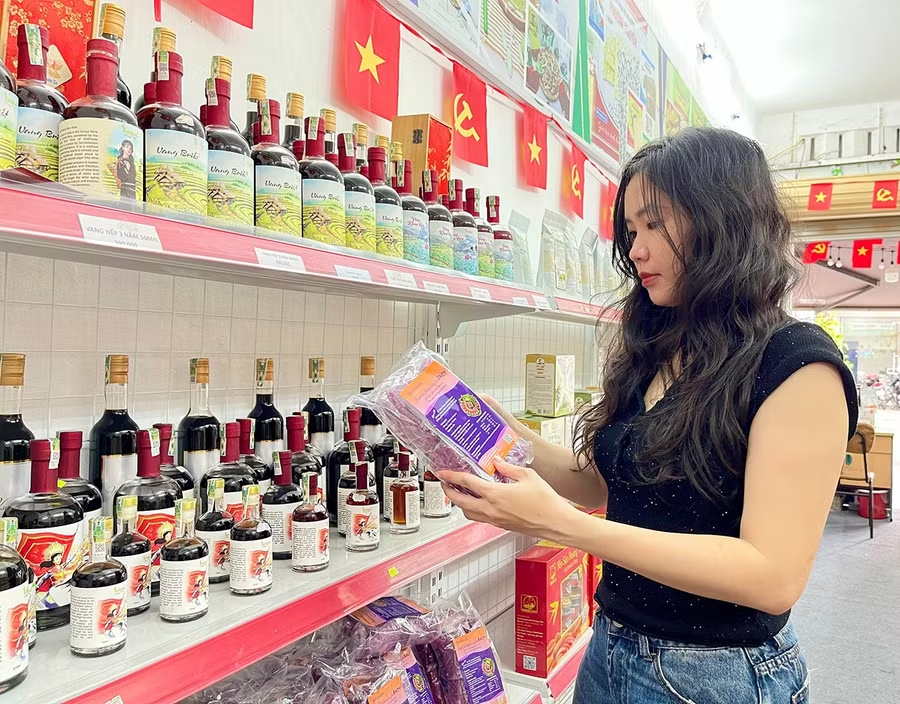
Mr. Mai Ngoc Quy, Head of the Economic Department of Phu Thien commune, said: "The sharp drop in sweet potato prices recently has directly affected people's income. Besides the reasons of oversupply and increased transportation costs, some traders are taking advantage of market fluctuations to force down prices, making things even more difficult for growers."
Each year, Gia Lai province has approximately 5,500-5,600 hectares of sweet potatoes, with an estimated yield of 87,800-90,000 tons. This provides an abundant source of raw materials for processing. However, the majority of the area is still cultivated on a small scale, lacking linkages between farmers, cooperatives, and businesses, resulting in unstable output. Over-reliance on fresh sweet potato consumption not only lowers value but also poses a risk of oversupply during peak season.
According to Ms. Le Thi Lan, Nalee Vietnam Joint Stock Company has surveyed key sweet potato growing areas in Phu Thien and Chu A Thai to propose development directions for deep-processed products. Currently, the company is focusing on developing crispy dried sweet potato sticks using raw materials from within the province, and is also proposing the formation of a processing chain right in the locality to reduce transportation costs, increase the value of agricultural products, and ensure a reliable source of raw materials.
Instead of relying entirely on the volatile, seasonally fluctuating fresh sweet potato market, processed products are opening up the possibility of significantly increasing the value of sweet potatoes, while also increasing access to new markets. This approach creates a foundation for forming a linkage chain between farmers, cooperatives, and businesses.
When a processed product comes with packaging, branding, and a regional story, its value is completely different from that of raw agricultural products. This is a suitable direction in a market that increasingly demands quality, traceability, and differentiation in agricultural products.
Source: https://baogialai.com.vn/che-bien-de-nang-cao-gia-tri-khoai-lang-post586728.html
![[Image] Hanoi's urban life under the challenge of a "scorching hot" environment](https://vphoto.vietnam.vn/thumb/1200x675/vietnam/resource/IMAGE/2026/05/25/1779706979265_nang-nong-t5-2026-minh-duy-7-4636-jpg.webp)

![[Image] Close-up view of the interchange connecting the two expressways and Long Thanh Airport.](https://vphoto.vietnam.vn/thumb/1200x675/vietnam/resource/IMAGE/2026/05/25/1779703378210_ndo_br_z7863716673926-224453a31600126cce10622af6290afd-4549-jpg.webp)

















































































Comment (0)