

Colombian experts observed a bird with the male's distinctive blue right side and the female's green left side.
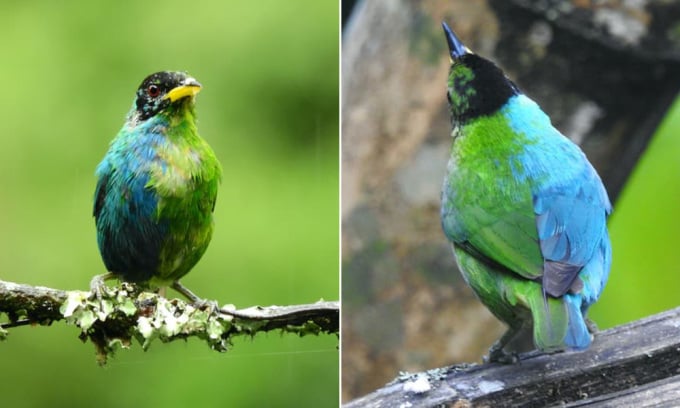
Hermaphrodite birds have both green and blue colors. Photo: John Murillo
Chlorophanes spiza is a species of bird belonging to the Passeriformes order; females have green plumage, while males are blue. However, amateur ornithologist John Murillo photographed a particularly unusual Chlorophanes spiza in Caldas, Colombia, New Atlas reported on December 12. The right half of the bird is blue, while the left half is green. From October 2021 to June 2023, the bird was also spotted several times at a local bird feeder station providing fresh fruit and sugar water.
Murillo contacted Professor Hamish Spencer, a zoologist at the University of Otago, about the unusual bird. Spencer personally observed and studied the creature. The new research was published in the Journal of Field Ornithology .
The bird in Murillo's photograph is a rare example of bilateral hermaphroditism, where one side of the organism exhibits male characteristics, while the other side displays female characteristics. This phenomenon exists in many animal groups, particularly those with sexual dimorphism (where the two sexes differ significantly in appearance). In birds, the cause is believed to be a malfunction in the process of egg cell division, followed by double fertilization with two separate sperm.
The bicolored bird in Caldas is only the second recorded instance of bilateral hermaphroditism in the species Chlorophanes spiza . The previous case was recorded in 1914, where the animal had blue on the left and green on the right.
Because no bisexual bird was captured in Caldas, experts were unable to determine whether it possessed internal organs of both sexes. This possibility exists because, when studying other birds exhibiting bilateral hermaphroditism, they found that these birds had ovaries on one side and testes on the other.
Most of the observed behavior of the two-colored Chlorophanes spiza is relatively normal, although it tends to avoid other members of its species, and they avoid it in return. Spencer noted that some such hermaphrodites reproduce, while others do not. The two-colored bird in Caldas has never been seen with another individual in a pair, so Spencer speculates it may not reproduce.
Thu Thao (According to New Atlas )
Source link





















































































Comment (0)