

Born and raised in the hilly area of Thuong Phuoc village, Trieu Phong commune (formerly Trieu Thuong commune, Trieu Phong district), Mr. Le Van Trung understands very well the climate, soil conditions, and economic development potential of the area.
Trung had always harbored the idea of starting a business in his hilly hometown, but unfortunately, his finances were too limited. In early 2006, he decided to go to Malaysia as a migrant worker, hoping to save up capital to return home and rent land for farming and livestock raising.
"That year, I was 27 years old, newly married, and luckily my wife and family supported my idea of working abroad. Although the work was hard, the income was high, and whenever I felt tired, I would think about the prospect of a vast mangrove forest, a fruit-laden orange orchard, and a herd of cows roaming freely on the hillside, all under my ownership. That would fill me with energy to work again. In this way, I always motivated myself with the goals I had set for the future, so the four years of working abroad passed quite quickly and smoothly," Trung recalled.
|
The organic cultivation model of V2 oranges and Xa Doai oranges has brought high income to the family of Mr. Le Van Trung, in Thuong Phuoc village, Trieu Phong commune - Photo: NB |
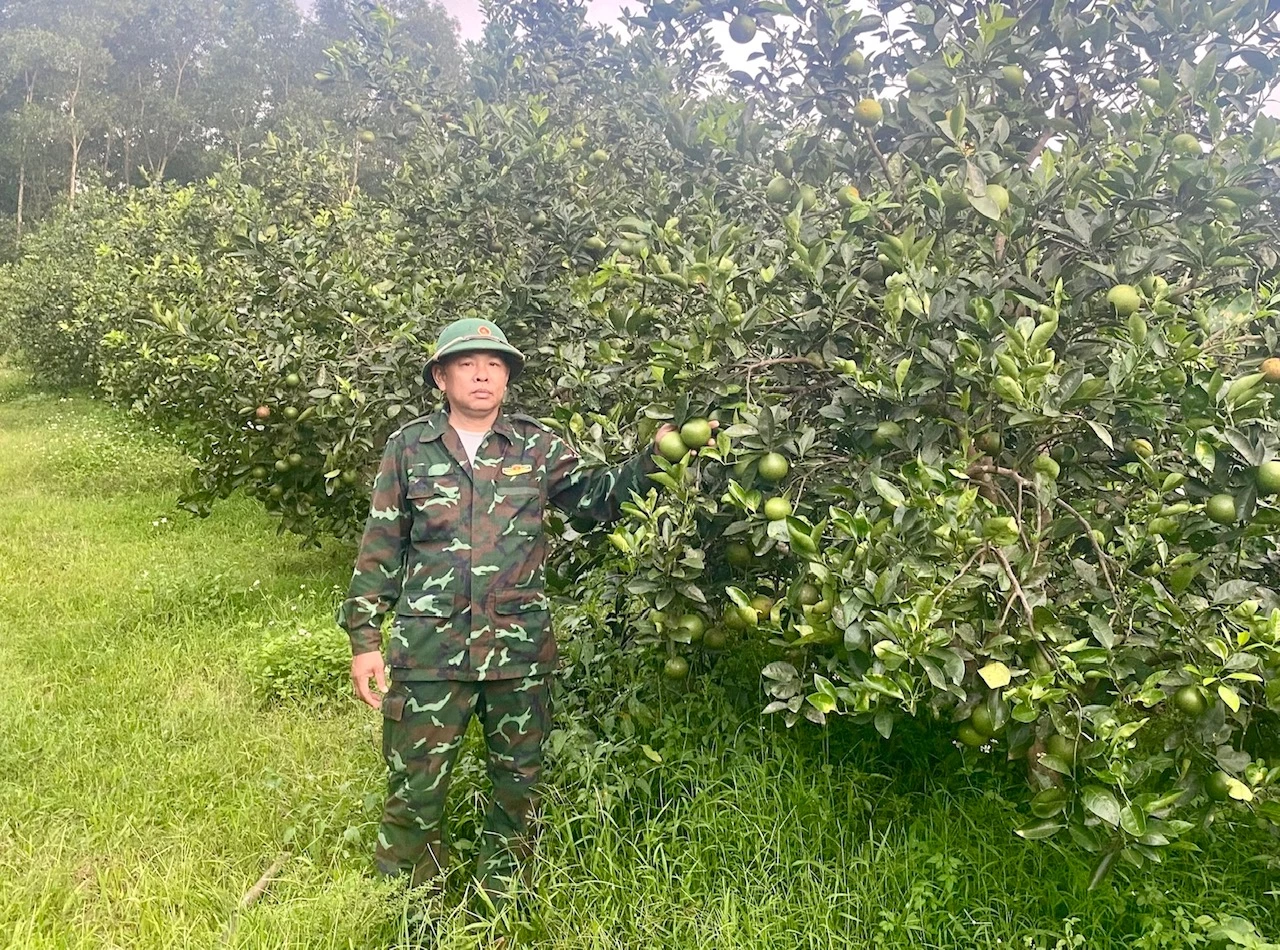
At the end of 2010, Mr. Trung returned to his hometown and boldly leased 7 hectares of land in the Tram Tieu hilly area, in Thuong Phuoc village, to develop a comprehensive farm economy combined with forest planting. After leasing the land, in early 2011, he drew up a land use plan, dividing the area for planting melaleuca trees, improving fish ponds, and building barns for raising Sind crossbred cattle. In the early days of starting to develop the Tram Tieu hilly area for economic purposes, Mr. Trung encountered many advantages because the terrain there was already very familiar, and moreover, he had carefully planned for many years beforehand.
"I chose the Tram Tieu hilly area because it's only about 5km from my house, and the terrain, soil, and climate here are very suitable for the economic venture I've been dreaming of for a long time. After clearing the land and improving the soil, I allocated 1.5 hectares to create ponds for raising freshwater fish such as carp, grass carp, and crucian carp; built barns and a breeding area for Sind crossbred cattle of about 0.5 hectares, enough to raise 20 breeding cows and 20-30 commercial beef cattle; and dedicated nearly 5 hectares to planting large timber forests, mainly acacia crossbreds," Trung shared.
In 2015, the economic model of large-scale timber forest cultivation developed favorably, and the income from his Sindhi crossbred cattle herd and freshwater fish farming was quite high, so Mr. Trung became even more confident in expanding his economic model. He continued to rent an additional 10 hectares of land in the Tram Tieu hilly area to plant large-scale acacia trees, combined with planting 450 V2 orange trees, Xa Doai orange trees, 150 green pomelo trees, and nearly 300 pear guava trees using organic methods. "I utilize cow manure to fertilize the fruit trees, so they grow very quickly. After 8 months of planting, the guava trees have started to yield a steady income. As for the orange and pomelo trees, it takes about 2-3 years to get the first harvest. Currently, the fruit trees are providing a high and stable income," Mr. Trung said.














































































Comment (0)