

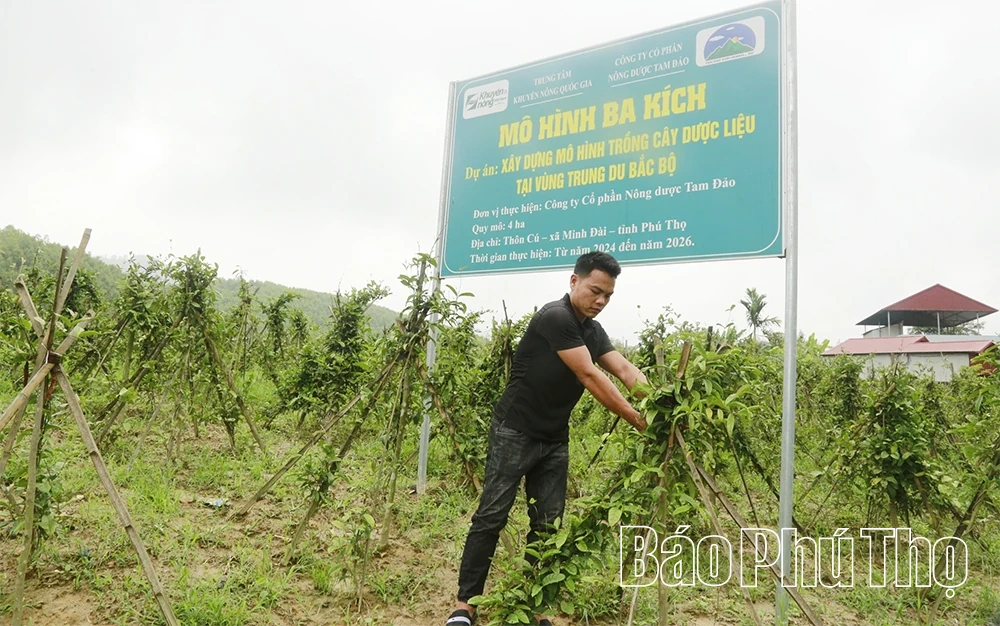
The ginseng garden of Mr. Dinh Van Duon's family is growing and developing well.
Born in 1988, after growing up and starting his own family, Mr. Dinh Van Duon inherited 2.8 hectares of production forest land from his parents. Like many households in the village, in the early years he planted eucalyptus trees on the entire area. However, when it came time to harvest, the economic efficiency was not as expected; the value obtained was not much better than farming. Undeterred, after the eucalyptus cycle, he converted the entire area to planting hybrid acacia. With a growth period of about 7 years, hybrid acacia yields higher productivity and has a stable market. Each hectare, after one harvest cycle, brings in an income of 130-140 million VND. Thanks to proactive crop rotation, his family has forest ready for harvesting every year. Earlier this year, he harvested over 1 hectare and quickly completed land preparation for replanting.
Determined to prosper in their homeland, Mr. and Mrs. Duon not only focused on developing the hill and forest economy but also opened a general store, sold animal feed, and provided transportation services. Saving up year after year, they continued to buy more forest land for production. From an initial 2.8 hectares, the family now owns approximately 12 hectares of forest.
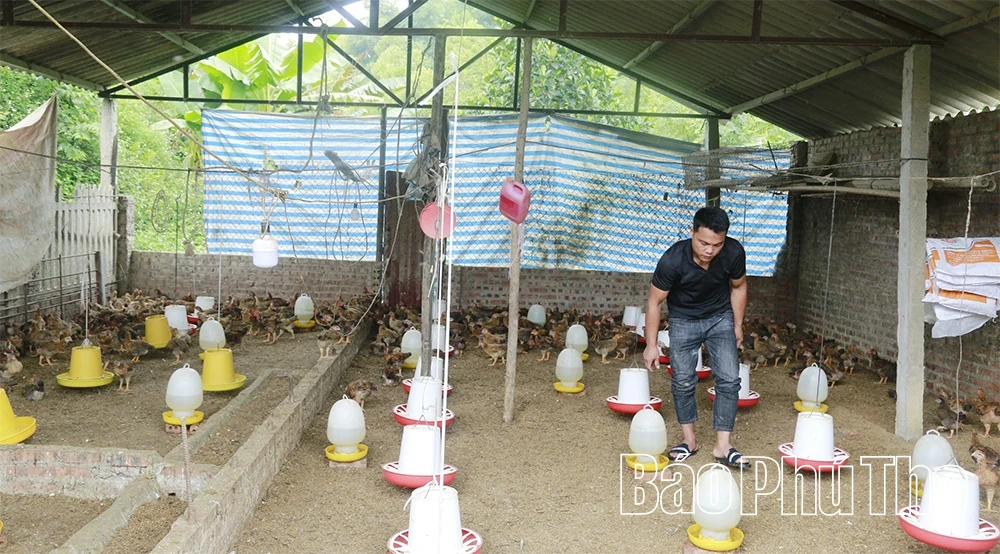
In addition to planting trees, Mr. Duon's family also raises about 1,000 free-range chickens per batch.
While acacia trees helped many households in Cu hamlet accumulate capital, the cultivation of Codonopsis pilosula opened up a new and promising path. About four years ago, during a visit to Tam Dao to see relatives, Mr. Dinh Van Bay happened to see local people growing Codonopsis pilosula with high economic efficiency. Curious, he bought seedlings to try planting them in his family's garden. At that time, although many people in the hamlet knew about medicinal products from Codonopsis pilosula, no one had thought of bringing this plant to cultivate on the local hilly land.
After more than two years of care, Mr. Bay's 1,500 ginseng plants have grown and developed well. When traders came to his garden to buy them, his family earned nearly 40 million VND, significantly more than growing rice or many other raw material crops on the same area. Recognizing the clear effectiveness, he continued to invest in an additional 4,000 seedlings.
Mr. Bay's model has attracted the attention of the villagers. Many households have come to visit and learn about the techniques of planting and caring for the plants. Recognizing that the soil and climate conditions in Cu hamlet are suitable for medicinal plants, Tam Dao Agricultural Pharmaceutical Joint Stock Company has collaborated with the local government to implement a project to build a model for growing medicinal plants in the midland region of Northern Vietnam, developing 4 hectares of Codonopsis pilosula plants in the period 2024-2026.
Seizing the opportunity, Mr. Dinh Van Duon discussed it with his wife and boldly invested in planting 15,000 Codonopsis pilosula plants on 1.8 hectares of forest land. After more than a year, the plants are growing well and developing steadily. If things continue to go smoothly, the first harvest is expected to bring the family nearly 400 million VND in revenue.
Mr. Dinh Van Duon happily shared: “Growing Codonopsis pilosula is easier than farming, and the income is significantly higher. The market is stable, and businesses buy directly from the farm. After this harvest, I will continue to expand the area for long-term development.”
Not content with just planting forests and medicinal plants, his family now also raises sows and about 1,000 free-range chickens. With a stable income of 500-600 million VND per year, the family has built a spacious house, invested in trucks and passenger vehicles for living expenses and developed transportation services.
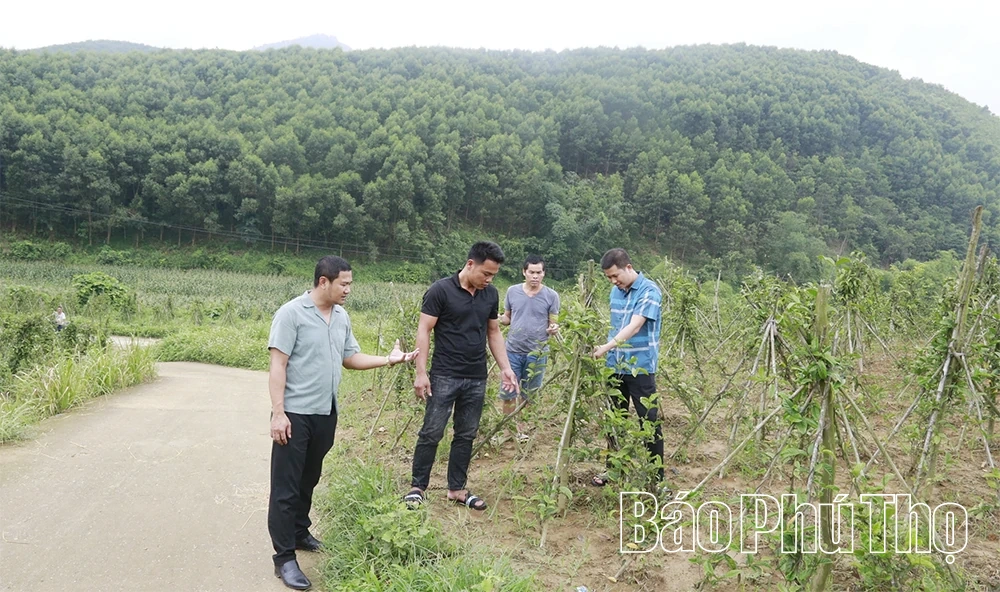
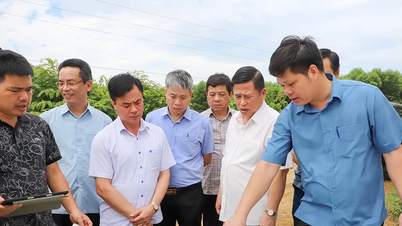
Leaders of Minh Dai commune inspect the project to plant Codonopsis pilosula in Cu hamlet.
Mr. Ha Van Tan, head of Cu area, said: “Cu area currently has 186 households with over 700 inhabitants, mainly Muong ethnic people. In recent years, the potential of hilly and forested land has been exploited more effectively by the people through farm economic models, production forestry, and medicinal plant cultivation. Old farming methods are gradually being replaced by flexible production thinking, knowing how to grasp market demand, so the value of agricultural products is increasing. Many families have become well-off from hilly and forested economic activities, and currently there are only 21 poor households left in the area.”
On the hillsides once known only for eucalyptus, acacia, and uncertain harvests, now lush ginseng gardens, livestock farms, and farm-based economic models providing stable income have emerged. The transformation in Cu hamlet stems not only from the potential of the forest land but, more importantly, from a change in the production mindset of the people. By knowing how to properly exploit advantages, boldly learning, and choosing the right direction, forest land is no longer a difficult area but is becoming a foundation for many households to become prosperous, contributing to the increasingly thriving development of the village.
Cam Ninh
Source: https://baophutho.vn/huong-mo-tu-dat-rung-xom-cu-254623.htm
















































































Comment (0)