


This policy is documented in major historical works such as the Dai Nam Thuc Luc and the Kham Dinh Dai Nam Hoi Dien Su Le .
A tradition of honoring the elderly.
According to records in the Dai Nam Thuc Luc (Chronicles of Dai Nam), in the 4th year of Minh Mang's reign (1823), the king established a reward system for those who lived to a ripe old age: "I wish for the country and its people to live long lives so that they may be imbued with great blessings. From now on, officials of all ranks, from 80 years old and above, should submit their names clearly to the king, awaiting his decree to be rewarded with money and silk according to their rank." For officials, the court stipulated specific reward levels according to rank upon reaching 80 years of age or older, especially for those who lived to 100 years old. In addition to money and silk, those rewarded were also given plaques and even had pavilions erected in their localities to serve as examples.
For the people, this policy was also clearly defined: men who reached 100 years of age were awarded the plaque "Longevity of the People," and women were awarded the plaque "Virginity and Longevity," along with money and silk fabrics. This was the official recognition by the State of individuals who were exemplary in terms of longevity within the community.
During the reign of Emperor Tự Đức, this policy was further refined. In the 16th year of Tự Đức's reign (1863), the court stipulated that for every 10 years of increased life expectancy, the reward would be increased. The "Longevity Citizen" plaque was designed as follows: it was surrounded by carved floral and leaf motifs, stylized dragons, and gilded with silver. The front bore the two Chinese characters "Sắc tứ" (Imperial Decree) in silver and red; the middle bore the two large Chinese characters "Thọ dân" (Longevity Citizen); the bottom bore the person's rank, full name, village, commune, district, prefecture, province, and the Chinese characters: "Longevity reaching a hundred years, special reward, a plaque of increasing peace and prosperity for the person," and the back bore the year, month, and day.
Imprints left in the land of Quang Nam
After the regulations were issued, localities throughout the country compiled lists to submit to the imperial court. According to historical records, approximately 100 people who lived to be 100 years old or older submitted lists to the imperial court, of which Quang Nam province accounted for 37.
However, due to the delayed submission of the reward, some individuals passed away before receiving it. Upon hearing the news, Emperor Minh Mạng reprimanded them, saying: “Age has long been a precious thing in the world. The policy of the monarchy prioritizes the care of the elderly. Now, in the capital region, there are people of such advanced age who have not yet had the chance to enjoy the blessings of peace and prosperity; this is the fault of the local officials. All officials in the court shall be demoted one rank.” This demonstrates the court's special attention to caring for the spiritual well-being of the elderly, contributing to the goal of “ensuring the people's peace and governing the nation.”
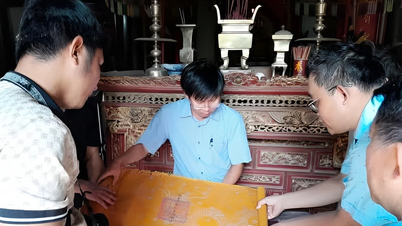
In Quang Nam province, from the reigns of Emperors Minh Mang and Khai Dinh, historical records indicate that 25 people were awarded the "Centennial Longevity" title. Notably, in Hoi An, there is still a plaque commemorating "Centennial Longevity" bestowed upon Mr. Pham Van Cang (Cuong), a resident of Thanh Chau commune, in the 16th year of the reign of Emperor Thanh Thai (1904). The plaque is currently displayed prominently at the Pham family ancestral temple (Hoi An ward), becoming a valuable document vividly reflecting the Nguyen dynasty's policies in community life.
The "Longevity of the People" policy was not merely an administrative practice but also deeply reflected the Nguyen Dynasty's governing philosophy, which placed people at the center and emphasized the nation's moral principle of respecting and honoring the elderly. Honoring the elderly not only contributed to consolidating social order but also fostered community cohesion and nurtured traditional moral values.
Today, this fine tradition is still inherited and promoted through the State's policies on elderly care. From a historical regulation, "Longevity for the People" has become a lasting cultural feature in Vietnamese life.
Source: https://baodanang.vn/chinh-sach-ban-thuong-tho-dan-3332131.html


























![[Photo] Reception to welcome General Secretary and President To Lam and his wife on their State visit to the Philippines](https://vphoto.vietnam.vn/thumb/1200x675/vietnam/resource/IMAGE/2026/06/01/1780295488620_vna-potal-chieu-dai-chao-mung-tong-bi-thu-chu-tich-nuoc-to-lam-va-phu-nhan-tham-cap-nha-nuoc-toi-philippines-8798060-7855-jpg.webp)




























































Comment (0)