

Touching the heritage
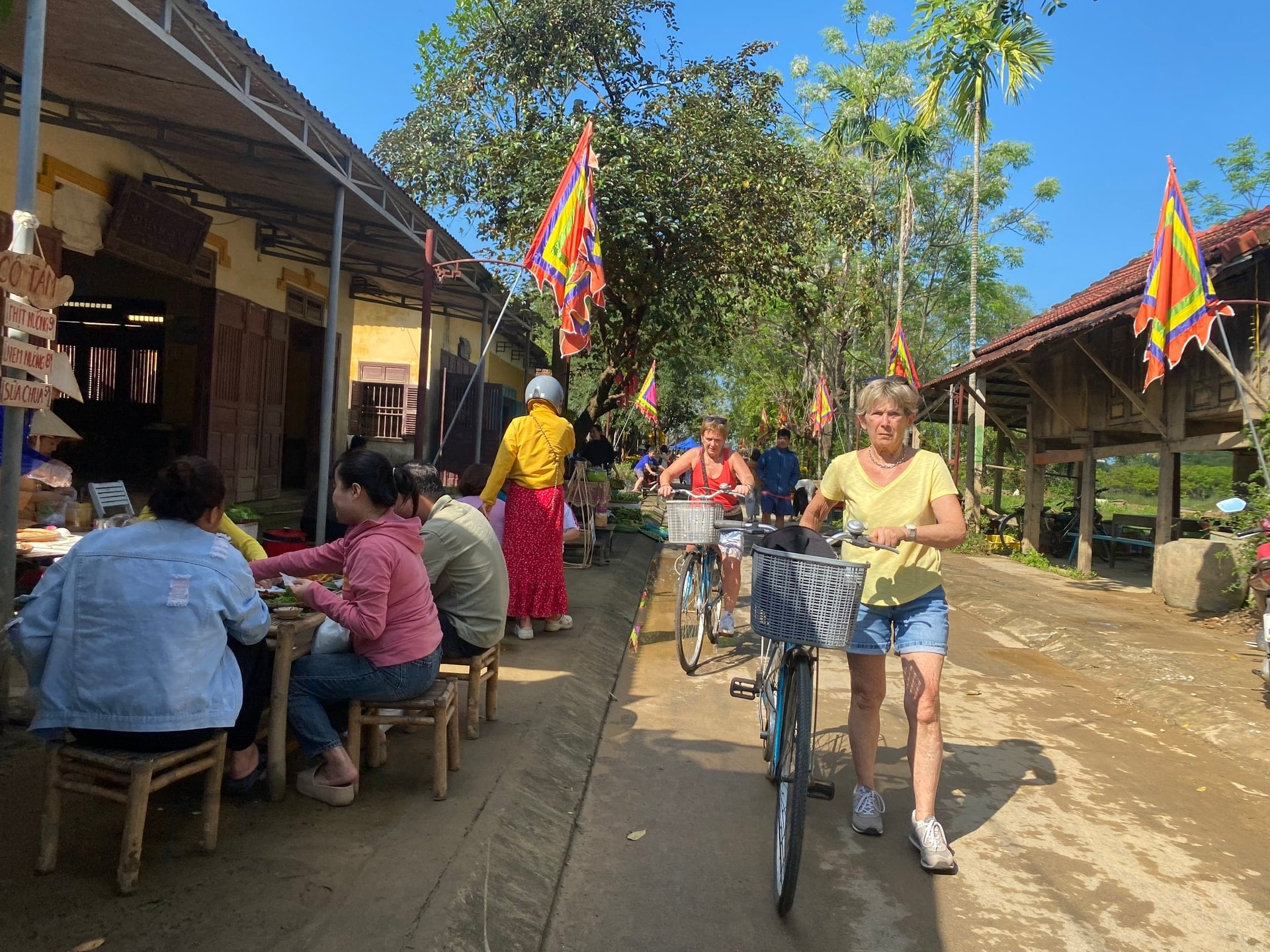
One morning in An My vegetable village (Hoi An Dong ward), the countryside was bustling with the laughter and chatter of tourists. Some were practicing rice planting, others enjoying riding buffaloes, some experiencing scooping water to catch fish, or sitting by the fire learning to cook traditional Quang Nam dishes.
No longer just a sightseeing trip, many tourists come to An My to slow down, touch the rice paddies, and feel the rhythm of life of the farmers.
These farmers, with their hands stained with mud, have now become special "guides," directly showing tourists how to transplant seedlings, sow seeds, or harvest vegetables in the garden.
According to the leaders of Hoi An Dong ward, the trend of developing green tourism associated with organic agriculture is being emphasized by the local people. Every year, the rice planting festival is organized not only to serve tourism but also as an opportunity for the community to express gratitude to farming, preserve the cultural heritage of rice cultivation, and spread love for traditional occupations.
Tourists also flock to Kim Bong carpentry village (Hoi An ward), where the sounds of chisels and saws still echo daily along the Thu Bon River. For over 600 years, the carpentry craft here has contributed to the creation of many unique architectural works for Quang Nam and Central Vietnam.
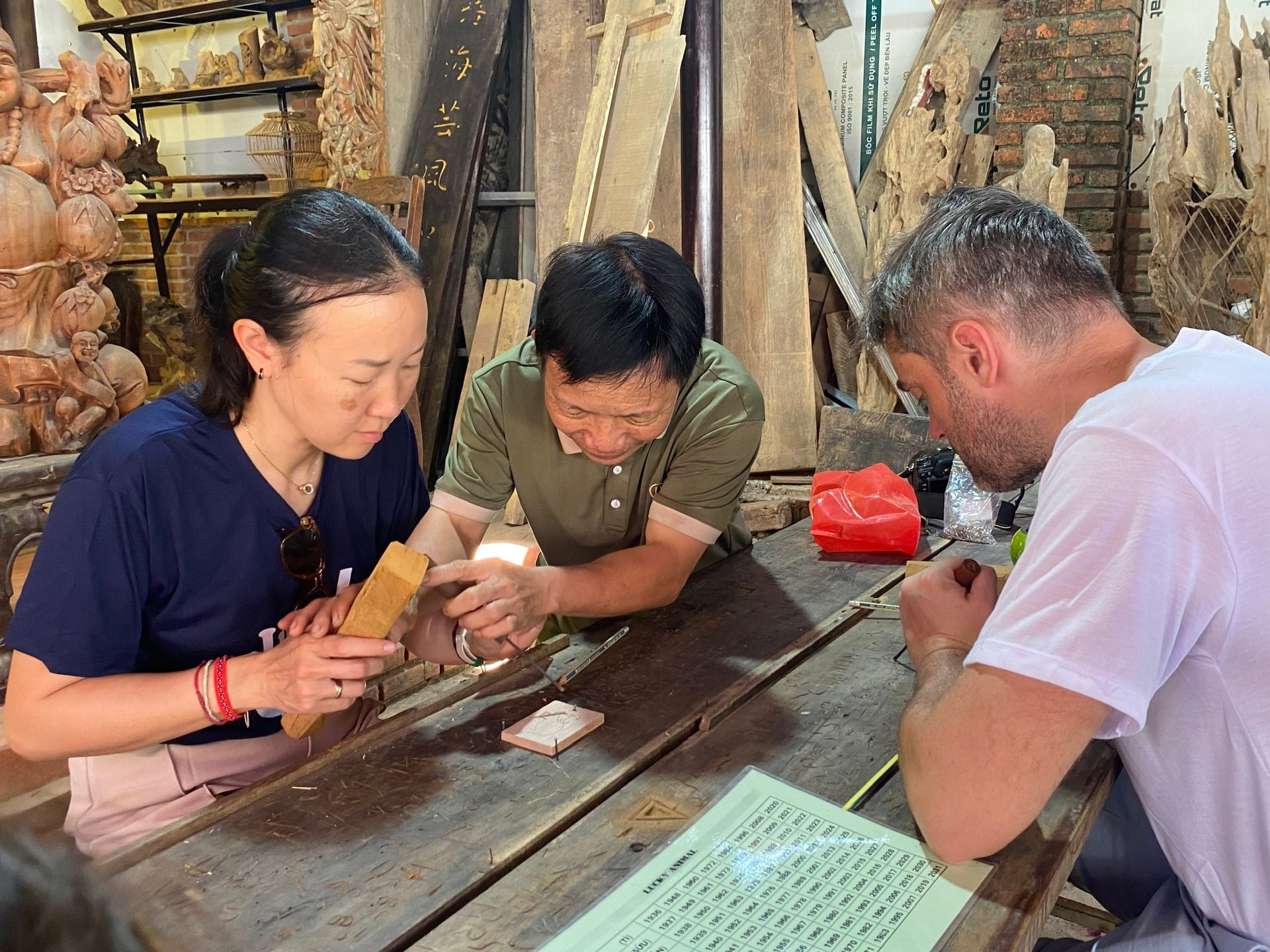
In the small woodworking workshop, artisans meticulously carve each detail into the wood. Many tourists spend hours observing each stage of shaping, chiseling, and carving patterns.
Artisan Huynh Suong, who has dedicated more than half his life to the Kim Bong carpentry craft, shared that what makes him happiest is that more and more young people and foreign tourists are interested in this traditional craft.
Because the wooden products in Kim Bong are not simply household items but also contain the imprint of local culture. Images of buffaloes, bamboo trees, boats, or the Japanese Bridge are carved in a rustic style, telling the story of the Hoi An countryside.
Along with carpentry, local people have also developed many green tourism models such as cycling through the countryside, visiting gardens, community-based ecotourism, and reducing plastic waste. For them, tourism is not a replacement for traditional crafts, but a way for those crafts to survive in modern life.
In Thanh Ha pottery village (Hoi An Tay ward), the craft village atmosphere is enlivened by experiential activities. In small pottery workshops, artisans both practice their craft and guide visitors in shaping pottery and creating products.
Moamet Anne, a Vietnamese expatriate living in France, shared that since the beginning of 2026, her family has made two trips to Vietnam, including a visit to Thanh Ha pottery village. “Seeing the people making the products firsthand, I realized how hard the artisans work. I love this place; it’s so beautiful,” she said.
Ms. Nguyen Thi Hao, the owner of a pottery workshop in the village, said that tourists enjoy directly participating in the pottery-making process and creating their own souvenirs to take home. Therefore, preserving the traditional craft and the rural atmosphere is becoming a major priority for the craft community.

Preserving traditional crafts is essential for preserving heritage.
The booming tourism industry is bringing new livelihoods to many households in traditional craft villages, but it is also creating considerable pressure. The risks of commercialization, the younger generation's lack of interest in traditional crafts, the impacts of urbanization, and climate change are becoming major concerns for the local community.
According to Nguyen Duc Binh, Chairman of the People's Committee of Hoi An ward, along with Thanh Ha pottery village, Kim Bong carpentry village are important elements that create the unique identity of Hoi An.
In the planning phase, the locality will continue to prioritize the preservation and restoration of traditional crafts at risk of disappearing, especially the Kim Bong carpentry craft, in the context of fewer and fewer young people pursuing the profession.

Local authorities have determined that it is essential to preserve the traditional craft village space, support artisans in passing on their skills to the younger generation, and develop community tourism in a green and sustainable direction.
According to Mr. Binh, many ideas are being promoted, such as building a bamboo museum in the western area of Kim Bong carpentry village to form a green tourism ecosystem associated with the natural landscape of the old Cam Kim area; developing mangrove forest ecological space along the river combined with preserving traditional craft villages and community tourism.
"The most important thing is not how many tourists we attract, but preserving the core values of the craft village. If we lose the cultural space and spirit of the craft village, tourism will also lose its identity," Mr. Binh said.
Meanwhile, Thanh Ha pottery village is showing positive changes as many workshops switch to using electric kilns instead of traditional, polluting kilns. Souvenir products are also being developed in a streamlined, environmentally friendly direction while still retaining the distinctive cultural characteristics of Hoi An.
The awarding of the "Best Community Tourism Destination" prize to Thanh Ha pottery village in 2025 is seen as proof of the approach of putting the community at the center and using living heritage as the foundation for sustainable tourism development.
The artisans, farmers, and villagers are quietly preserving the familiar sounds of chiseling, the flames, and the earthy smells of their homeland. This is how they safeguard the cultural memories and soul of traditional villages for future generations.
Source: https://baodanang.vn/gin-giu-ban-sac-lang-nghe-3338887.html

























![[Photo] Reception to welcome General Secretary and President To Lam and his wife on their State visit to the Philippines](https://vphoto.vietnam.vn/thumb/1200x675/vietnam/resource/IMAGE/2026/06/01/1780295488620_vna-potal-chieu-dai-chao-mung-tong-bi-thu-chu-tich-nuoc-to-lam-va-phu-nhan-tham-cap-nha-nuoc-toi-philippines-8798060-7855-jpg.webp)



































































Comment (0)