

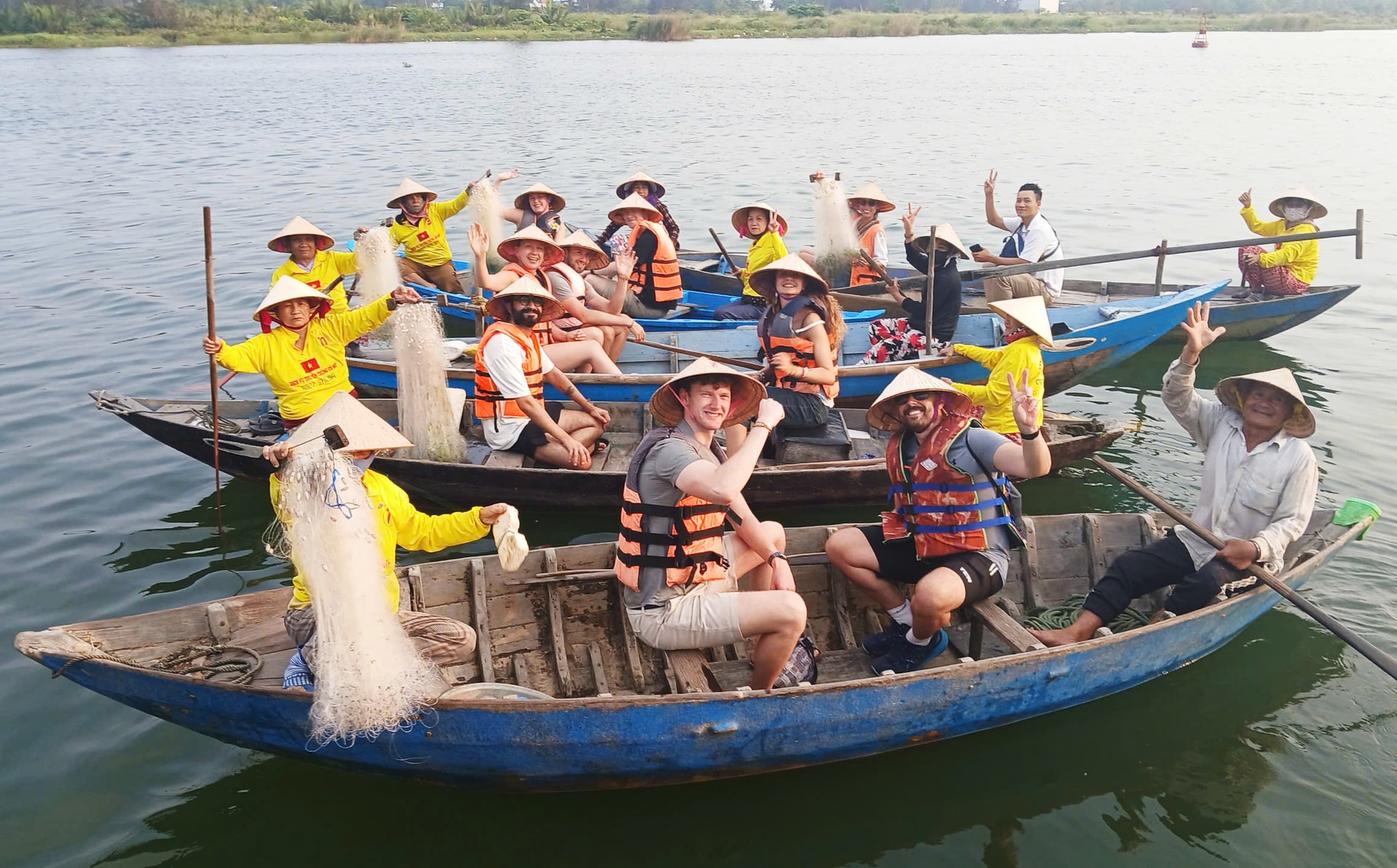
From the silence in Tan Thanh
The Tan Thanh fishing village community tourism service (Hoi An Tay ward) of the Tan Thanh Fishing Village Community Tourism Service Cooperative was once considered one of the pioneering models in integrating the lives of fishermen into OCOP products. In 2021, the product was recognized as a 4-star OCOP product, marking an important experimental step in integrating community tourism services into the OCOP system.
However, after the 36-month period, the program was not renewed, and the Tan Thanh Fishing Village Community Tourism and Service Cooperative has since been dissolved, leaving behind a model that was once highly anticipated but failed to sustain itself in the long term. Observations from recent tourist seasons show that community activities among fishermen and small traders in Tan Thanh are still maintained, but mainly on an event-by-event basis, lacking the stable and well-organized operational structure of the initial phase.
Mr. Le Quoc Viet, former Deputy Chairman of the Tan Thanh Fishing Village Community Service and Tourism Cooperative and Vice President of the Da Nang Tourism Association, observed that when the model was first established, it received attention because it was linked to the real-life experiences of a fishing village.
"However, in the long term, difficulties begin to arise in maintaining manpower, organizing regular activities, connecting tours and routes, and ensuring stable output. A community-based tourism product needs continuous support, especially from the local government, to survive, while the support resources have not kept pace, so maintenance faces many obstacles," Mr. Viet said.
The story of Tan Thanh clearly reveals the gap between a much-talked-about model and a product that can operate sustainably in the long term.
Overall, the city currently has only 3 products in the community tourism, ecotourism, and tourist destination service categories that still have valid licenses: the model in Dong Giang commune, Banarita Glamping Farm, and An Phu Farm in Hoa Vang commune, accounting for 0.63% of the total 473 OCOP products.
This figure highlights a significant gap, as many community-based tourism models, agricultural experiences, and traditional craft villages have emerged but still operate spontaneously, on a small scale, and are dependent on individual households or groups.
In some cases, OCOP recognition only provides initial acknowledgment and has not created a clear competitive advantage due to a lack of support in market connectivity, training, and service organization. Many models have to sustain themselves, leading to stagnation, while many new initiatives continue to develop outside the OCOP system.
Systematic organization
Many community-based tourism models are operating quite effectively in the city, demonstrating their ability to adapt to the market and tourist needs, even though they have not yet been included in the OCOP system to create a driving force for development.
The common thread among these models is their flexible approach, directly utilizing local resources—from daily life and traditional crafts to rural landscapes—to create highly personalized experiential packages.
In Tra Nhieu (Nam Phuoc commune), Pham Minh Tam's community tourism model is a prime example of this approach, where activities such as rowing basket boats, experiencing traditional rural cuisine, weaving nets, brewing rượu (rice wine), and making noodles are organized into a chain linking many households in the village.
Each day, the model welcomes about 50 visitors, while also creating jobs for more than 30 local workers, contributing to maintaining livelihoods right on the spot. “Visitors here often want to experience the real life of the people, from small things like weaving nets, cooking, or going boating, so each experience must be carefully prepared, with a guide and stories to tell.”
"When doing tourism this way, we have to both provide services and be storytellers. If we can participate in the OCOP program, we hope to have more opportunities to standardize, improve quality, and connect more broadly with the market," Tâm shared.
Models like Tra Nhieu demonstrate that tourism trends have gradually shifted towards value-based experiences connected with people, culture, and emotions.
However, for these activities to become OCOP products, there is still a certain gap, ranging from the requirement for service standardization and community organizational capacity to maintaining consistent quality over the long term.
Mr. Le Quoc Viet, Vice Chairman of the Da Nang Tourism Association, believes that the city has great potential for developing community-based tourism and ecotourism. The key is to focus on how to organize these elements so that they become stable, operational products that can connect with travel businesses and the tourism market.
According to Mr. Viet, for OCOP (One Commune One Product) goods, standardization should focus on quality, packaging, labeling, and traceability. Meanwhile, OCOP tourism services require a different set of standards, encompassing everything from service personnel and the organization of experiences, local stories, cultural spaces, to the ability to accommodate guests and maintain operations.
"The gap in OCOP services is clearly evident in the small number of products, but besides that, the way to organize tourism resources into structured products that can be operated and developed stably is also a major issue."
"As tourism is becoming a clear value-adding channel for local products, perfecting this product group will determine the ability of OCOP to participate more deeply in the destination experience journey in the future," Mr. Viet said.
Source: https://baodanang.vn/khoang-trong-nhom-san-pham-dich-vu-3338488.html
![[Photo] Admire the coral "masterpiece" amidst the million-year-old heritage of Dak Lak province.](https://vphoto.vietnam.vn/thumb/1200x675/vietnam/resource/IMAGE/2026/05/30/1780107638639_y25-jpg.webp)



























































































Comment (0)