


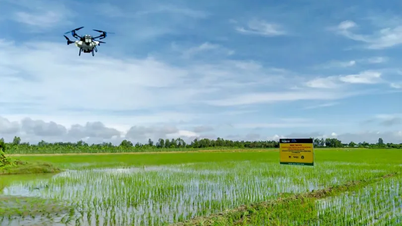
Farmers in Thoi Lai commune are tending to their winter-spring rice crop.
The rice is growing well.
The prolonged rainy season in 2025, slow flood receding, high tides, and complex weather patterns created many difficulties for farmers producing the 2025-2026 winter-spring rice crop. Farmers in many areas had to incur additional costs for pumping water to prepare for rice planting, and some even had to delay planting until the water receded. However, with the active support of the authorities at all levels, farmers were able to adapt to these unfavorable production conditions. In particular, the city's Department of Agriculture and Environment intensified its efforts to provide warnings, update weather, hydrological, and pest information, and provide technical training to help farmers proactively manage production and avoid risks. As a result, most of the winter-spring rice crops planted so far have developed well. Currently, 26,138 hectares of rice have been harvested, with an estimated yield of 56.25 quintals/hectare, totaling over 147,000 tons.
Mr. Ho Hoang Anh, residing in Thoi Phuoc A hamlet, Thoi Lai commune, stated: "This winter-spring crop season, I sowed Dai Thom 8 rice variety on an area of 20 acres. The rice is now over 40 days old, developing well, and has few pests and diseases. However, I am not being complacent and will continue to monitor the fields to promptly prevent and control pests and diseases and respond to extreme weather conditions."
Mr. Nguyen Van Bac, residing in Truong Tho 1 hamlet, Truong Xuan commune, stated: "My family's 30 acres of rice, sown with the Dai Thom 8 variety in the 2025-2026 winter-spring crop, are nearly 50 days old and developing well. The heavy flooding required significant costs for pumping water at the beginning of the season. However, the floods helped eliminate pathogens and enriched the fields with silt, reducing investment costs. I am confident of a bountiful harvest this season."
According to Mr. Le Van Na in Hoa Thanh area, O Mon ward, this year's floods were severe and the water receded slowly, so he only planted his rice seedlings more than 20 days ago. The rice is developing well, and he is actively applying pest management measures recommended by the Department of Agriculture to ensure safe and efficient production.
Strengthen field inspection and supervision.
To help farmers achieve a successful 2025-2026 winter-spring rice crop, the Department of Agriculture and Environment, along with local authorities in Can Tho City, is actively promoting information dissemination, warnings, and guidance to encourage farmers to proactively implement solutions for caring for and protecting rice at each growth stage. Farmers are advised to sow seeds simultaneously and in a concentrated manner across all fields to avoid pests; to apply advanced technical solutions; and to proactively prevent various pests and diseases from an early stage. This will significantly contribute to better rice growth, reduced pest and disease problems, and cost savings.
As of January 23rd, Can Tho City had planted the 2025-2026 winter-spring rice crop on 266,370 hectares, reaching 85% of the plan. Generally, the winter-spring rice crop in the area is developing quite well. However, some rice fields have shown signs of pests and diseases such as brown planthopper, golden apple snail, rats, small leaf-rolling caterpillars, rice blast, leaf blight, and neck blast. To ensure a successful rice crop, the city's Department of Agriculture and Environment requests that localities strengthen recommendations and guidance for farmers to regularly inspect their fields to promptly detect and control pests and diseases, and proactively respond to unfavorable weather conditions. For areas affected by drought and saltwater intrusion, the "1 must, 5 reductions" technical package should be applied, along with improved rice cultivation systems (SRI) that save water, alternating wet and dry irrigation, and adjusting the planting season accordingly. Scientific and rational water management, saving water right from the beginning of the season, ensuring sufficient water according to the needs of each stage of rice plant development, and using drought- and salinity-tolerant rice varieties.
According to Ms. Nguyen Thi Giang, Deputy Director of the Department of Agriculture and Environment of Can Tho City, rice cultivation from the tillering to heading stage accounts for about 52% of the planted area. This is a sensitive stage for many pests and diseases, especially brown planthopper, blast disease, leaf roller, and rats. Particularly during the period leading up to the Lunar New Year of the Horse 2026, the majority of rice fields enter the heading to ripening stage (over 70% of the area), with about 10% of the area harvested coinciding with Tet. This is a very sensitive stage; if not monitored, cared for, and pest and disease controlled in a timely manner, it will affect rice yield and quality. The People's Committees of communes and wards need to strengthen field inspections and supervision before, during, and after Tet. They should organize farmers to regularly visit their fields, closely monitor the development of pests and diseases, especially brown planthopper, blast disease, and leaf blight, and promptly identify affected areas and guide effective control measures. Timely notification and forecasting of pest outbreaks, drought warnings, and saline intrusion information for each area enable farmers to proactively prevent and manage them…
To reduce costs and ensure safety and effectiveness in controlling pests and diseases affecting rice during the heading, flowering, and grain-filling stages, the Department of Agriculture and Environment of the city advises farmers not to spray pesticides indiscriminately for the sake of a peaceful Tet holiday. Carefully consider spraying pesticides when not absolutely necessary. Maintain a water level of 3-5 cm in rice fields. Apply alternating wet and dry irrigation methods and fertilize with balanced nitrogen, phosphorus, and potassium. When rice reaches the flowering stage, ensure the fields do not dry out. For brown planthoppers, carefully inspect the rice fields and determine the correct time for spraying. Absolutely do not spray preventively according to traditional practices… For rice fields that will be harvested simultaneously after the Lunar New Year, farmers should proactively contact combine harvesters, transporters, and purchasing services… to avoid a shortage of harvesting services, and to prevent the rice from being left in the fields for too long, which reduces yield and quality.
Text and photos: KHANH TRUNG
Source: https://baocantho.com.vn/chu-dong-cham-care-bao-ve-lua-dong-xuan-a197660.html


![[Photo] National Assembly Chairman Tran Thanh Man working with the Standing Committee of the Law and Justice Committee](https://vphoto.vietnam.vn/thumb/1200x675/vietnam/resource/IMAGE/2026/05/21/1779378929214_ndo_br_1-4610-jpg.webp)
![[Photo] General Secretary and President To Lam presides over a working session with the Central Policy and Strategy Committee on the development of the materials industry.](https://vphoto.vietnam.vn/thumb/1200x675/vietnam/resource/IMAGE/2026/05/21/1779359935432_a3-bnd-3129-1412-jpg.webp)






































































Comment (0)