

 |
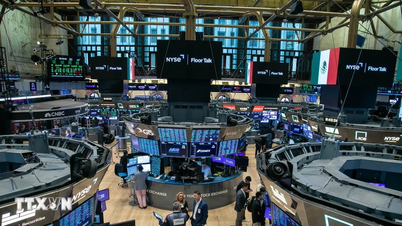
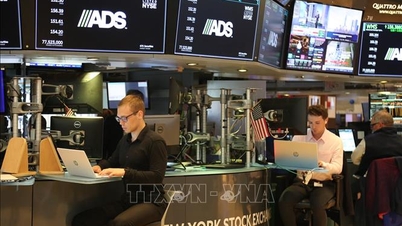
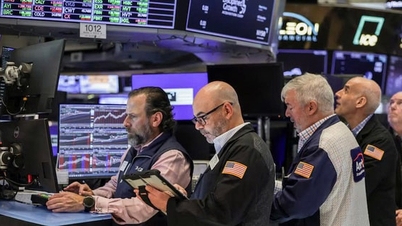
| Wall Street closed the trading session on May 18th with mixed results, as technology stocks faced profit-taking pressure amid continued increases in US bond yields. |
Deep divergence on Wall Street.
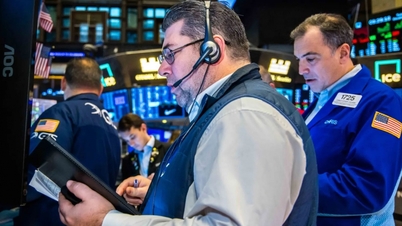
The first trading session of the week on May 18th (US time) closed in a state of intense tug-of-war, clearly reflecting the return of cautious sentiment among investors after a series of consecutive weeks of rapid growth in the US stock market. Wall Street was divided into two opposing halves as money tended to flee from high-valued technology stocks in search of safer havens.
At the close of trading, the Dow Jones Industrial Average was the only bright spot, maintaining its positive performance with a gain of 159.95 points (0.3%), closing at 49,686.12 points. Conversely, the broader S&P 500 continued its second consecutive day of declines since reaching its all-time high last week, losing 5.45 points (0.1%) to 7,403.05 points. The Nasdaq Composite suffered the heaviest losses, plummeting 134.41 points (0.5%) to 26,090.73 points. The negative trend also spread to small and medium-sized enterprises, causing the Russell 2000 to lose 18.20 points (0.7%) to 2,775.10 points.
One of the main factors influencing market sentiment in this session stemmed from the unpredictable developments in the Middle East. Oil prices and global stock markets continued to experience volatile fluctuations due to conflicting information surrounding the conflict involving Iran.
According to Reuters and AP, crude oil prices surged overnight before abruptly reversing course and then rebounding in a yo-yo pattern. The cooling down at the end of the day only occurred after President Donald Trump announced a postponement of the planned military attack on Iran on Tuesday. However, concerns about energy inflation risks continue to haunt investors. The volatile energy prices fear that the Federal Reserve will be forced to maintain record-high interest rates to curb inflation, rather than lowering them sooner as previously expected.
Technology stocks were sold off ahead of earnings reports.
Amidst an uncertain macroeconomic environment, high-growth technology stocks, which had been the driving force behind the market's upward trend for some time, unexpectedly turned into the biggest drag. A wave of profit-taking occurred across the board as investors adopted a defensive stance ahead of the upcoming quarterly earnings season.
Pressure is mounting on the semiconductor and data storage component sectors. Data from Investopedia shows that a series of major memory stocks such as Micron Technology, Western Digital, Sandisk, and Seagate Technology have all plummeted by 5% to 7%. This is seen as a necessary technical correction for stocks related to artificial intelligence (AI) after a long period of overheated growth. Even the "giant" Nvidia was not immune to this downturn, falling by about 1.3%. The market is holding its breath awaiting Nvidia's upcoming financial report this week, an event considered a "test" to determine whether the wave of investment in AI will continue to maintain its leading position.
Furthermore, the surge in 10-year US Treasury yields to around 4.61%, the highest level in a year, has further exacerbated the difficulties faced by technology companies. Rising interest rates and bond yields increase opportunity costs and capital costs, directly putting tighter pressure on valuations for growth companies.
Cash flow and long-term market outlook
However, the positive aspect is that the market did not descend into a full-blown panic sell-off. Instead, a spectacular rotation of capital occurred. As money flowed out of the technology sector, value and defensive stocks in the financial, industrial, and energy sectors immediately absorbed this capital. It was this support from traditional sectors that helped the Dow Jones index successfully reverse its downward trend, keeping Wall Street in positive territory.
Looking at the broader picture, despite some fluctuations during the May 18th trading session, the US stock market is generally maintaining a positive growth trajectory since the beginning of the year. To date, the Nasdaq still leads with an impressive increase of over 12%, followed by the S&P 500 with 8.1% and the Dow Jones with 3.4%.
Financial analysts believe that, in the short term, Wall Street will continue to be closely dependent on three major variables: the geopolitical situation in the Middle East, upcoming US inflation data, and the earnings results of major technology companies. Although the market may experience further technical corrections due to pressure from the Fed's hawkish monetary policy, the long-term outlook remains strong thanks to a stable macroeconomic foundation, a positive labor market, and the ongoing wave of the AI revolution.
Source: https://thoibaonganhang.vn/chung-khoan-pho-wall-phan-hoa-tam-ly-gioi-dau-tu-than-trong-182173.html
![[Image] Nearly 125,000 Hanoi students completed the Literature exam for the 10th grade entrance exam.](https://vphoto.vietnam.vn/thumb/1200x675/vietnam/resource/IMAGE/2026/05/30/1780117233041_ndo_br_thiet-ke-chua-co-ten-2-png.webp)





































































































Comment (0)