

 |
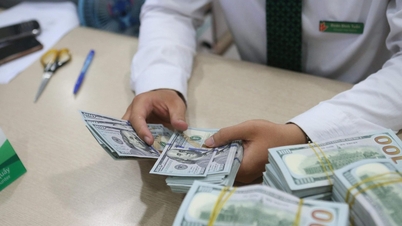
Private banks are still heavily investing in the real estate sector. Photo: Nam Khanh . |
Data from the Q1/2026 financial reports of 14 listed commercial banks, which include disclosures on loan portfolios, shows that real estate loans at this group of banks continue to expand strongly, but the allocation strategies of each bank differ significantly.
5 leading banks
Specifically, in just the first three months of 2026, the total outstanding real estate loans (including real estate business loans and construction loans) reached over 1.58 trillion VND , an increase of nearly 7% compared to the end of 2025. This figure reflects the continued attractiveness of the real estate sector to bank capital, despite the market still facing numerous challenges.
Of the total outstanding loans mentioned above, loans for real estate business reached 1 trillion VND (accounting for 63.2%), while loans for construction reached 581,068 billion VND , equivalent to the remaining 36.8%.
Of these, the top 5 banks, includingSHB , VPBank, Techcombank, MB, and HDBank, hold a total of nearly 1.18 trillion VND in outstanding loans, accounting for 74.4% of the total size of the 14 banks surveyed.
If we consider only real estate business loans, VPBank stands out as the most positive growth unit. The bank's outstanding real estate business loans reached VND 238,473 billion as of March 31st, an increase of VND 31,046 billion , equivalent to a 15% increase in just one quarter, which is also the largest credit growth rate in the entire system.
SHB ranked second with outstanding loans of VND 210,374 billion , an increase of VND 5,060 billion (+2%). MB recorded the second largest absolute increase after VPBank, adding VND 10,707 billion (+9%), bringing its outstanding loans to VND 131,896 billion . HDBank also increased by VND 8,028 billion (+11%), raising its total real estate loan outstanding to VND 78,196 billion .
Notably, Techcombank, which was once one of the banks with a high proportion of real estate loans, bucked the trend by reducing its outstanding loans from VND 207,027 billion to VND 198,854 billion , a decrease of VND 8,173 billion (-4%), dropping to third place.
Among medium-sized banks, TPBank recorded the highest growth rate in percentage terms with an increase of 18%, bringing its outstanding loans to VND 37,902 billion . MSB increased by VND 1,820 billion to VND 30,343 billion ; VIB increased by VND 2,919 billion to VND 24,007 billion ; BVBank increased by VND 720 billion to VND 23,808 billion ; and PGBank increased by VND 669 billion to VND 5,205 billion .
Conversely, Kienlongbank recorded an 18% decrease, equivalent to a reduction of VND 1,413 billion , bringing its real estate loan balance to VND 6,349 billion at the end of the first quarter. LPBank also saw a slight decrease of VND 373 billion , down to VND 14,722 billion .
| OUTSTANDING REAL ESTATE LOANS AT BANKS AS OF THE END OF Q1/2026 | |||||||||||||
| Source: Financial statements of commercial banks, Q1/2026. | |||||||||||||
| Label | VPBank | SHB | Techcombank | MB | HDBank | TP-Bank | MSB | VIB | BVBank | LPBank | Kienlongbank | PGBank | |
| Outstanding loans for real estate business | billion dong | 238473 | 210374 | 198854 | 131896 | 78196 | 37902 | 30343 | 24007 | 23808 | 14722 | 6349 | 5205 |
Real estate will remain attractive to investment capital over the next 10 years.
While data from 14 listed commercial banks that have published explanatory notes have shown a significant increase in real estate lending at some banks, macroeconomic data from the Ministry of Construction paints an even clearer picture.
According to the latest report published by the Ministry, as of February 28th, the total outstanding credit for real estate business activities across the entire banking system reached approximately 2,235 trillion VND , an increase of 11.7% compared to the fourth quarter of 2025, equivalent to an increase of over 233,000 billion VND . Compared to the same period last year, the increase reached 43%.
This figure is even more striking when considered in the context of overall credit growth. According to data from the State Bank of Vietnam, credit growth across the entire economy in the first two months of the year reached only 1.4%. This means that real estate credit is growing at a rate more than eight times higher than the overall average.
In terms of capital utilization structure, urban development and housing projects led with nearly VND 784,000 billion , accounting for 35% of total outstanding loans and increasing by 24.1% compared to Q4/2025. This was followed by loans for land use rights ( VND 255,352 billion ), industrial parks and export processing zones (over VND 139,000 billion ), and tourism, ecological, and resort projects ( VND 84,281 billion ).
The Ministry of Construction assesses the concentration of capital in the housing and urban development segments as a positive sign, reflecting that investors are accelerating project implementation and signaling the potential for improved supply in the near future.
Given these figures, at the 2026 annual general meetings of commercial banks, many questions were raised regarding the principles of lending to the real estate sector.
VPBank Chairman Ngo Chi Dung assessed that Vietnam's urbanization rate is currently still below 40%, significantly lower than China's approximately 77%. Therefore, the demand for housing in the next 10-20 years will remain very high.
He noted that real estate is not a homogeneous market but comprises many different segments such as resort properties, industrial parks, commercial properties, and residential properties; within residential properties alone, there are many groups ranging from social housing, mid-range to high-end and ultra-high-end.
The demand for housing over the next 10-20 years remains very high.
VPBank Chairman Ngo Chi Dung
"We cannot view real estate as a homogeneous entity. There are segments that serve investment needs, but there are also segments that serve actual housing needs. The important thing is to correctly identify the segments that meet the real needs of society," Mr. Dung said.
Based on that, VPBank has determined that it will continue to consider real estate as an important sector, but will adjust its strategy to be more selective, prioritizing segments that meet the real needs and affordability of the majority of the population.
Techcombank Chairman Ho Hung Anh also acknowledged that real estate will continue to be a growth driver for at least the next 5-10 years, but emphasized that the bank only finances projects with complete legal documentation and good liquidity.
CEO Jens Lottner added that Techcombank tightly controls cash flow, only disbursing funds when the end buyer, the purpose of the capital, and the level of suitability to the actual market demand are clearly identified, and projects that cannot demonstrate sufficient demand will be rejected.
In the state-owned banking sector, Vietcombank stated that its credit orientation is clearly categorized, prioritizing housing projects that serve real needs at reasonable prices, while strictly controlling speculative loans.
This bank focuses on three main pillars: industrial and export processing zones (linked to attracting FDI and exports), tourism and resorts (a driver of the local economy), and social housing and office space in major cities. Notably, social housing is also identified as a target in the ESG strategy, contributing to the stability of social security for low-income earners and workers.
Source: https://znews.vn/ai-dang-bom-von-manh-cho-bat-dong-san-post1655311.html


![[Video] Sunset at Lap An Lagoon – Where the sun sets over the fishing nets](https://vphoto.vietnam.vn/thumb/1200x675/vietnam/resource/IMAGE/2026/05/31/1780192137701_beach-landscape-sea-water-nature-grass-745871-pxhere-com.jpeg)













![[Video] Sunset at Lap An Lagoon – Where the sun sets over the fishing nets](https://vphoto.vietnam.vn/thumb/800x450/vietnam/resource/IMAGE/2026/05/31/1780192137701_beach-landscape-sea-water-nature-grass-745871-pxhere-com.jpeg)














































![[Video] Sunset at Lap An Lagoon – Where the sun sets over the fishing nets](https://vphoto.vietnam.vn/thumb/402x226/vietnam/resource/IMAGE/2026/05/31/1780192137701_beach-landscape-sea-water-nature-grass-745871-pxhere-com.jpeg)




























Comment (0)