

On April 8th, FTSE announced that Vietnam had passed its mid-term review and was officially upgraded to a Secondary Emerging Market. This decision will take effect from Monday's trading session, September 21st, 2026. The transition will be implemented in four phases, starting in September 2026.
According to the roadmap, index investment funds will begin disbursing funds into the Vietnamese market in four phases as follows: September 21, 2026 (10% allocation), March 22, 2027 (20%), June 21, 2027 (35%), and September 20, 2027 (35%).
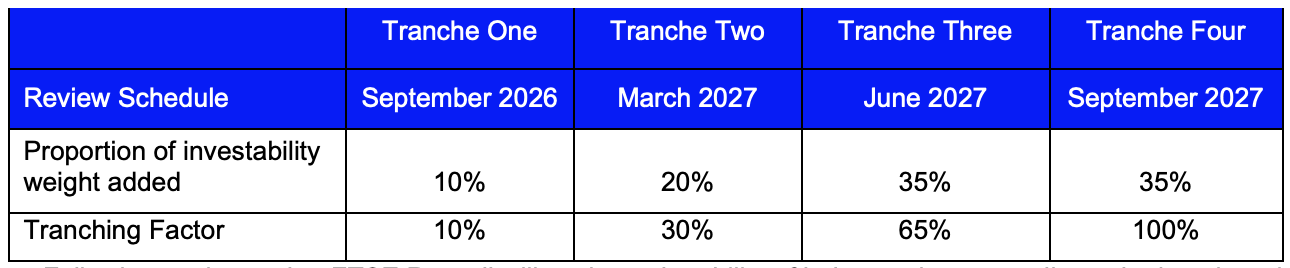 |
| Capital allocation schedule and investment weighting. Source: FTSE |
FTSE also announced the expected weighting of Vietnamese stocks in its four main indices, specifically: FTSE Global All Cap (0.037%); FTSE Emerging All Cap (0.35%); FTSE All-World (0.024%) and FTSE Emerging (0.227%).
According to data from the SSI analysis team, research on previously upgraded markets such as Qatar, UAE, Kuwait, Saudi Arabia, Romania, and Iceland shows that short-term market performance after upgrading is inconsistent, with some markets experiencing corrections in the first year.
However, in the medium term, most have yielded significant returns, around 20-50% within 3 years. This suggests that upgrades typically act as a medium-term growth driver, rather than creating an immediate effect, SSI noted.
In reality, market performance is still primarily determined by fundamental factors such as the macroeconomic environment, earnings growth prospects, and valuation levels. In these respects, Vietnam is outperforming many other markets in its group thanks to its solid macroeconomic foundation, positive earnings prospects, and relatively attractive valuations.
More importantly, beyond the short-term price volatility, the FTSE Russell upgrade is a fundamental milestone, contributing to the standardization of Vietnam's capital market infrastructure according to international standards.
This improvement is expected to enhance market credibility and attract more stable, long-term foreign capital flows, thereby supporting the sustainable development of the stock market. After FTSE Russell, MSCI will be the next strategic milestone. The MSCI reclassification process will depend on Vietnam continuing to promote reforms, especially in areas such as market access, transparency, and operational standards, in order to move closer to international best practices.
In the short-term outlook, the upgrade of the Vietnamese stock market remains a positive supporting factor for the market this April, alongside relatively positive expectations for Q1/2026 earnings growth, the prospect of de-escalation of the US-Israel and Iran conflicts, and investor expectations regarding the new government .
However, SSI also forecasts that the bullish momentum is likely to weaken in the second half of the month. Historically, seasonal factors also show that April is usually a cautious period for the market, with the average percentage of stocks increasing in price reaching only about 47.7% – the second lowest level of the year, only higher than October.
This seasonal "downturn" usually stems from the market having absorbed a certain amount of business plans after the shareholder meetings, coupled with profit-taking activity during the period of first-quarter earnings announcements.
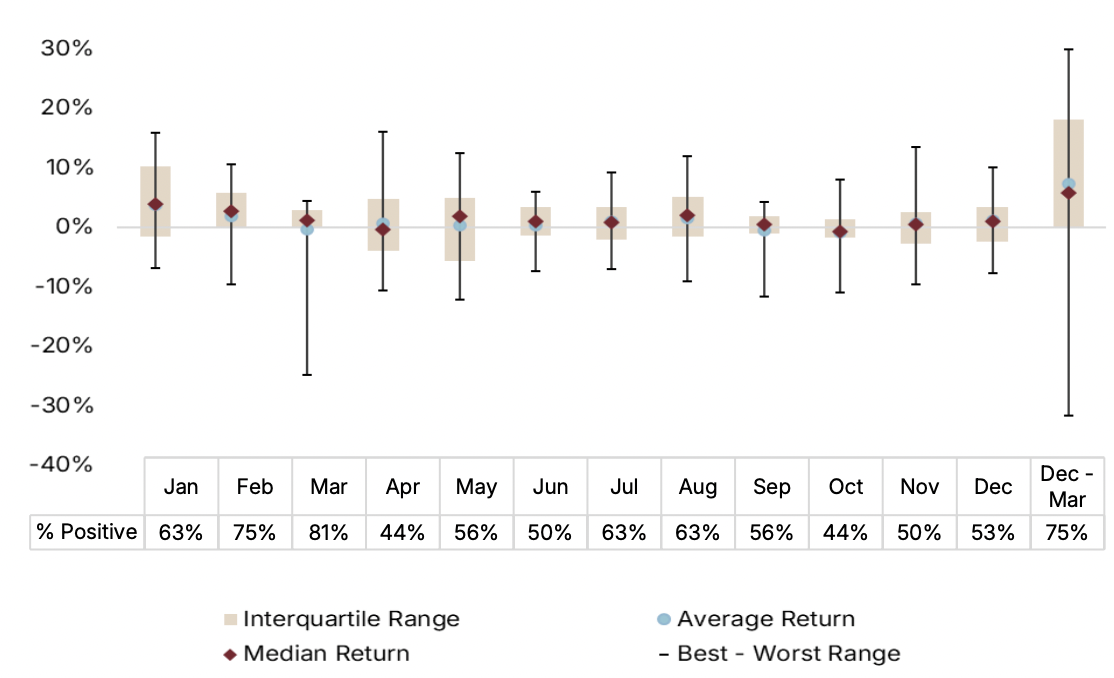 |
| Monthly fluctuations of the VN-Index (2010 - 2025). Source: SSI |
As of early April 2026, the VN-Index is trading at a projected P/E ratio of approximately 12.0x, significantly lower than the 10-year average of 14.0x. Simultaneously, the discount offered by the Vietnamese market compared to other ASEAN markets is also widening.
If we exclude Vingroup's group of stocks (VIC, VHM, VRE), the market valuation could even fall to around 10.5x, thus forming a relatively attractive valuation range based on fundamentals. However, in previous sell-offs, such as in 2020, 2022, and 2025, the forward P/E ratio had at times bottomed out in the 9-10x range.
With market liquidity still under pressure and interest rates rising, and 12-month deposit rates exceeding 8%, the room for support from valuation factors may remain limited.
Therefore, although the current valuation level has become significantly more attractive and increasingly convincing on a relative comparative basis, the risk of a short-term downward correction cannot be completely eliminated and may not yet be fully reflected in the share price, SSI noted.
Source: https://baodautu.vn/chung-khoan-thang-4-don-luc-do-tu-thong-tin-nang-hang-d564919.html

![[Photo] Standing Committee member of the Party Central Committee Tran Cam Tu working with the Central Inspection Committee](https://vphoto.vietnam.vn/thumb/1200x675/vietnam/resource/IMAGE/2026/05/28/1779969579668_ndo_br_bnd-2495-jpg.webp)





























































































Comment (0)