

The series of articles "The Journey to Bring Our Heroes Back to Their Homeland" was awarded the B Prize at the 17th National Journalism Awards - 2022.
A meaningful trip "back to our roots".
To commemorate the 75th anniversary of the Day of War Invalids and Martyrs, the leadership of the People's Electronic Newspaper decided to launch two series of articles on the work of searching for, excavating, and collecting the remains of Vietnamese martyrs, and the work of showing gratitude to the relatives of martyrs and those who have contributed to the revolution.
The online reporting team of the People's Daily was divided into two groups heading to the hotspots. One group went to Quang Tri to produce a series of articles on gratitude and remembrance, while the other group, consisting of journalist Nguyen Van Toan and his colleagues, proposed going to the hotspot of An Giang and received approval from the leadership. Before departing, Van Toan and his team prepared a detailed plan and proactively contacted information sources/witnesses in An Giang as well as the Ministry of National Defense .
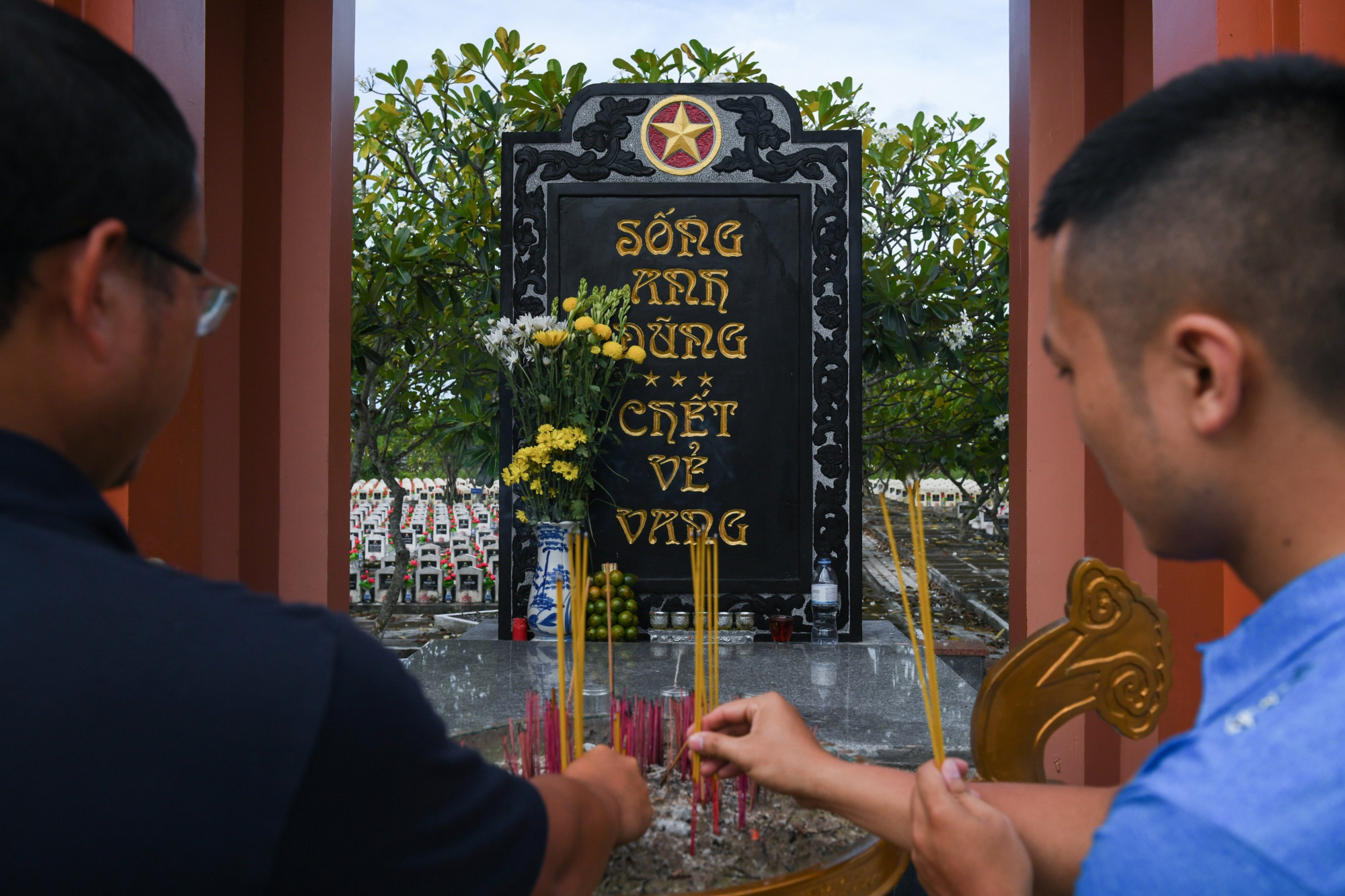
Reporters from the People's Daily Online offered incense at the Dốc Bà Đắc Martyrs' Cemetery.
The series "The Journey to Bring Our Heroes Back to Their Homeland" consists of 5 articles, created using a combination of written articles (reports), videos , and photo essays to fully utilize the strengths of modern online journalism. With this approach, the authors hope to create a positive impact on readers, thereby enhancing the quality and reach of the articles.
Journalist Van Toan shared that this wasn't his first field trip to the area for writing, but for him and his team members, the trip to An Giang held a very special meaning. It wasn't just a simple work trip; it was a "return to the roots," a visit to the heartland where thousands of Vietnamese People's Army soldiers bravely fell defending the southwestern border of the Fatherland.
"The ultimate goal the team aims for is to help readers gain a comprehensive understanding of the efforts of officers and soldiers in An Giang in particular to search for and collect the remains of fallen soldiers, as well as the determination of the Party and the State in general to bring the heroes and martyrs back to their homeland," journalist Van Toan said.
The series was completed after a trip lasting over a week, but to achieve that, the team of authors had to overcome many difficulties. Journalist Van Toan recounted: “Upon arriving in An Giang, contacting contacts and witnesses did not go as planned, forcing us to change our entire work schedule. This included traveling hundreds of kilometers by motorbike to the border district of Tinh Bien early in the morning, and then another journey of hundreds of kilometers back to the city that same night. Although exhausted from the long journey, the good news is that the team completed the work objectives.”
Coincidentally, the day journalist Van Toan and his colleagues arrived in An Giang coincided with the return of the K93 search team after a nearly six-month journey in Cambodia, having recovered 41 remains of fallen soldiers.
The reporters from Nhan Dan Newspaper focused on interviewing key figures and historical witnesses. These included Lieutenant Colonel Le Dac Thoa, Political Officer of Team K93, who recounted moving stories of the K93 search force since its inception; Colonel Pham Quang Trung (Tu Trung), former Team Leader of K93, who was involved with the team from its early days; and Colonel Huynh Tri (Hai Tri), former Head of Political Affairs of the An Giang Provincial Military Command, who dedicated 20 years after retirement to searching for his comrades. Over the past nearly 20 years, Colonel Huynh Tri and Team K93 have found 2,533 sets of remains of fallen soldiers, of which 275 have been identified.
Offering incense to pay tribute to the heroes and martyrs who fell for peace, independence, and freedom.
The journey to the Dốc Bà Đắc Martyrs' Cemetery in Thới Sơn commune, Tịnh Biên district, An Giang province, was perhaps the most emotionally impactful trip for journalist Văn Toản and his team of reporters. Dubbed the Trường Sơn Cemetery of the Bảy Núi region of An Giang, it contains the remains of over 8,000 soldiers from all three regions of Vietnam – North, Central, and South – who sacrificed their lives during various wars; the majority of whom were Vietnamese volunteer soldiers who fell in the war to defend the southwestern border and the war against the Pol Pot genocidal regime.
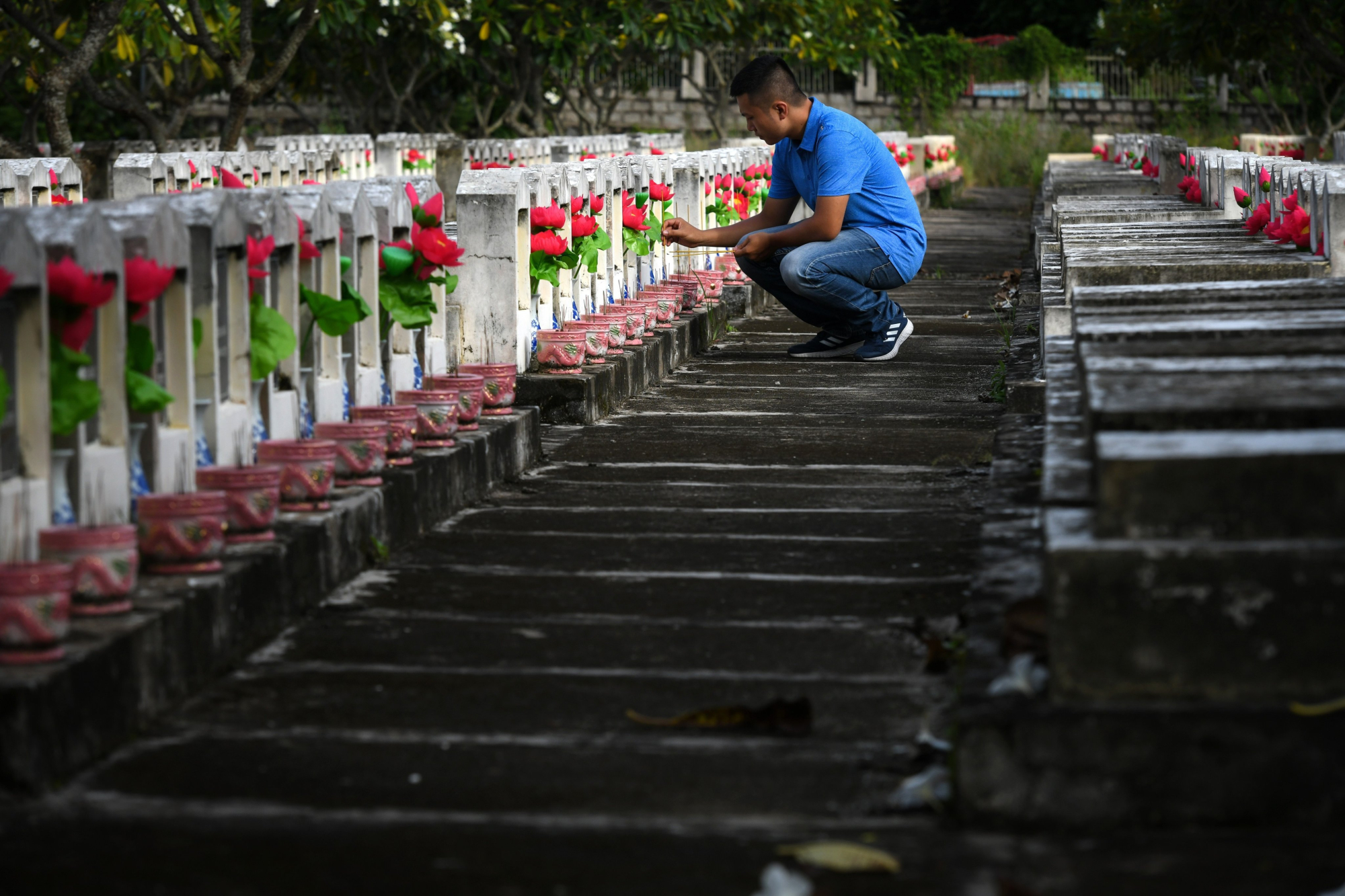
For journalist Nguyen Van Toan, the field trip to An Giang held a very special meaning.
“Arriving at the Dốc Bà Đắc Martyrs' Cemetery in the historic last days of July, we stood silently amidst the vast afternoon breeze. As far as the eye could see, the tombstones, painted yellow, lay densely packed and perfectly aligned. Beside the incense burners were plastic lotus flowers arranged respectfully. Around them, rows of frangipani and white frangipani flowers had bloomed brightly, making everyone feel even more acutely the pain and loss of war,” journalist Văn Toản recalled.
Mr. Van Toan said that, heartbreakingly, out of more than 8,000 graves, nearly 5,000 bear the inscription: "Martyr whose information has not been identified." More than half of these heroes, even after being brought back to their homeland, share this fate of anonymity. Many martyrs have names but no hometown or unit name, or vice versa. Many martyrs have personal belongings but no name or address... In addition, the cemetery has hundreds of empty burial plots ready to receive martyrs returning to their motherland.
Journalist Van Toan said emotionally, “The war ended more than 40 years ago. And for all those years, our comrades have remained buried in foreign lands. At this cemetery, hundreds of remaining comrades have built their ‘homes’ to await their return to the embrace of the Fatherland. The fragrant incense, the pure white frangipani flowers, and tens of thousands of tombstones lying side by side in perfect rows… truly leave an unforgettable impression and emotion.”
As the person primarily responsible for the images in this series, photojournalist Thanh Dat stated that there have been quite a few articles and reports researching the issue of searching for the remains of Vietnamese martyrs. Therefore, he needed to change his perspective and approach the images from a different angle regarding the search and collection of martyrs' remains in An Giang in particular, and Vietnam in general, today.
“Standing in front of the Doc Ba Dac cemetery to film, my colleagues and I couldn't hold back our tears at the sight of thousands of tombstones densely packed and neatly arranged. Most of these young men died at the tender age of nineteen or twenty, but sadly, half of them bear nameless tombstones. Some left behind elderly mothers in their hometowns during the harvest season, others put aside their books and pens, abandoning their youthful dreams to embark on this journey,” shared Thanh Dat.
The series "The Journey to Bring Our Heroes Back to Their Homeland" carries a profound message to all the public and readers: The peaceful life we enjoy today was bought with the bones, blood, and youth of hundreds of thousands of heroes and martyrs who fell. Some heroes and martyrs have been recognized, but others remain unidentified, still lying somewhere deep beneath the cold earth…
The responsibility of today's generation is to never forget the immense sacrifices of previous generations, and to do even better in showing gratitude to the families of martyrs and those who have rendered meritorious service, in order to somewhat comfort and alleviate the pain of losing loved ones. As for soldiers in peacetime, they still harbor a deep concern: "As long as there is information about our comrades, we will continue to search!"
Hoa Giang
Source


![[Photo] Prime Minister Pham Minh Chinh presides over a meeting on private sector economic development.](/_next/image?url=https%3A%2F%2Fvphoto.vietnam.vn%2Fthumb%2F1200x675%2Fvietnam%2Fresource%2FIMAGE%2F2025%2F12%2F20%2F1766237501876_thiet-ke-chua-co-ten-40-png.webp&w=3840&q=75)






























































Comment (0)