

Yesterday (April 21), Reuters reported that Japan announced the biggest overhaul of its defense export regulations in decades, removing restrictions on overseas arms sales and paving the way for the export of warships, missiles, and other weapons.

Japanese F-2B fighter jet
Photo: Jerry Gunner
The period of isolation ended.
This move strengthens the foundation for a breakthrough in Japan's defense industry, marking a new shift away from the constraints that were part of Tokyo's post-World War II security policy. This shift is being undertaken in parallel with Japan's increased defense cooperation with other parties in Asia amid the rise of China.
In an interview with Thanh Nien newspaper yesterday, Professor Stephen Robert Nagy (International Christian University - Japan, scholar at the Japan Institute for International Studies) analyzed: "Although regulations have been significantly relaxed, Japan still maintains certain control barriers. For example, the export of the new generation fighter jet is currently limited to countries that have signed defense treaties with Japan and are not directly involved in conflicts. However, this reform marks a definitive end for Tokyo to the era of strict defense isolationism."

JS Mogami is a Japanese Mogami-class corvette.
Photo: Hiroshi Miyaji
Similarly, in an interview with Thanh Nien newspaper , Dr. Satoru Nagao (Hudson Institute, USA) assessed: "Japan is relaxing its arms export regulations because the regulations are inherently impractical. A typical example is the recent agreement for Japan to export Mogami-class warships to Australia, where the regulations stipulated that both sides had to adopt a 'joint development' model instead of arms exports. But in essence, it's still an arms export."
"Meanwhile, Japan needs to export weapons to support the strengthening of military capabilities for its allies and partners in the face of new challenges in the region. Exporting weapons requires training, maintenance, and the supply of ammunition for operation, so many restrictions need to be removed. Furthermore, the global defense industry is experiencing strong growth. Overseas markets can offer many opportunities and sustain Tokyo's weapons production lines. Recently, the US has been pushing Japan to share the burden of regional security, so the need to relax regulations for arms exports is even greater for Tokyo," Dr. Nagao further analyzed.
Breakthrough opportunity
Over the years, Tokyo has steadily increased its arms exports while gradually removing legal restrictions on the matter. In 2023, Japan approved a plan to allow the export of fighter jets, missiles, and certain lethal weapons to 12 countries, including Australia, India, the United States, the United Kingdom, Germany, France, Italy, and five Southeast Asian nations. By March 2024, Japan relaxed its strict regulations on military equipment transfers to allow the export of its next-generation fighter jets, which it is developing, to the United Kingdom and Italy. Also in 2024, Japan announced it would sell Patriot missiles to the United States to help the Pentagon replenish its weapons stockpile, which was depleted due to funding for Ukraine.
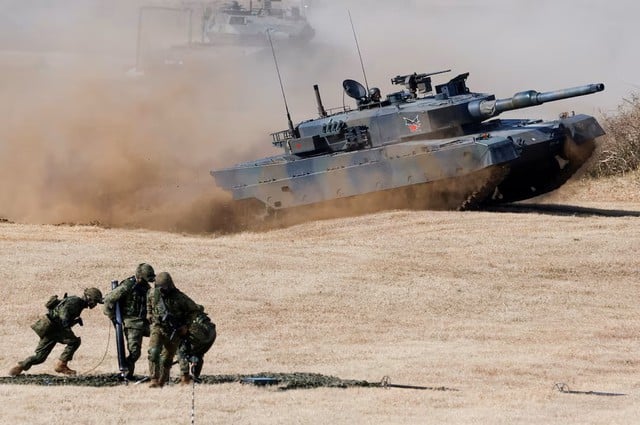
Japanese T-10 tanks during a military exercise last January.
Photo: Reuters
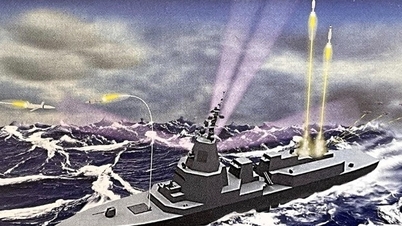
Recently, a contract was signed on April 18th between Japan and Australia for the supply of Mogami-class frigates. Under the agreement, Japan will provide 11 of these warships to Australia, with a total order value of up to US$6.8 billion. With a full-load displacement of over 5,000 tons, the Mogami-class frigates possess stealth capabilities and incorporate many advanced technologies and powerful weaponry.
In fact, Japan has developed a world- leading defense industry for many years, producing many types of modern weapons. To date, Japan has assembled its own F-35 fighter jet and is simultaneously developing its own sixth-generation fighter jet. Previously, the country manufactured the Mitsubishi F-2 fighter jet from the American F-16 and developed the Mitsubishi P-1 anti-submarine aircraft to replace the P-3 Orion supplied by the US.
Tokyo has also upgraded its Izumo-class helicopter destroyers to become aircraft carriers capable of carrying the fifth-generation stealth F-35 fighter jets. Its diesel-electric submarine fleet is also considered state-of-the-art and possesses powerful combat capabilities. Similarly, Japan's destroyer classes also boast modern and powerful weapon systems. Furthermore, its T-10 main battle tank consistently ranks highly globally.
With such a foundation, boosting arms exports could help Japan enhance the effectiveness of its diplomatic activities as it continuously promotes military cooperation with various parties in the region. Through this, Tokyo can further assert its important role in military security in the Asia-Pacific.
Japan has a clearer path to arms exports after lifting restrictions.
The global arms market is undergoing significant changes.
According to a report published in March by the Stockholm International Peace Research Institute (SIPRI, Sweden), the volume of major weapons transfers between countries between 2021 and 2025 increased by 9.2% compared to the period from 2016 to 2020. European countries more than tripled their arms imports, making them the largest arms recipients. Total exports from the United States, the world's largest arms supplier, increased by 27%.
Accordingly, while tensions in Asia, Oceania, and the Middle East continue to drive large-scale arms imports, the sharp increase in arms flows to European countries has also fueled global arms transfers. The arms transfers to Ukraine since 2022 are the most obvious example, but most other European nations have also begun importing significantly more weapons to bolster their military capabilities due to concerns about Russia.
Source: https://thanhnien.vn/co-hoi-but-pha-cua-dai-gia-vu-khi-nhat-ban-185260421222922749.htm


![[Photo] General Secretary and President To Lam presides over the meeting to approve the draft report on the results of the second inspection by the Politburo of the Standing Committee of the Hanoi City Party Committee.](https://vphoto.vietnam.vn/thumb/1200x675/vietnam/resource/IMAGE/2026/05/26/1779789811432_a2-bnd-4430-9620-jpg.webp)






























































Comment (0)