


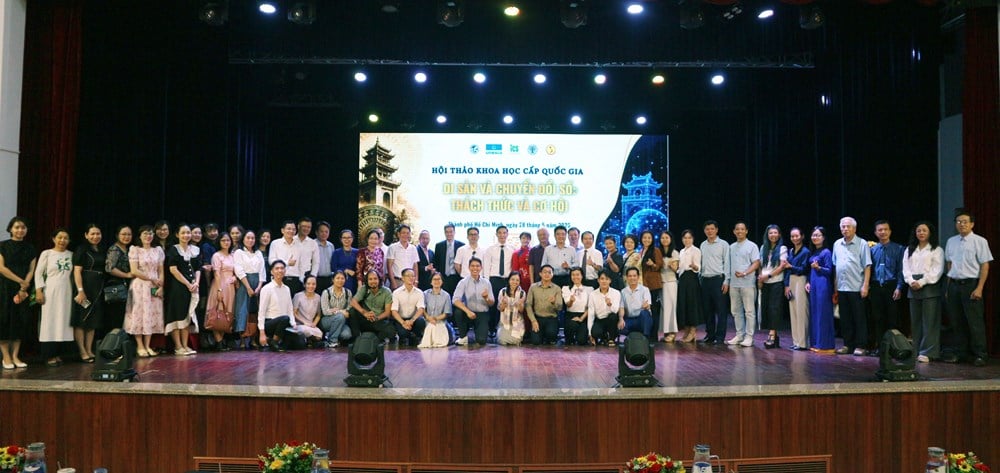
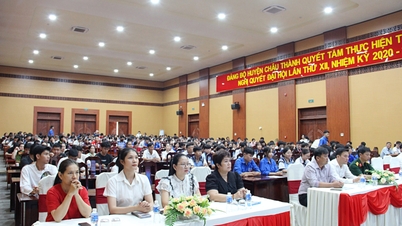
The workshop attracted the participation of numerous researchers, cultural experts, managers, lecturers, technology businesses, and representatives of cultural institutions nationwide, focusing on discussing the role of digital transformation in preserving and promoting cultural heritage values in the new context.
In his welcoming remarks, Associate Professor Dr. Lam Nhan, Rector of Ho Chi Minh City University of Culture, stated that in the context of globalization, the fourth industrial revolution, and the strong development of digital technology , cultural heritage is facing many great opportunities to be protected, disseminated, and promoted through new methods.
According to Mr. Lam Nhan, from national digital transformation programs to the Vietnam Cultural Development Strategy to 2030, all affirm the role of technology, innovation, and digital knowledge in enhancing Vietnam's soft power in the era of international integration.
Many museums, libraries, archives, historical sites, and cultural institutions are now gradually applying digital technology to digitize artifacts, build databases, develop digital museums, online exhibitions, artificial intelligence (AI), virtual reality, and interactive digital platforms to expand accessibility for the public, especially young people.
"Digital transformation not only contributes to more effective heritage preservation but also opens up opportunities to connect heritage with education, cultural tourism, creative media, and the knowledge economy ," Associate Professor Dr. Lam Nhan emphasized.

However, he also noted that the digital transformation process in the heritage sector still raises many issues that require further research, such as perfecting policies and legal frameworks, standardizing data, ensuring interoperability and sharing of digital resources, training human resources, balancing conservation and exploitation, and preserving human values and cultural identity in the digital environment.
Through a video submitted to the workshop, Jonathan Baker, Head of the UNESCO Office in Vietnam, highly appreciated the workshop's role in bringing together researchers, cultural workers, policymakers, and technology experts to exchange ideas and seek human-centered approaches to digital heritage.
Jonathan Baker argues that digital technology is transforming the way cultural heritage is preserved, interpreted, and disseminated. From digital archives and online exhibitions to artificial intelligence and immersive technologies, digital innovation is opening up numerous opportunities to connect heritage with education, creativity, and younger generations.

However, according to UNESCO representatives, this process also requires caution regarding issues such as authenticity, accessibility, ethics, and the protection of cultural identity in the digital space.
UNESCO also acknowledged Vietnam's increasingly strong efforts in promoting innovation while preserving the diversity and richness of its cultural heritage for future generations. "UNESCO is committed to continuing to work alongside Vietnam and its partners in promoting the role of culture as a driver of sustainable development in the digital age," emphasized Jonathan Baker.
Professor Dr. Le Hong Ly, President of the Vietnam Folk Arts Association, believes that science, technology, and engineering are always important breakthroughs not only for socio-economic development but also contribute to promoting cultural progress.
Professor Le Hong Ly shared that many cultural researchers used to dream of having modern recording and filming equipment to authentically preserve rituals, festivals, folk melodies, voices, and traditional cultural practices. However, due to limited technological resources, many "living human treasures" were lost before they could be fully preserved.

"Now that we have modern technologies, many traditional cultural values have disappeared. That is very regrettable. Therefore, digital transformation for the cultural sector today is essential to fulfill the aspirations that many generations of researchers have pursued," said Professor Le Hong Ly.
According to him, Vietnam's cultural heritage is not only a spiritual asset that contributes to preserving national identity, but also an important resource for economic development. Especially in the context of the cultural industry increasingly asserting its role in the national economy, exploiting traditional cultural heritage is a key area in the development of the cultural industry.
At the workshop, delegates focused on discussing topics such as assessing the current state of information technology application and digital transformation in the field of cultural heritage; identifying the role of digital transformation in heritage preservation and promotion; sharing domestic and international experiences; and proposing solutions for applying technology to serve sustainable development in culture, economy, tourism, and society.

The workshop also aims to build a network connecting experts, software engineers, businesses, and organizations working in the field of heritage preservation and promotion.
On this occasion, Ho Chi Minh City University of Culture also signed a cooperation agreement with Hanoi University of Culture to strengthen coordination in training, research, and development of activities related to culture, heritage, and digital transformation.
Source: https://baovanhoa.vn/van-hoa/co-hoi-mo-rong-khong-gian-van-hoa-232290.html
![[Photo] Standing Committee member of the Party Central Committee Tran Cam Tu working with the Central Inspection Committee](https://vphoto.vietnam.vn/thumb/1200x675/vietnam/resource/IMAGE/2026/05/28/1779969579668_ndo_br_bnd-2495-jpg.webp)



































































Comment (0)