

The Legend of the Goddess of the Treasury
In the temple, in the most prominent and easily visible location, is recorded the legend of Lady Chua Kho from the Tran Dynasty. Her name was Ly Thi Chau (commonly known as Chau Nuong), and she was talented and beautiful. Her father held an official position under the Tran Dynasty in Thang Long (Hanoi). She often assisted her father with daily treasury records.
 |
The gate of Phu Temple (Ba Chua Kho Temple) is located at the end of Nguyen Van Cu Street, Bac Giang Ward. |
At the age of 22, Chau Nuong married an official named Tran Thai Bao, who held the position of District Chief in Hoan Chau (Nghe Tinh).
In 1285, when the Mongol invaders attacked Vietnam, Tran Thai Bao was ordered to lead the army against them. His wife, Chau Nuong, assisted him in commanding the defense forces and protecting the food supply depot. Despite several enemy attacks, the depot remained well-protected, and she ensured the soldiers received adequate supplies.
During this time, Chau Nuong disguised herself as a man and, together with her husband, fought many victorious battles, inflicting heavy losses on the enemy. Due to their great service, Chau Nuong and her husband were summoned back to the capital. Her husband was appointed to the position of Vanguard Guard protecting the king, while she was entrusted with the entire treasury of the imperial court.
 |
The former Phu Temple. Archival photo taken by the French. |
During the third Mongol invasion, Tran Thai Bao, then the military governor defending Thang Long, fought bravely and sacrificed his life. The Tran dynasty king and his court retreated to Thien Truong. Lady Chau Nuong remained behind to store military supplies and unfortunately fell into enemy hands. She committed suicide to preserve her honor.
When the Mongol invaders were defeated by the Tran dynasty and forced to retreat, Lady Chau Nuong was posthumously bestowed the title of "Princess in Charge of the National Treasury" by the king. Her achievements are recorded in historical texts, and in some places, people have erected temples to worship her.
On the front lines against the Mongol invaders on the Nhật Đức River, there was a granary located in Tiền Môn Street, Phủ Lạng Thương. In remembrance of the contributions of Lady Châu Nương, after her death, the people built a temple right next to the Phủ Lạng Giang citadel, in Châu Xuyên commune, Thọ Xương district, Kinh Bắc province. This temple is located at the site of the current ancient temple in Tiền Giang 1 residential area, Bắc Giang ward, Bắc Ninh province.
Ancient traces remain
The Phu Temple today is just a small temple located right in the middle of the city. However, according to historical records and accounts from the elders of the area, in ancient times, the temple was built quite grandly, in the style of "inner courtyard, outer enclosure," consisting of five front halls and a rear sanctuary.
 |
The main hall of Phu Temple. |
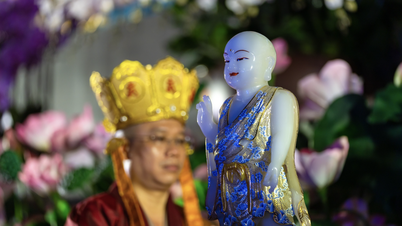
In front of the main hall are two bell towers on either side. The temple gate has a horizontal plaque inscribed with eight characters: "Tien Giang military history/ Three realms sacred and sacred." Inside the temple are statues of the Goddess of the Treasury, the Immortal Boy and the Jade Girl, made of wood painted in red and gold, and three chambers containing various Buddha statues.
In front of the spacious courtyard stands an elaborate triple-arched gate, followed by a large lotus pond. Particularly noteworthy is an ancient banyan tree to the south of the temple; according to the elders, its branches and roots spread wide, almost completely covering the temple grounds, attracting herons and egrets to roost there.
Through the vicissitudes of history and natural disasters, the temple has suffered much damage and deterioration, but its sacredness remains intact.
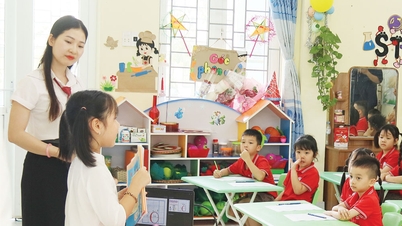
For a long time, the temple was used for various purposes, including at one point as a school. Strangely, the students there, though incredibly mischievous, kept all the Buddha statues and religious artifacts neatly arranged, and almost never did any of the children dare to vandalize them.
My house is near the temple. When I was little, I also studied there. I remember the teacher just telling us, "This is a place for worshipping the ancestors; you mustn't knock over anything or take anything away." So for all those years of schooling, everything in the temple remained exactly as it was. Occasionally, the teachers would light incense, clasp their hands in prayer to the "ancestors," and we children would do the same, even though we didn't understand.
 |
The temple today. |
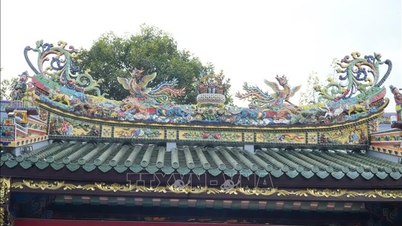
In 2008, the temple was handed over to the local people for restoration and worship. Thanks to the generous donations of the people, the temple has now been restored on its original foundation, covering an area of nearly 300 square meters, and has essentially retained some of its religious artifacts and original architecture. In 2012, Phu Temple was classified as a provincial-level historical and cultural relic.
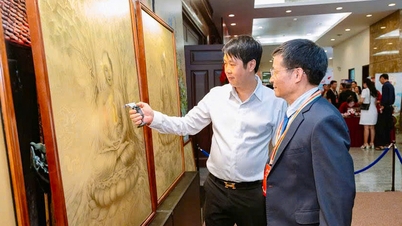
The temple currently houses a portrait statue of Lady Chua Kho, with five altars arranged horizontally in each section. Each altar contains a wooden statue painted in red and gold. In addition to horizontal plaques and couplets, each altar has an elaborately carved wooden archway. Notably, the temple currently displays two large oil paintings depicting the portrait of Lady Chua Kho Ly Thi Chau.
The first painting depicts her in the majestic and imposing attire of a female warrior, beside her pure white warhorse, with a female army charging into battle in the distance. Below are two poems in Chinese characters praising her disguise as a man in battle and her great contributions. The second painting shows the transformed Saint Mother Chau Nuong, possessing vast supernatural powers and the ability to bless future generations.
Visiting Phu Temple to pray for peace.
Amidst the hustle and bustle of the city, Phu Temple still exudes the fragrant scent of incense every day. This is a place where, in the first moments of the new year, almost every local resident comes to light incense sticks, hoping for a peaceful and happy new year.
 |
In particular, business people visit the Phu Temple (Ba Chua Kho Temple) to "borrow blessings," hoping for good fortune and success in their business. For residents in the neighborhood, before going anywhere or doing anything, even before major family events, everyone goes to the temple to "report" and "ask" the goddess for her blessings to ensure everything goes smoothly. Ba Chua Kho has become an integral part of people's spiritual lives, a symbol of their aspirations for a smooth start, prosperity, and the accumulation and preservation of good fortune.
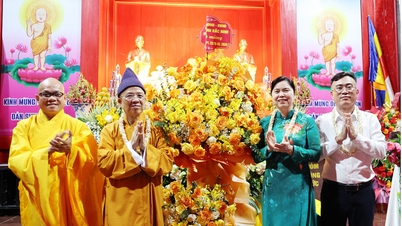
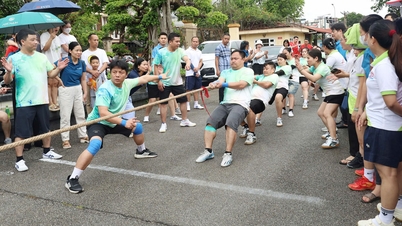
To commemorate the Goddess, the Phu Temple festival is held annually on the 11th and 12th of the second lunar month. This year's festival took place in a solemn and respectful atmosphere with many rich activities. Everyone in the town, no matter how busy they were, joined in the festivities. Visitors from far and wide also came to celebrate.
 |
The solemn ceremony includes rituals such as drumming and gong playing; offering incense and flowers to pray for a year of favorable weather, national peace and prosperity, and happiness and well-being for all families. The festive part features spectacular cultural programs with drum performances and musical and dance acts showcasing the rich national cultural identity.
In the heart of the city, there is a place where locals and tourists alike can find peace and tranquility; a sense of lightness and serenity upon arriving at the temple. Perhaps this is why the Phu Temple has been preserved, maintained, and continued by the local people for generations as a lasting cultural and religious value, contributing to a better life.
Source: https://baobacninhtv.vn/co-mot-ngoi-den-thieng-giua-long-pho-postid442455.bbg




































































Comment (0)