

The flood of perfect scores in the national high school graduation exam has made university admission cutoffs unpredictable. The multiple-choice exam questions have sparked controversy. Exam cheating in some localities remains difficult to control…
Are these the shortcomings that have arisen, are arising, and will continue to arise after 8 years of organizing the "2-in-1" exam, which combines high school graduation and university/college entrance exams?
Many questions are being raised regarding the national high school graduation exam. What is the most suitable approach that can ensure fairness and objectivity?

Shortcomings in the organization of the high school graduation exam.
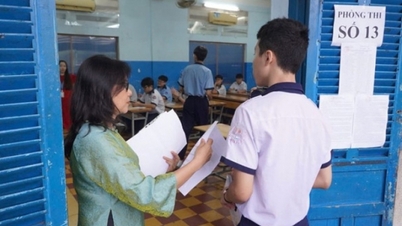
Since 2014, the Ministry of Education and Training officially decided to merge the high school graduation exam and the university entrance exam into one, with the expectation that universities could use the results of the high school graduation exam as a basis for university admissions.
However, Associate Professor Dr. Nguyen Kim Hong, former Rector of Ho Chi Minh City University of Education, believes that the goals of the high school graduation exam have not been achieved as expected: "The expectation regarding the use of high school graduation exam results for university admissions… is not very high, especially since the differentiation is not very high, particularly the lack of differentiation in the annual high school graduation exam."
Furthermore, the shift from essay-based exams to multiple-choice exams in 2017 resulted in a surge in perfect scores, with over 4,200 perfect scores – 70 times more than in 2016. These high scores caused a dramatic increase in university admission cutoffs, sometimes exceeding 30 points, catching many students and parents off guard.
In particular, the shift to multiple-choice math exams has sparked much controversy, as it fails to develop students' logical thinking, problem-solving, and critical thinking skills, and does not create fairness in learning and testing. Many students rely on luck rather than focusing on self-study.
Le Duc Tri, a first-year student at the Banking Academy in Hanoi , expressed: "With the current high school graduation exam format, all subjects, even Math, are tested using multiple-choice questions, so the exam scores do not accurately reflect students' academic abilities and do not foster logical thinking."
Many students in the class perform well academically but score at the top of their class in exams. Or, their high scores in graduation exams lead to very high entrance requirements for many universities, with 27 or 28 points needed to get admitted, and in some cases, even top-scoring graduates still fail to get into university."
According to some experts, the high school graduation exam is essentially a way to assess whether the quality of teaching and learning meets the requirements set by the State in the general education program. In reality, over 90% of students currently pass the graduation exam, and in many localities, this number even exceeds 100%.
While Vietnam is moving towards universal secondary education, one listener suggested that the quality of high school graduation only needs to be at an average level, and that there's no need to invest heavily in an exam or promote fierce competition among schools.
One listener commented: "Every year, regardless of the exam format—centralized or decentralized—the shortcomings become apparent, such as the high cost, meaning we're wasting too much money, trillions of dong already. Secondly, university admissions based on high school exam scores are not scientific at all, and therefore fail to meet the requirements. University admissions are not aligned with the high school exam. In my opinion, we shouldn't have the current expensive exam format; we should make it more cost-effective. University entrance exams should be separate."
Some opinions suggest that the current method of organizing the high school graduation exam needs to be reviewed, assessing its strengths and weaknesses, and then proposing solutions to address the issues and suggesting adjustments to the Government and the National Assembly to suit the actual situation.
The high school graduation exam needs reform.
Associate Professor Dr. Nguyen Kim Hong, former Rector of Ho Chi Minh City University of Education, believes that although the high school graduation exam has not met expectations in terms of using its results for university admissions due to a lack of differentiation, it remains very necessary.
" The national high school graduation exam is very important for ranking high schools and educational and training institutions , as well as assessing the learning situation of students. It helps identify subjects where students are weak so we can implement appropriate policies in subsequent years. Therefore, this is a necessary exam. However, we need to find a way to organize it in a way that is less tiring for candidates and does not create unnecessary costs for society."
Instead of holding the exam in one day, which wastes too much effort and travel time for students, the exam could be divided into several stages so that schools can implement it more easily. If we apply the development of information technology, and schools are autonomous and responsible, especially with honesty, we can completely organize the exam at each high school based on the national exam question bank. If we can do that, high school principals could issue high school graduation certificates or diplomas to students in the future," said Associate Professor Dr. Nguyen Kim Hong.
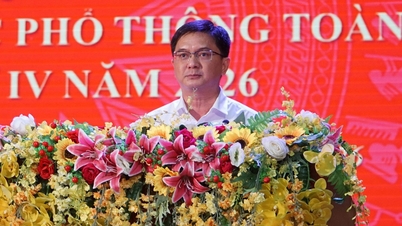
Currently implementing the new general education program, National Assembly representative, Professor Dr. Thai Van Thanh, Director of the Nghe An Department of Education and Training, believes that after 2025, the organization of the national high school graduation exam needs to be reformed to suit the actual situation:
"We will continue with this exam for another year. From 2025 onwards, we will still organize the 2-in-1 exam, but with a maximum of only 4 subjects: 2 compulsory and 2 elective. This will reduce pressure on students. The two elective subjects from the remaining 9 are in line with the curriculum and the spirit of the program, which is to develop students' qualities and competencies. Currently, we are testing 6 subjects," Mr. Thanh stated.
Mr. Dinh Quoc Binh, Principal of Luong The Vinh High School, believes that in the long term, the education sector needs a roadmap, preparation of human resources, selection of experts, and a gradual development of a question bank to create proactiveness in organizing the high school graduation exam: " Once we have built a sufficient question bank, we can organize the exam 1-2 times a year. In the future, it will still be the high school graduation exam, but on a regional and provincial/city basis, aiming for long-term sustainability. Universities, with their autonomy, can have various forms of admissions to suit their needs."
Based on his experience in the job application process, according to Dinh The Hung in Hanoi, a high school diploma is not a guaranteed ticket to employment at companies and businesses, so the organizational process can be simplified.
"If universities could organize their own exams with their own style and requirements, they could do so without necessarily relying on the results of the national high school graduation exam. In my opinion, a high school diploma is no longer sufficient for getting a job. If we could simplify things, we could just issue a graduation certificate to those who don't need to take the university entrance exam," Hung shared.
PV (VOV Traffic)
Source































![[Photo] Reception to welcome General Secretary and President To Lam and his wife on their State visit to the Philippines](https://vphoto.vietnam.vn/thumb/1200x675/vietnam/resource/IMAGE/2026/06/01/1780295488620_vna-potal-chieu-dai-chao-mung-tong-bi-thu-chu-tich-nuoc-to-lam-va-phu-nhan-tham-cap-nha-nuoc-toi-philippines-8798060-7855-jpg.webp)


































































Comment (0)