

Entrepreneur Dominic Scriven: A Unique Path and a Journey of Engagement with the Vietnamese Capital Market
At the beginning of the Year of the Dragon 2024, Dominic Scriven, Founder and Executive Chairman of Dragon Capital, shared insights into Dragon Capital's 30-year journey as well as his aspirations and plans for the Year of the Dragon, as the fund's name suggests.
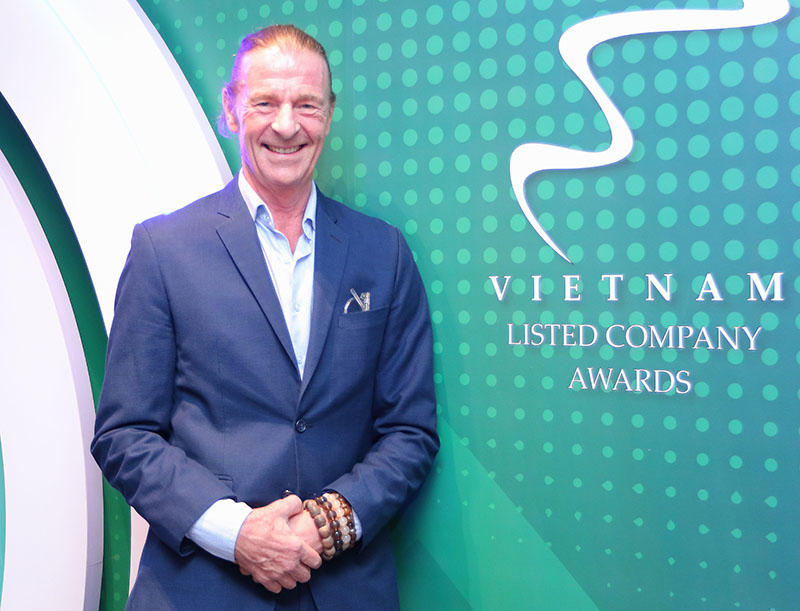 |
| Dominic Scriven, Founder and Executive Chairman of Dragon Capital. |
We met Dominic Scriven – a renowned British figure in the Vietnamese stock market, dubbed the "bridge builder bringing foreign capital into Vietnam" – at his office in one of the most beautiful buildings in District 1 (Ho Chi Minh City). Still maintaining his artistic style, with a subtly patterned shirt and his hair neatly tied back in a ponytail, he shared his insights, expectations about the market, and even the books he's currently reading...
Marking its 30th anniversary, the Year of the Dragon 2024 certainly holds great significance for Dragon Capital, wouldn't you agree, sir?
The Year of the Dragon is very significant to us because the Fund is named Dragon Capital ("Dragon" in English means dragon - ed.) and this year marks Dragon Capital's 30th anniversary.
Currently, Dragon Capital has 200 employees, some of whom were born after the company was founded. This made me realize that I need to think about the future, about concepts like "legacy," "inheritance," "responsibility," and "leaving a mark." The new year is also the time when we reflect most on these things.
2022 was an extremely difficult year for us. 2023 is more promising, but challenges remain. In our business, the main goal is to retain investors, persuade them to stay, and simultaneously seek new investors. Last year, we acquired some new investors, but some also left. Therefore, it can be said that 2024 will be a challenging year, but overall, Dragon Capital remains quite stable in terms of business performance.
Everyone is hoping that this year will be a year of recovery.
Over its 30 years of operation, what has set Dragon Capital apart from other investment funds in the market?
Whether an investment fund is considered successful depends on whether it achieves its goals. These goals are measured through various indicators. Our mission is to outperform all of the indicators set by our clients.
Another important aspect of investing is the long-term perspective. If someone wants to invest for a week, a month, or two, they don't need us. They can do it themselves. Those who want to invest for their children's future, for their education , for their parents' retirement, or to manage their savings – these are the clients we focus on supporting. And because of that, we also bear very high responsibilities.
Long-term responsibility also means not chasing today's profits. It's great to make a profit today, but avoiding risks and disasters tomorrow is far more important.
During the Covid-19 pandemic, many private investors participated in the stock market. However, the number of institutional investors gradually decreased, not only in Vietnam but also in other emerging economies . How did Dragon Capital respond to these challenges and capitalize on the opportunities arising from this trend?
During the pandemic, as people stayed home to avoid the virus and temporarily suspended work; everyone had smartphones, along with government support policies from all over the world. These factors fueled investment trends, leading to a sharp increase in the number of individual investors entering the market.
Technology gives individual investors more control over their future. With more information, they have more choices, and people like us have to provide even more information to investors.
Similarly, everyone can cook at home, but sometimes we need to eat out at restaurants to be served by professional chefs. We can buy medicine ourselves at the pharmacy, but sometimes we are forced to see a specialist. This shows that using services from professionals offers many benefits, as they are trained, experienced, dedicated, and accountable. And the same applies to investing; not everyone can manage and invest their own money.
We can't force people to come to us, we can only provide excellent service. This year, Dragon Capital is 30 years old. For about 25 years, we have mainly supported foreign investors. Dragon Capital's biggest investors are governments of European and Asian countries and large organizations.
In recent years, we have begun preparing to support Vietnamese investors. Dragon Capital has four funds specifically for Vietnamese investors: the DC Dynamic Securities Investment Fund (DCDS), the DC Dividend-Focused Equity Investment Fund (DCDE), the DC Bond Investment Fund (DCBF), and the DC Fixed Income Bond Investment Fund (DCIP).
In addition, we also have another interesting type of investment: ETFs (exchange-traded funds) – a more modern instrument. This type of investment is very popular in the US, Europe, China, etc. Dragon Capital has 3 ETFs, offering investors flexibility and diversification in portfolio management.
In addition, we have a long-term platform in the form of retirement funds, available for both individuals and businesses. This allows our clients to have options that suit their long-term financial goals and plans.
Could you share more information about Dragon Capital's pension fund?
Launching the first pension fund in Vietnam presents both an opportunity and a challenge for Dragon Capital. Pension funds are a long-term commitment, typically lasting around 20 years, so our focus is on building sustainable customer service.
Currently, our fund has approximately 100,000 account holders, of which 50,000 are active accounts. However, this number is only a small fraction of Vietnam's population of around 100 million people.
Our goal is to improve accessibility through Dragon Capital's applications for individual and corporate investors; and to ensure transparent management so investors know the status of their investments. Dragon Capital has invested heavily in its technology platform to serve Vietnamese investors. I believe that technology will be the key to the future.
Having been involved with Vietnam for over 30 years and known as the "bridge builder bringing foreign capital into Vietnam," what are your observations on the development of Vietnam's capital market in recent years and its prospects for the coming years?
The past 30 years have been a period of formation and development of Vietnam's capital market. Vietnam has focused on introducing its potential and investment opportunities to foreign investors, who have experience and knowledge of stocks, bonds, and market regulations.
 Whether an investment fund is considered successful depends on whether it achieves its goals. These goals are measured through various indicators. Our mission is to outperform all of the indicators set by our clients.
Looking ahead, we expect the Vietnamese capital market to mature and become a professional player.
Vietnam is ready to become a mature member of the global capital market, shedding its image as a "frontier" market. To put it figuratively, the Vietnamese capital market is no longer just toddling along on a bicycle, but will mature and grow stronger, eventually riding a motorbike or a car.
This development reflects Vietnam's aspiration to be recognized as an equal, confident, and respected member of the international financial market.
In fact, when deposit interest rates fall, people will look for alternative investment channels, such as real estate, bonds, stocks, life insurance, pension funds, etc. This is a natural trend, not only in Vietnam, but in all countries.
The Vietnamese stock market currently has 7 million accounts, of which approximately 3 million are active. This is still a small number compared to Vietnam's urban population of around 40 million and total population of approximately 100 million. Dragon Capital forecasts that the number of active investors will increase significantly in the coming years.
Having managed Dragon Capital for many years, did he learn from or draw inspiration from any particular fund manager or fund?
At Dragon Capital, we believe our path is unique and one-of-a-kind. We don't follow a single model of any fund. Instead, we value learning from many different successful examples, as each fund has its own strengths.
For example, BlackRock is the world's largest asset management firm, managing a portfolio of approximately $10 trillion in assets (about 5% of global GDP). They have many strategies worth learning from, from risk management and scaling operations to offering a diverse range of products.
However, our focus remains on leveraging collective ideas from the team to create a unique path within Vietnam's evolving capital market.
It is known that he enjoys reading. Could he share some of the books that have influenced his thinking and outlook on life?
I read a lot of books and am particularly drawn to three areas: history, philosophy and spirituality, and the natural world.
As I've gotten older, my fascination with Asian philosophy has grown. These fields offer profound insights into our existence and purpose. While history explains our past actions and events, philosophy delves deeper, questioning the nature of humanity and the essence of reality. For me, the natural world is a source of endless fascination.
Some of the books I've recently read, such as the intricate communication networks between trees or the ecological importance of fungi, offer truly amazing insights. They remind us that there is still so much we don't know about the planet and the universe.
As we grow older, we often realize that non-fiction books offer more than fiction or romance novels. Because truth, with its unembellished depth, is always more captivating and beautiful than any work of fiction or novel in the world!
Source

![[Photo] Closing Ceremony of the 10th Session of the 15th National Assembly](/_next/image?url=https%3A%2F%2Fvphoto.vietnam.vn%2Fthumb%2F1200x675%2Fvietnam%2Fresource%2FIMAGE%2F2025%2F12%2F11%2F1765448959967_image-1437-jpg.webp&w=3840&q=75)









![[Infographic] Vietnam's stock market exceeds 11 million trading accounts](https://vphoto.vietnam.vn/thumb/402x226/vietnam/resource/IMAGE/2025/11/09/1762677474332_chungkhoanhomnay0-17599399693831269195438.jpeg)

































![[OFFICIAL] MISA GROUP ANNOUNCES ITS PIONEERING BRAND POSITIONING IN BUILDING AGENTIC AI FOR BUSINESSES, HOUSEHOLDS, AND THE GOVERNMENT](https://vphoto.vietnam.vn/thumb/402x226/vietnam/resource/IMAGE/2025/12/11/1765444754256_agentic-ai_postfb-scaled.png)







































Comment (0)