Turning point
Dr. Tran Ngoc Vinh's success stems from his courageous decision to leave his comfort zone and the intense experiences he faced during his years of studying and working in South Korea and the United States. His journey, from his early days studying Physics and Mathematics in Vietnam, through South Korea, to the United States, is a story of willpower to overcome limitations and a burning desire to find solutions to protect communities from natural disasters.
After graduating from the University of Science (Vietnam National University, Hanoi), Vinh began his career as a researcher at his alma mater. However, the decision to go to South Korea as a graduate student was a major turning point. “The cultural and linguistic differences made me feel insecure, and at times I doubted whether I had the ability to continue my studies. But that was the most important turning point in my career. Away from my family, I had to stand on my own two feet: setting my own goals, creating my own plans, and striving to achieve them,” Dr. Vinh shared.
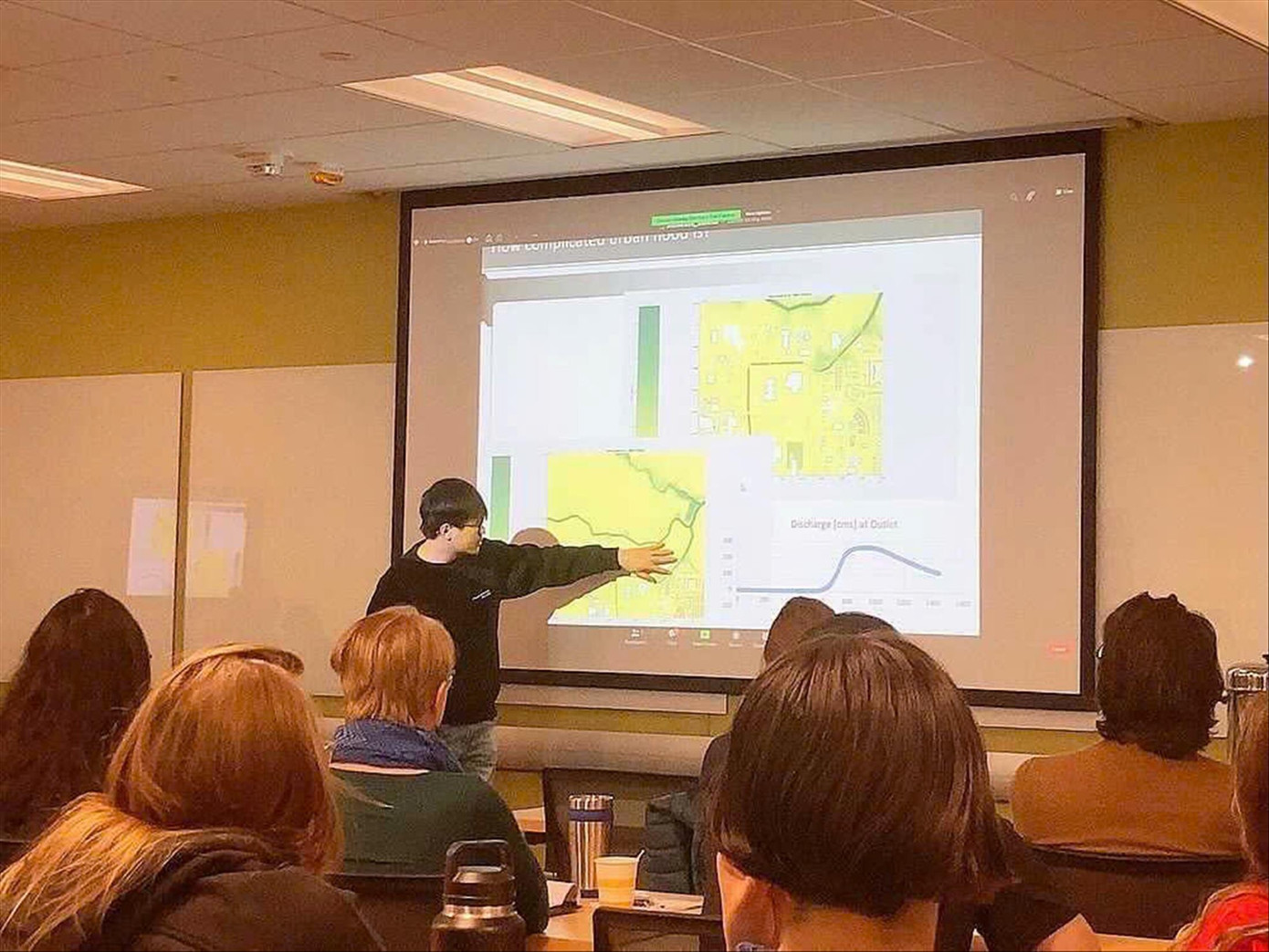
Tran Ngoc Vinh presented on the phenomenon of urban flooding at the University of Michigan, USA.
Looking back on his nearly five years as a graduate student at Ulsan University in South Korea, he realizes that the pressure he put on himself was even greater than the demands of his supervising professors. “There was a period when my life was almost unbalanced: during my graduate studies, I often worked more than 15 hours a day, many nights staying up until 6 or 7 in the morning before going to sleep. But it was precisely that harsh period that helped me realize my true passion and the path I wanted to pursue, laying the foundation for the groundbreaking work I would do later,” he recalls.
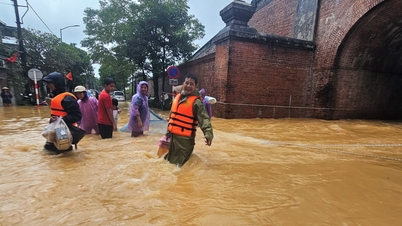
Dr. Vinh's original major was Earth science, specifically meteorology and hydrology. During his undergraduate studies at the University of Natural Sciences, he was fortunate to participate in many research projects with his professors and go on field trips throughout Vietnam, especially in Central Vietnam, focusing on flooding. These field trips to the central provinces, witnessing firsthand the devastating floods that swept away lives, property, and material possessions, left a deep impression on him. “Throughout my work, I have always pondered two questions: Is it possible to predict natural disasters? And what can we do to minimize the damage caused by floods?” he said.
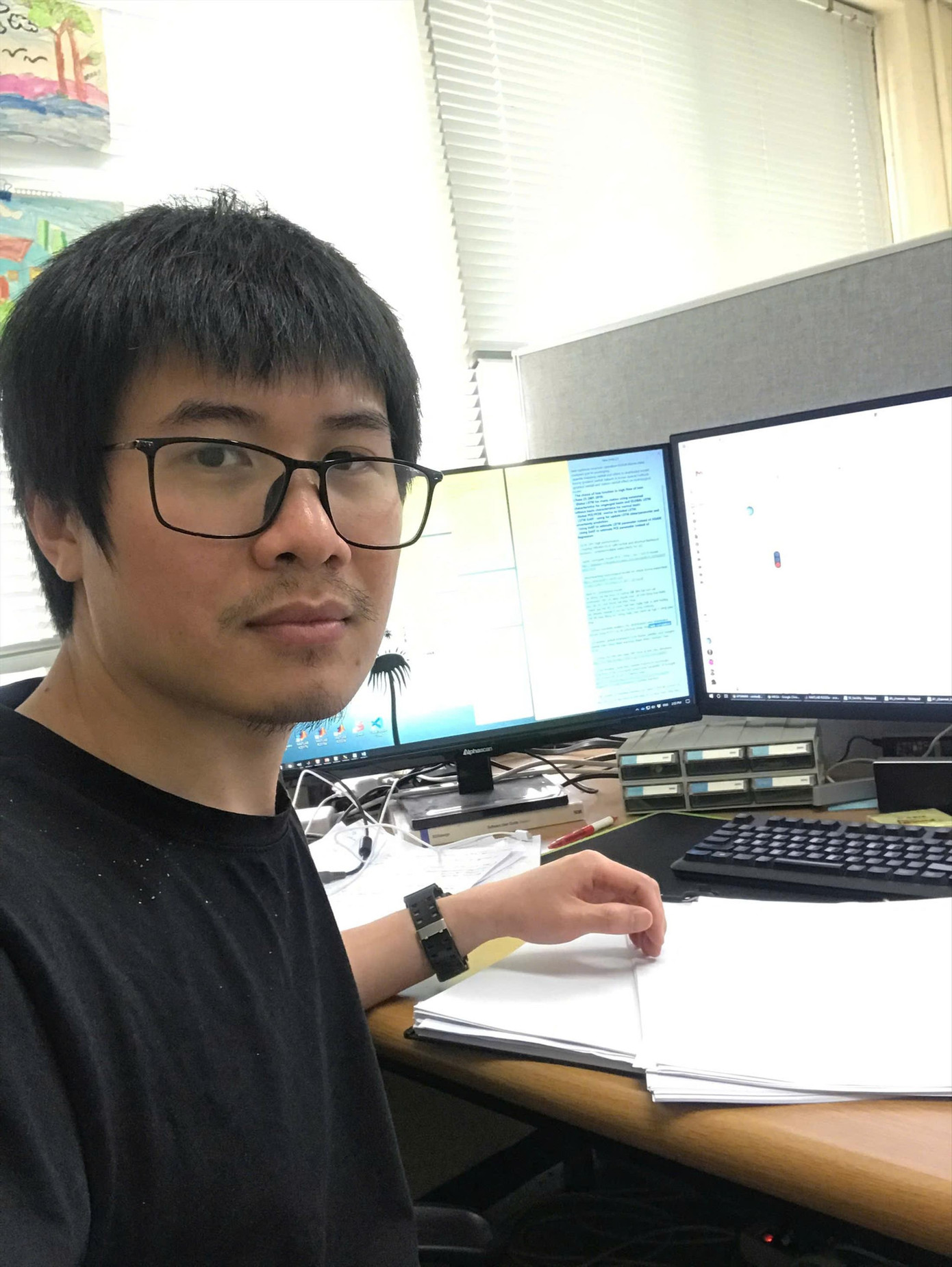
Dr. Tran Ngoc Vinh, researcher at the University of Michigan, USA
Having a passion for physics and a fascination with traditional flood disaster forecasting models, he also recognized their limitations: "Human capabilities are limited; large-scale forecasting is impossible." In contrast, AI can process massive amounts of information quickly and accurately, with a high degree of discipline. He believes that combining AI with physical models and human experience is the way to overcome the weaknesses of each tool.
Based on that idea, the research team he led at the University of Michigan (USA) conducted the research project "Artificial Intelligence Enhances the Accuracy, Reliability, and Economic Value of Medium-Term Flood Forecasts on a Continental Scale," completed in 2023. The research developed a new hybrid model framework combining AI and the existing US National Water Model (NWM) for flood forecasting, which can minimize errors in national flood forecast programming and provide more accurate predictions of where floods will occur.
Dr. Vinh and his team of scientists discovered that when AI is used in combination with the NWM model developed by the U.S. National Oceanic and Atmospheric Administration (NOAA), the resulting hybrid model is 4 to 6 times more accurate. The AI is trained on NOAA data for the United States, but the system can be customized for any country.
The research results show that the hybrid model not only outperforms NWM, but also achieves higher performance than even advanced AI models developed by Google, especially in extreme flood situations. The work was published in the leading journal of the American Geophysical Union (AGU), which publishes fewer than 100 studies per year.
Testing across the United States.
Dr. Tran Ngoc Vinh, a Top 20 finalist in the 2025 Golden Globe Science and Technology Awards, holds 8 national patents in South Korea and has published 29 scientific articles in international Q1-listed scientific journals…
Dr. Vinh shared: “To announce these results, we had to overcome many obstacles and a huge workload. But this is proof of our continuous journey to find better solutions for predicting natural disasters, a goal I have cherished since the beginning of my career.”
As the lead author of this research, he worked tirelessly for many years, almost without rest, from collecting and processing input data, including meteorological data (rainfall, temperature, wind, etc.), flood flow data, and simulation data from NWM, to designing the overall research framework, building simulation scenarios to evaluate the model's effectiveness, proposing solutions, leading the manuscript writing, and participating in the peer review process of the research…
“Regarding research direction, I will integrate artificial intelligence into the Earth modeling system to improve simulation capabilities and computation speed. The goal is to predict large-scale natural disasters such as storms and heavy rains for longer periods, for example, 10 days ahead. With more accurate and earlier forecasts, we will be better prepared, minimizing damage to people and property,” said Dr. Tran Ngoc Vinh (University of Michigan, USA).
In particular, he was directly responsible for designing, programming, and training an experimental AI model across the United States with over 42,000 flood events and a forecast timeframe of 1-10 days. “It can provide probabilistic forecast scenarios – a key factor in decision-making in high-risk environments – and can run on a regular computer, not a supercomputer,” Dr. Vinh stated, highlighting the model's superior characteristics.
Alongside his research on flooding, Dr. Tran Ngoc Vinh also published a work on urban flooding in the journal Nature Cities, pointing out the "flooding-drainage system upgrade-flooding cycle," warning that the current approach to drainage system design is not optimal. He hopes to apply this research to practice in Vietnam, not only focusing on flood prediction, but also providing solutions for prevention and serving the design of disaster prevention structures, optimizing flood drainage systems in major cities such as Hanoi and Ho Chi Minh City.
Source: https://tienphong.vn/tien-si-tre-dot-pha-trong-du-bao-lu-post1780398.tpo



![[Photo] General Secretary and President To Lam presides over the meeting to approve the draft report on the results of the second inspection by the Politburo of the Standing Committee of the Hanoi City Party Committee.](https://vphoto.vietnam.vn/thumb/1200x675/vietnam/resource/IMAGE/2026/05/26/1779789811432_a2-bnd-4430-9620-jpg.webp)

































































Comment (0)