

On May 28th, in Can Tho City, the Vietnam Federation of Commerce and Industry (VCCI), together with the Fulbright School of Public Policy and Management (FSPPM), announced the Annual Economic Report for the Mekong Delta 2025 with the theme: Enterprise Development - A Key Driver for Growth.
 |
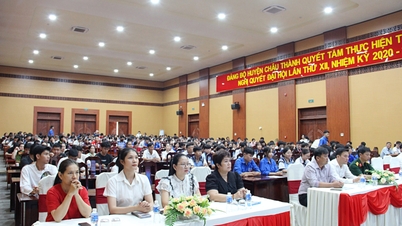
| The delegates attending the conference announced. |
According to the report, the Mekong Delta continues to play a strategic role in ensuring food security and agricultural exports for the entire country. By 2025, the region's GRDP is projected to increase by approximately 7.24%, contributing 8.39% to the overall national growth and accounting for 12.2% of the national GDP. The industrial and service sectors are expected to recover positively, with growth rates of 9.6% and 8.8% respectively. The region's export turnover is projected to increase from US$8.5 billion to US$20.3 billion between 2015 and 2024, maintaining a high trade surplus.
Business development activities in the Mekong Delta also show many positive signs. In 2025, the entire region is expected to have more than 16,300 newly established businesses, a 30% increase compared to the previous year. In the first four months of 2026 alone, over 3,900 businesses entered the market, making it the region with the highest business development rate in the country.
However, the Mekong Delta is facing many limitations such as a shortage of high-quality labor, low labor productivity, weak logistics infrastructure, and high transportation costs. Currently, logistics costs account for about 20-25% of product costs because goods have to be transshipped through Ho Chi Minh City and the Southeast region. The Mekong Delta has become the region with the lowest density of businesses in the country. In 2000, this region accounted for about 22% of the total number of businesses nationwide, but by 2024 it had fallen to only about 7%. Micro-enterprises account for a very large proportion, while there is a lack of leading enterprises and enterprises at the beginning of the supply chain.
The research team also identified nine major bottlenecks hindering regional business development, including a low value-added growth model, weak logistics, a shortage of skilled labor, limited credit, low FDI, and a low level of linkages.
Associate Professor Ho Sy Hung - Chairman of VCCI, stated: The 2025 Annual Economic Report on the Mekong Delta is a comprehensive research publication that VCCI has been undertaking for the fifth consecutive year, as assigned by the Prime Minister in Resolution 57/NQ-CP on perfecting the institutional framework for socio-economic regions. The report is built on a standardized data platform, combining synchronized macroeconomic statistics with quantitative models and in-depth analysis.
According to the plan for 2030, the Mekong Delta needs to shift from a raw material supply region to an innovative, climate-resilient, and highly competitive agricultural economic ecosystem. The region's breakthrough lies not only in infrastructure or new industrial zones, but also in forming a strong business community capable of transforming its potential into sustainable added value.
Mr. Le Tan Can, Deputy Minister of Finance, stated: The Ministry of Finance is committed to continuing to support the Mekong Delta region, listening to and incorporating feedback from the Vietnam Chamber of Commerce and Industry (VCCI) and the business community. This will enable continuous improvement of the financial system, creating favorable conditions for businesses in the Mekong Delta to develop, enhance competitiveness, participate more deeply in the value chain, and contribute to the prosperous and sustainable development of the Mekong Delta. With a strong business sector and a truly conducive institutional environment, the Mekong Delta economy will "transition," steadily entering a new phase of development.
Text and photos: TRÀ MY
Source: https://baovinhlong.com.vn/kinh-te/202605/cong-bo-bao-cao-kinh-te-thuong-nien-dbscl-2025-80e0f26/


![[Photo] Standing Committee member of the Party Central Committee Tran Cam Tu working with the Central Inspection Committee](https://vphoto.vietnam.vn/thumb/1200x675/vietnam/resource/IMAGE/2026/05/28/1779969579668_ndo_br_bnd-2495-jpg.webp)




















































































Comment (0)