


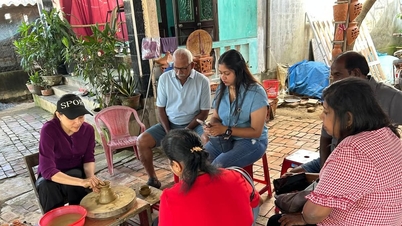
Tourists visit traditional craft villages in the Mekong Delta. Photo: NGUYET ANH
From simply showcasing beautiful scenery, many campaigns now aim to tell in-depth stories about local culture, people, and experiences, thereby building an image of Vietnam as a destination with its own unique identity on the global tourism map.
On May 25th, during a meeting between leaders of the Ministry of Culture, Sports and Tourism, the Vietnam National Tourism Administration, and representatives of CNN International, both sides agreed to promote cooperation in showcasing Vietnam's tourism image through CNN's global media ecosystem. Notably, the tourism industry aims to build a comprehensive narrative about Vietnam, where each destination is placed within a shared context of culture, lifestyle, and experiences.
When travel is no longer just about "checking in at places"
Over the years, many localities have chosen to promote themselves using familiar images: blue seas, beautiful mountains, lively festivals, or spectacular flycam shots. This approach helps increase recognition in the short term, but sometimes makes the destination's image lack depth and struggle to differentiate itself among the numerous similar tourism campaigns in the region.
Currently, trends in international tourism promotion are changing quite rapidly. Instead of just showcasing places to visit, many countries are focusing on telling the story of the lives, emotions, and experiences of tourists while they are at the destination.
Phil Nelson, Executive Vice President of CNN International Commercial, believes that Vietnam has many advantages in areas such as cultural tourism, luxury resorts, golf, and film-related tourism. However, the important thing is not just possessing beautiful scenery, but also knowing how to tell its story in a way that resonates with international tourists.
This is also evident in the tourism industry in recent years. Many foreign tourists coming to Vietnam are no longer just looking for famous landmarks to "check-in," but are more interested in authentic experiences such as learning to cook Vietnamese food, staying in homestays in the highlands, participating in craft village tours, or exploring life in the ancient town.
Anne Dubois, a tourist from France, shared her experience visiting Hanoi: “What I remember most isn't a specific place, but the feeling of sitting in a small cafe by the street, listening to the sounds of traffic, and chatting with the locals. Vietnam feels very vibrant and intimate.”
Meanwhile, Tran Minh Duc, a tour guide in Mu Cang Chai (Lao Cai), said that international tourists now ask a lot about local culture and life instead of just focusing on the tour itinerary. "They prefer the feeling of immersing themselves in the local environment and life rather than visiting many places in a short time," Duc said.
Cuisine and cinema have become "soft languages."
One of the key areas emphasized in this collaboration is promoting Vietnamese cuisine on CNN's international platforms and within the Warner Bros. Discovery ecosystem.
Over the years, pho and banh mi have gradually become familiar "representative faces" of Vietnamese cuisine around the world. However, tourism professionals believe that Vietnam still has many untapped values, especially the stories behind its dishes, regional cultures, and lifestyles connected to its cuisine.
According to the tourism industry's direction, the next phase will focus on building a network of authentic Vietnamese restaurants in several key international markets, while also promoting cuisine linked to cultural experiences.
In addition, film is also considered a highly potential promotional tool. Following the success of several international films shot in Vietnam, many destinations have seen a significant increase in visitors thanks to the images featured on screen.
Ms. Nguyen Thanh Thao (Vietnam Tourism Joint Stock Company VNTRAVEL) believes that cooperating with major media platforms can help Vietnamese tourism reach international tourists with higher spending power. However, it is crucial that the actual experience matches the promotional image.
"International tourists now find information very quickly. They might watch beautiful videos about a destination, but they will also read reviews right afterward. If services, infrastructure, or the tourism environment haven't kept pace, the effectiveness of promotion will be difficult to sustain," Ms. Thao said.
In reality, the appeal of modern tourism lies not only in beautiful scenery but also in the feeling that the destination gives to visitors. A dish, a cultural story, or an experience of local life can sometimes leave a longer-lasting impression than even the most elaborate promotional images.
This collaboration with CNN demonstrates that Vietnamese tourism is gradually shifting from promoting destinations to building a national image through cultural stories, experiences, and unique identities. In the context of increasingly fierce global tourism competition, this is seen as a direction for Vietnam's image to appear more prominently on the international tourism map.
According to Nhandan.vn
Source: https://baoangiang.com.vn/cung-cnn-ke-chuyen-viet-nam-a487170.html

![[Image] Nearly 125,000 Hanoi students completed the Literature exam for the 10th grade entrance exam.](https://vphoto.vietnam.vn/thumb/1200x675/vietnam/resource/IMAGE/2026/05/30/1780117233041_ndo_br_thiet-ke-chua-co-ten-2-png.webp)



































































Comment (0)