

 |
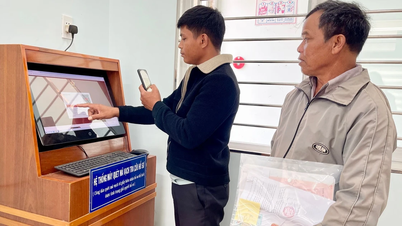
| Hop Tien Transport Cooperative assists drivers in registering for ride-hailing services. |
In this context, the "Electronic Cooperative" project, implemented by the Institute of Educational and Environmental Sciences in collaboration with the Project Steering Committee, is opening up a new approach that places people, knowledge, and the community at the center.
A comprehensive social security approach
Social security is closely linked to the stability of people's daily lives. When livelihoods lack a proper management foundation, the risks that arise not only affect income but also impact social psychology and public order. In the context of widespread digital transformation, the requirements for transparency, legal compliance, and technology application have become essential.
In practice, individual businesses and traditional cooperatives are maintaining the dynamism of social life, but are also facing many pressures as management methods shift from manual to modern. The lack of support tools, management knowledge, and connectivity has led to difficulties in the adaptation process for many.
According to Mr. Luu Viet Dung, Chairman of the National Cooperative Union, the biggest difficulty currently lies in the support gap between the people and the new management system. Many business households are very concerned as the requirements for declaration and transparency become increasingly clear. They are not avoiding their obligations, but are worried about how to comply with regulations and do so effectively.
Based on his observations, Mr. Dung concluded that without a comprehensive support system, people would find it difficult to feel secure in their livelihoods, leading to adverse impacts on social stability. "When people are confident that their activities are supported in terms of governance, legal framework, and financial transparency, they will be more confident in developing. This sense of security is of great importance to social welfare," Mr. Dung affirmed.
Based on that need, the "Electronic Cooperative" project was researched and implemented as an intermediary organizational model, helping to connect people with modern management tools, gradually creating a stable foundation during operation.
The "Electronic Cooperative" project, implemented by the Institute of Educational and Environmental Sciences in collaboration with the Project Steering Committee, is based on practical research and aims for an inclusive development model in which social welfare is linked to human resource training, knowledge dissemination, and enhanced community cohesion.
According to Mr. Nguyen Van Khuong, Director of the Institute of Educational and Environmental Sciences, the project is comprehensive, going beyond the scope of supporting ordinary production activities. This is a development project with an inclusive approach, aiming to build a community with knowledge, a spirit of commitment, and responsibility towards society.
Mr. Khuong also emphasized the role of training in strengthening the social foundation. When people are equipped with the right knowledge, skills, and attitudes, social welfare will be ensured from the root, instead of just dealing with the resulting consequences. This approach is consistent with the spirit of Resolution No. 68-NQ/TW dated May 4, 2025, of the Politburo on the development of the private economy, which identifies people and the quality of human resources as decisive factors for sustainable development. Along with that, Resolution No. 57-NQ/TW dated December 22, 2024, of the Politburo continues to set requirements for creating breakthroughs in science, technology, innovation, and national digital transformation, in order to enhance the adaptability and development capacity of the entire society.
The "Electronic Cooperative" project is being implemented as a concrete step in realizing those resolutions, through the development of a model of the Electronic Cooperative Federation - Digital Economic Alliance, forming a linkage structure between the community, training institutions, scientific organizations, and technology platforms. In this model, social welfare is extended to the fields of culture, education, and sports. Online training platforms, digital libraries, and activities promoting reading culture are being implemented to improve spiritual life, expand access to knowledge, and foster long-term learning habits within the community.
Preparing resources in the new context
A key aspect of the "Electronic Cooperative" project is the participation of educational institutions and students. According to Dr. Dinh Quang Toan, Director of the Institute for Innovation and Digital Economy, linking the project with schools helps prepare resources suitable for current development requirements. Through the project, students participate in practical models, hone their skills, access technology, and better understand the demands of the digital society.
 |
| Hop Tien Transport Cooperative assists drivers in registering for ride-hailing services. |
Mr. Toan believes that the collaboration between schools, the community, and e-commerce cooperatives helps transform knowledge into practical value. This is a way for young human resources to adapt better and contribute directly to the community. In addition, the collaboration between the Institute of Educational and Environmental Sciences and the Project Management Board also contributes to ensuring the scientific rigor, systematic approach, and long-term orientation of the implementation process.
In practice, the "Electronic Cooperative" project is contributing to the formation of a proactive social security structure based on providing tools, enhancing capabilities, and strengthening community connections. When people are supported in managing, learning, and participating in the network, their ability to adapt to social changes is significantly improved.
It can be seen that the Electronic Cooperative Federation - Digital Economic Alliance model creates an environment for cooperation and resource sharing, thereby strengthening social security through the synchronized participation of many stakeholders. In the context of the country implementing the Politburo's resolutions on digital development and transformation, the "Electronic Cooperative" project is contributing to building a stable foundation, aiming for the long-term development of society.
Source: nhandan.vn
Source: https://baodongnai.com.vn/xa-hoi/202512/cung-co-an-sinh-xa-hoi-trong-ky-nguyen-so-54809af/






























![[Photo] Reception to welcome General Secretary and President To Lam and his wife on their State visit to the Philippines](https://vphoto.vietnam.vn/thumb/1200x675/vietnam/resource/IMAGE/2026/06/01/1780295488620_vna-potal-chieu-dai-chao-mung-tong-bi-thu-chu-tich-nuoc-to-lam-va-phu-nhan-tham-cap-nha-nuoc-toi-philippines-8798060-7855-jpg.webp)



























































Comment (0)