

If provincial-level strategies are the macro-level planning documents, then the operation of commune-level governments is the most practical answer to the effectiveness of digital transformation.
In Lam Dong province, following the major administrative boundary consolidation, local authorities are becoming vibrant "laboratories," where digital data is no longer confined to computers but has been transformed into economic value and citizen satisfaction.
Data is becoming a new resource for development.
For many years, local growth relied primarily on land, labor, and investment capital. However, as the room for these traditional resources shrinks, data is emerging as a new factor of production.
Following the merger, Lam Dong possesses a unique economic space with full advantages in high-tech agriculture , processing industry, renewable energy, marine economy, and tourism.
However, to effectively connect those advantages across an area of over 24,000 km², data is becoming a new resource for growth.
In agriculture, data on meteorology, soil, water resources, and markets helps improve forecasting, reduce production costs, and enhance traceability.
In tourism , visitor data supports regulating visitor flows, developing new products, and enhancing experiences. In the field of planning, GIS systems and shared databases help shorten investment preparation time and reduce information access costs for businesses.
When databases on population, land, businesses, and infrastructure are interconnected, the government will not only better serve citizens and businesses but also create a more transparent investment environment.
This is considered a crucial condition for digital transformation to truly become a driving force for economic development, rather than merely administrative reform.
In addition to digital economic models, Ward 1 of Bao Loc consistently leads the entire province in service quality on the National Public Service Portal, demonstrating that data not only creates economic value but also contributes to improving governance efficiency and citizen satisfaction.
Data is stored electronically for reuse, and a stable network infrastructure has enabled 100% of incoming and outgoing documents to be processed on the digitally signed interconnected system, minimizing printing costs and travel time for citizens.
The remote and disadvantaged commune of Cát Tiên is writing a different story about digital transformation – using data to create wealth. The commune has identified 2026 as a breakthrough year with a target of achieving a GRDP growth rate of 11.05%.
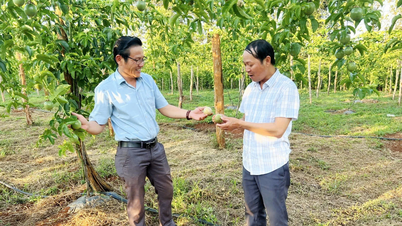
The key to achieving this figure is to raise the average production value to 70 million VND/hectare through the digital economy of agriculture.
According to Mr. Nguyen Van Tien, Vice Chairman of the People's Committee of Cat Tien Commune: “The digital revolution in Cat Tien began with the ‘digital identity card’ for agricultural products. The commune has been actively guiding farmers to apply electronic logs and QR codes for traceability, helping local agricultural products transform from fragmented production into branded goods, meeting the standards to enter e-commerce platforms and global value chains. It is expected that by the end of June, some durian growing areas in Cat Tien commune will receive planting area certification, making them eligible for export.”
Not only in production, but the digital society in Cat Tien also witnessed substantial changes, with over 95% of eligible residents having activated their VNeID Level 2 identity verification accounts.
This provides the foundation for 100% of budget expenditures and employee benefits to be processed through bank accounts, ensuring complete transparency in the flow of public finances at the local level.
Digital data is changing local governance.
New developments in building digital rural areas are being observed in many localities. In Nhan Co commune, the e-commerce commune model has completed its pilot program since February 2026.
Here, digital infrastructure is leveraged to restructure rural spaces towards "residential clusters - service clusters," forming large-scale production areas linked along the value chain.
This demonstrates that digital transformation is not just about administrative reform, but also a tool for reorganizing the rural economy to move closer to a smart model.
Meanwhile, Ham Thuan commune has made a strong impression with unprecedented administrative reform models: "Paperless files," "Files without appointments," and "Files outside of administrative boundaries."
These models demonstrate a groundbreaking management mindset: using data to free up the workforce of the administrative apparatus. When data is interconnected and cleaned, a commune official after a merger can handle a workload that is 2-3 times greater while still ensuring maximum satisfaction and convenience for citizens.
The success of the aforementioned "digital fortresses" is inseparable from the role of the network of 2,765 community digital technology groups with more than 16,880 members throughout the province. These are the core forces directly implementing the province's directive: "going door to door" to support the people.
Under the guidance of this force, the province-wide rate of online applications reached a record high of nearly 80%, and in the first quarter of 2026 alone, it reached 90.11%. The presence of more than 150 telecommunications technicians seconded to communes, along with the project to equip 100% of commune-level officials with modern computers, has helped bridge the technological gap between urban and remote areas.
According to Vo Thanh Cong, Director of the Department of Science and Technology of Lam Dong province: “We are reviewing and investing in the synchronized provision of equipment for both commune-level committees and provincial-level departments to meet the requirements for operating the software system in the future. With Lam Dong's favorable conditions, we will continue to invest in infrastructure, especially digital infrastructure, to operate the large data center system, and the green and clean data center.”
Following the merger, Lam Dong is facing a historic opportunity to create a new development space on the largest scale in the country. While transportation infrastructure connects geographical regions, digital data is the infrastructure that connects the flows of information, resources, and development opportunities.
From remote base stations and data centers operating around the clock to artificial intelligence platforms supporting local governments, a digital ecosystem is gradually taking shape throughout the province.
This journey aims not only to modernize the state management apparatus but also towards a larger goal: transforming data into a strategic asset, a new resource for growth, research, and attracting investment, helping Lam Dong effectively leverage its advantages in agriculture, tourism, industry, energy, and marine economy in the digital age.
In the future, the value of a locality will not only be measured by its area or population size, but also by its ability to create, exploit, and enrich itself from data.
On this journey, Lam Dong is laying the first bricks for a new development model: Digital data helps Lam Dong operate its highland, coastal, and border economic space in a green, clean, and transparent manner.
Source: https://www.vietnamplus.vn/kha-nang-thay-doi-gia-tri-post1113897.vnp





























![[Photo] Reception to welcome General Secretary and President To Lam and his wife on their State visit to the Philippines](https://vphoto.vietnam.vn/thumb/1200x675/vietnam/resource/IMAGE/2026/06/01/1780295488620_vna-potal-chieu-dai-chao-mung-tong-bi-thu-chu-tich-nuoc-to-lam-va-phu-nhan-tham-cap-nha-nuoc-toi-philippines-8798060-7855-jpg.webp)

































































Comment (0)