

Julius Robert Oppenheimer is known as the "father of the atomic bomb," but he spent the latter half of his life opposing nuclear weapons.
Julius Robert Oppenheimer was born on April 22, 1904, into a wealthy family in New York City, USA. His father was a German Jewish immigrant who worked as a cloth merchant, and his mother was an American artist. He had a younger brother named Frank, who later also became a physicist.
After graduating with honors from Harvard University in 1925, Oppenheimer moved to England and worked at the Cavendish Laboratory at Cambridge University, under the guidance of JJ Thomson, the British physicist who won the Nobel Prize in 1906.
During this time, Oppenheimer is believed to have suffered from some psychological problems due to a strained relationship with Patrick Blackett, one of his supervisors at the laboratory.
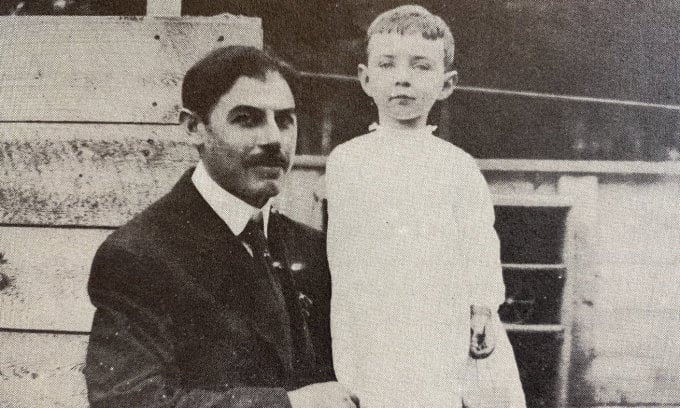
J. Robert Oppenheimer with his father, Julius Oppenheimer, in 1905. Photo: J. Robert Oppenheimer and Kitty Oppenheimer Memorial Committee.
According to American Prometheus, a biography of Oppenheimer by Kai Bird and Martin J. Sherwin, the physicist told friends that he had once placed a poisoned apple on Blackett's desk, but luckily no one ate it. Nevertheless, he was investigated by the university administration and placed on probation for a period of time.
Jeffries Wyman, a friend of Oppenheimer, said the physicist may have exaggerated the event, but "whether it was a real or imaginary apple, it was an act of envy."
In late 1926, Oppenheimer left Cambridge to work at the University of Göttingen in Germany, where he earned his doctorate in quantum physics. He returned to the United States in 1929 to serve as an assistant professor at the University of California-Berkeley, as well as teaching at the California Institute of Technology. Within 14 years, he had made California-Berkeley one of the most renowned universities in the field of theoretical physics.
In early 1942, Oppenheimer was invited by the U.S. government to participate in the top-secret atomic bomb project codenamed "Manhattan." He was appointed the project's chief scientific officer later that year. Atomic bomb development began in 1943 at the Los Alamos laboratory in New Mexico.
Here, Oppenheimer assembled a team of the world's leading scientists to carry out the project. He persuaded the U.S. military to allow scientists to bring their family members to Los Alamos, as some only agreed to participate in the project if they could go with their families.
As a leader, Oppenheimer inspired, motivated, and encouraged team members to reach their full potential.
"He didn't direct from his office. He was by our side, both intellectually and practically, at every crucial stage of the project," said Victor Weisskopf, a member of the "Manhattan" project.
Nearly three years after the project was established, Openheimer and his colleagues successfully conducted the "Trinity," the first nuclear test in human history, in the Jornada del Muerto desert in New Mexico. Just about three weeks later, on August 6th and 9th, 1945, the United States dropped two atomic bombs on the Japanese cities of Hiroshima and Nagasaki, killing approximately 200,000 people and bringing an end to World War II.
For his contributions to the effort to end the war, Oppenheimer was awarded the Medal of Merit by the U.S. government in 1946. However, the horrific devastation caused by the atomic bombs dropped on Hiroshima and Nagasaki left a deep trauma for him.
At a meeting with U.S. President Harry Truman in October 1945, two months after the atomic bomb explosion in Japan, Oppenheimer said that he felt "his hands were stained with blood." The physicist's attitude displeased President Truman.
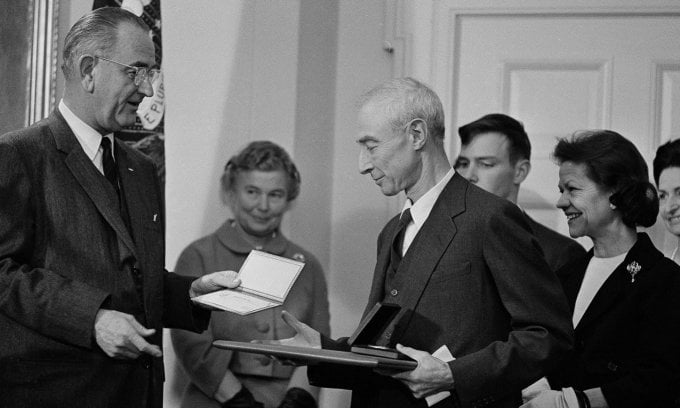
Oppenheimer was awarded the Enrico Fermi Prize by former U.S. President Lyndon B. Johnson on December 2, 1963. Photo: AP
"His hands are stained with blood, but there's not even half as much blood on his hands as on mine," Truman told his advisor after the meeting. "You can't go around whining like that. I don't want to see that bastard in my office again."
In a documentary released by NBC News in 1965, Oppenheimer continued to express his remorse, quoting a line from the Bhagavad Gita, an ancient Hindu text, to describe himself: " Now I have become Death, the destroyer of all worlds ."
As chairman of the Atomic Energy Commission (AEC), an organization established to replace the Manhattan Project after World War II, Oppenheimer actively opposed the use of nuclear weapons, including the development of thermonuclear bombs. He urged the U.S. government to use nuclear weapons only for tactical purposes and to pursue other applications of nuclear technology such as energy production.
Oppenheimer's anti-nuclear weapons stance made him a political enemy to some. He was notified by the AEC that his security clearance had been revoked in 1953 due to suspicions of spying for the Soviet Union.
Following Oppenheimer's appeal, a hearing was held in April 1954 to clarify the allegations against him, but the AEC's decision remained unchanged.
This decision meant Oppenheimer was no longer allowed access to U.S. government nuclear secrets, ending his career as a nuclear physicist.
"Oppenheimer was a man of peace and science, and they destroyed him. A small but malicious group," commented physicist Isidor Isaac Rabi, a close friend of Oppenheimer, regarding the hearing.
It wasn't until December 2022 that the US Department of Energy "cleared" Oppenheimer's name by overturning the AEC's decision to strip him of his security clearance.
"We have found considerable evidence of bias and unfairness in the handling of Dr. Oppenheimer's case, while evidence of his loyalty and patriotism continues to be affirmed," U.S. Energy Secretary Jennifer Granholm declared.
After severing ties with the U.S. government, Oppenheimer dedicated the rest of his life to his scientific career and teaching. In 1963, when the AEC sought to mend relations with Oppenheimer, he was awarded the Enrico Fermi Prize, the AEC's highest honor.
He passed away on February 18, 1967, due to nasopharyngeal cancer.
Oppenheimer is hailed as the "father of the atomic bomb," but spent the latter half of his life opposing nuclear weapons due to regrets over his invention. He was once honored as a national hero by the U.S. government, but was later suspected of spying for a foreign country.
Whether a great scientist or a "world destroyer," a patriot or a traitor, Oppenheimer is still considered an important figure in history, as noted by Christopher Nolan, director of the blockbuster film of the same name currently showing worldwide.
"Whether we like it or not, we are all living in Oppenheimer's world," Nolan said. "He created the world we are in, for better or worse."
Pham Giang (Based on Time, CNN, Washington Post )
Source link



































































































Comment (0)