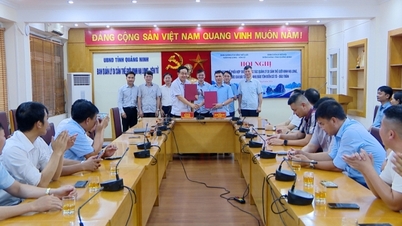
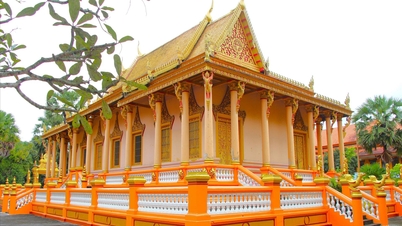
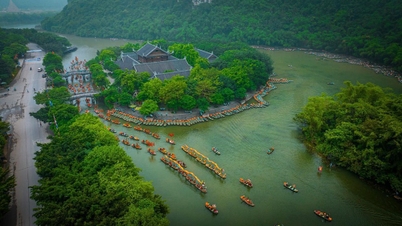
The delegation from Van Phu ward offered prayers at Van Luong Temple.
A place where community memories converge.
Legend has it that during the reign of the 18th Hung King (Hung Due Vuong), one year, on the occasion of the Lunar New Year, the King's son-in-law, Saint Tan Vien, came to pay his respects to his father. On the morning of the 3rd day of the Lunar New Year, the King ordered Saint Tan Vien and his officials to hold a hunting festival to celebrate the start of the new year, to eliminate wild animals, protect the crops, and ensure peace for the people. The officials hunted a wild boar and brought it back to the King. Pleased, the King ordered the boar to be slaughtered and feasted, celebrating the successful start of the new year. The feast included a boiled boar's head covered with lard and four pork legs offered to the King. In addition, there was a jar of rice wine, sticky rice cakes, and three cotton chopsticks symbolizing three drinking straws, and six plain cotton chopsticks for the officials. After the ceremony and the King and officials had finished their feast, the master of ceremonies threw the cotton chopsticks to the villagers to grab, considering them precious lucky charms for the first day of the new year, hoping for prosperity and good fortune throughout the year. After the feast, the villagers threw stones to drive away wild animals back into the forest...
According to the preserved genealogical records of Van Luong Temple, it was built a long time ago to worship the Hung Kings, as well as other relics of the ancestral land. Folk cultural festivals reflect the aspirations of the people and the realities of life. During the two wars of resistance against French colonialism and American imperialism, the village was devastated, but the people still protected and preserved the temple. The temple was restored in 1821 and underwent major repairs in 1939.
In 1992, Van Luong Temple was recognized as a provincial-level historical and cultural relic according to Decision No. 735/QD-UB, dated August 14, 1992, of the People's Committee of Vinh Phu province (formerly). In 2009, the temple was classified as a national-level historical relic according to Decision No. 4703/QD-BVHTTDL, dated December 18, 2009, of the Ministry of Culture, Sports and Tourism.
Deeply aware of the historical, cultural, and educational value of the traditional Van Luong Temple Festival, in 2020, the People's Committee of Van Phu Ward submitted a report to higher authorities requesting that the festival be included in the list of intangible cultural heritage sites for national ranking. With the consensus and positive response of the local people and elders, along with the close attention and guidance of all levels and sectors, after a year of collecting documents and completing the dossier for appraisal, the traditional Van Luong Temple Festival was officially recognized by the Ministry of Culture, Sports and Tourism as a national intangible cultural heritage site according to Decision No. 72/QD-BVHTTDL, dated January 12, 2022. As per tradition, every year, the local people organize the "Flower Snatching and Net Throwing" festival on the 3rd day of the first lunar month and the "Going Down to the Fields" festival on the 4th day of the ninth lunar month. This is an opportunity to recreate unique traditional cultural values, contributing to community cohesion, fostering solidarity, and educating on the moral principle of "drinking water and remembering the source," as well as filial piety of descendants towards their grandparents and ancestors.

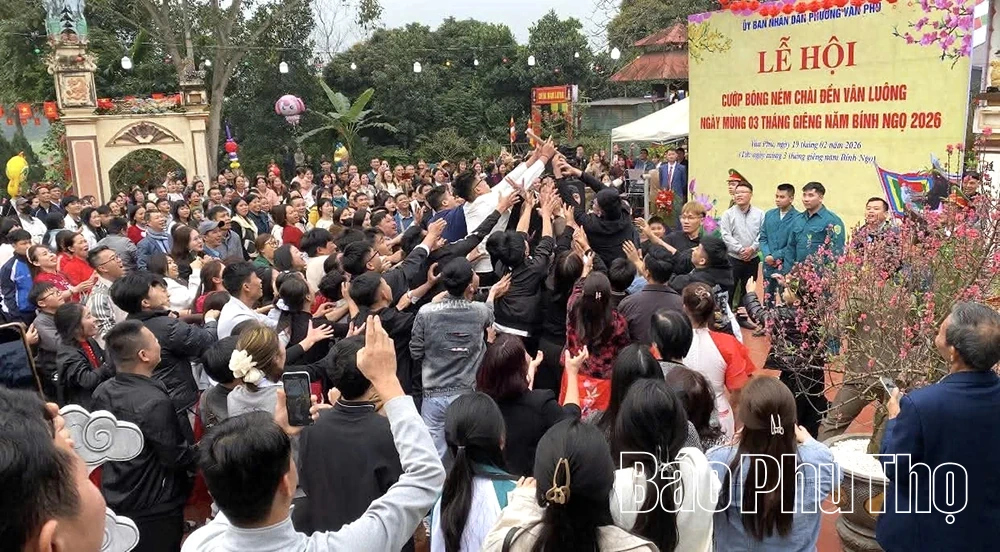
Tourists participate in the "Flower snatching, net throwing" ritual.
Preserving values in modern life
The "Cotton-Snatching and Net-Throwing" festival is organized into two parts: a solemn ceremony and a lively celebration. The ceremony includes rituals of offering incense and sacrifices to commemorate the merits of the Hung Kings and reenact ancient stories. The selection of characters playing the roles of "củ sát" and "củ hờ," along with strict rules regarding taboos, shows the importance placed on spiritual elements in community life. The celebration is the highlight, attracting a large number of locals and tourists: The "cotton-snatching" ritual – cotton balls are thrown out for everyone to grab – symbolizes a wish for good luck and prosperity at the beginning of the year. The "net-throwing" symbolizes the act of driving away wild animals, expressing the aspiration to control nature and protect peaceful life.
Today, preserving and promoting traditional cultural values is becoming increasingly urgent. Festivals are not only community-based cultural activities but also effective methods of traditional education, helping the younger generation better understand their national origins. The recognition of the festival as a National Intangible Cultural Heritage in 2022 is a significant milestone, raising social awareness of the heritage's value and creating favorable conditions for its preservation and promotion.
The festival also contributes to promoting cultural tourism . Ms. Dao Thu Trang, a tourist from Hanoi, shared: “The festival is both lively and deeply spiritual. The cheers, the drums, and the laughter echo throughout the temple grounds, captivating everyone. It's not just about games or rituals, but also a way for the younger generation to understand their roots and the historical stories of the nation.”
Comrade Pham Duc Chien, Head of the Culture and Social Affairs Department of Van Phu Ward, said: "The 'Flower Snatching and Net Throwing' festival, a unique cultural tradition, has been preserved and passed down through generations. This is not only an opportunity for local people and visitors from all over to respectfully offer incense and pay tribute to their ancestors, but also to recall historical traditions, awaken pride in the homeland, foster national unity, and continue to promote positive cultural values in the construction and development of a more prosperous, beautiful, and civilized homeland."


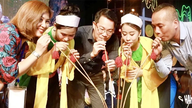
The "Cotton-Snatching and Net-Throwing" festival symbolizes community solidarity, the principle of "drinking water, remembering the source," and national pride. Amidst modern life, these values become even more precious, serving as a spiritual anchor that helps people connect with their roots, preserve their identity, and build a sustainable future for their homeland.
Hanh Thuy
Source: https://baophutho.vn/cuop-bong-nem-chai-le-hoi-dam-net-thoi-hung-vuong-252379.htm


![[Photo] Prime Minister Le Minh Hung presides over the thematic session on promoting science and technology development and innovation.](https://vphoto.vietnam.vn/thumb/1200x675/vietnam/resource/IMAGE/2026/06/23/1782207872934_ndo_br_dsc-1724-jpg.webp)