

According to the National Children's Hospital, the patient is a 4-day-old boy from Ha Tinh province . He was born healthy but developed progressively worsening jaundice after only 8 hours. At the local hospital, he was diagnosed with severe anemia with a hemoglobin level of 86 g/l.
Despite tests, the cause remained unclear and the condition did not improve. Shortly afterward, the child was transferred to the National Children's Hospital in a critical condition with severe jaundice, neonatal sepsis, and respiratory failure.
At the Neonatal Center of the National Children's Hospital, after conducting paraclinical tests, doctors noted that the hemoglobin level had dropped to 71 g/l, and the patient had severe jaundice, necessitating an emergency blood transfusion.
Because the mother had just undergone a cesarean section, she was unable to donate blood. That same night, doctors compared the baby's blood with available O-group units, but could not find a suitable sample.
Following a consultation, the child's blood sample was sent to the National Institute of Hematology and Blood Transfusion for further testing. There, doctors determined that the child carried the anti-Jk3 antibody – an extremely rare blood type, and the blood bank did not have a compatible unit available for transfusion.
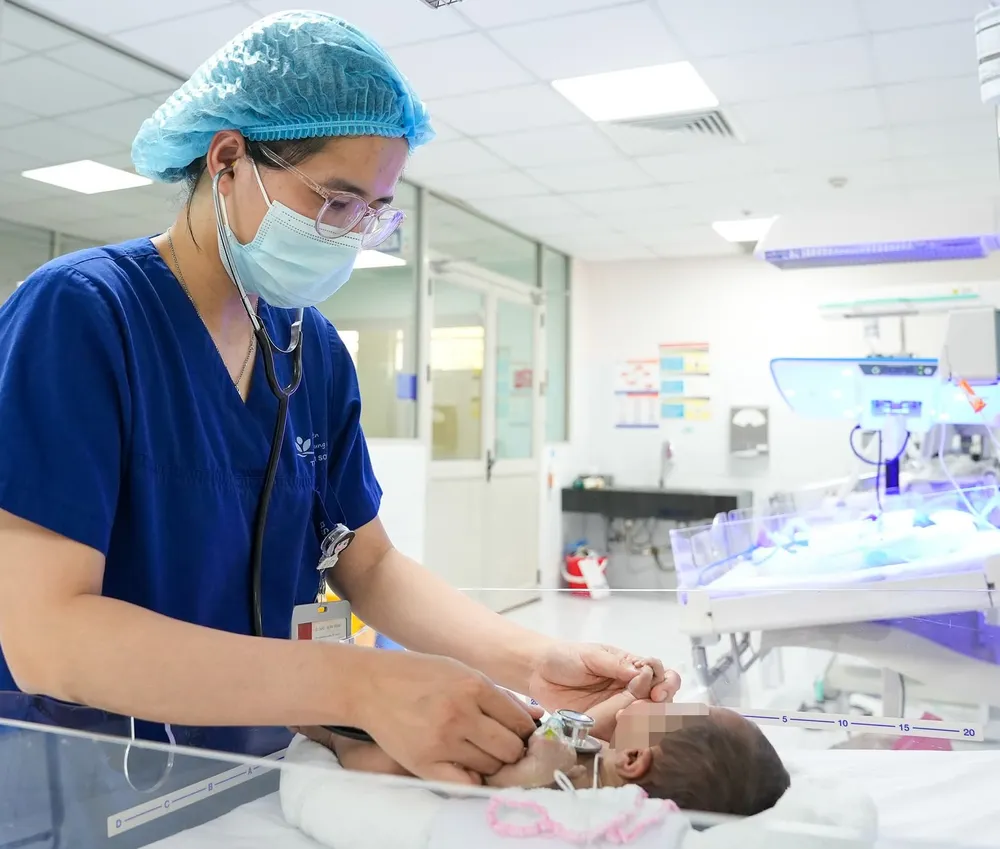
After determining that the child had a rare blood type, doctors mobilized the patient's relatives to participate in testing to find a compatible blood type. Although they found a family member with a compatible blood type, this person was ineligible to donate blood due to having hepatitis B.
Therefore, doctors were forced to use the mother's blood, even though she had just undergone a cesarean section.
During the blood collection process, doctors closely monitored the mother and ensured her maximum safety. After two days of treatment, the child's condition improved significantly, no longer requiring respiratory support or phototherapy. After nearly two weeks of treatment, the patient was discharged from the hospital.
According to Dr. Pham Thao Nguyen from the Neonatal Center, in addition to the familiar ABO blood group system, science has identified 43 different blood group systems. Among them, the Jk(ab-3) blood group belongs to the Kidd system, originating from a mutation in the SLC14A1 gene on chromosome 18, resulting in red blood cells lacking the Jka, Jkb, and Jk3 antigens.
The absence of these antigens makes finding compatible blood very difficult, especially when the patient develops anti-Jk3 antibodies, in which case only blood of the same type can be transfused. Therefore, this blood type is classified as "extremely rare".
Source: https://www.sggp.org.vn/cuu-song-tre-so-sinh-co-nhom-mau-hiem-post851254.html


























![[Photo] Reception to welcome General Secretary and President To Lam and his wife on their State visit to the Philippines](https://vphoto.vietnam.vn/thumb/1200x675/vietnam/resource/IMAGE/2026/06/01/1780295488620_vna-potal-chieu-dai-chao-mung-tong-bi-thu-chu-tich-nuoc-to-lam-va-phu-nhan-tham-cap-nha-nuoc-toi-philippines-8798060-7855-jpg.webp)







































































Comment (0)