

The nutritional composition of fish skin can vary depending on the type of fish. Some fatty fish, such as salmon, mackerel, and sardines, often have skins rich in beneficial fats, according to the American website Eating Well .
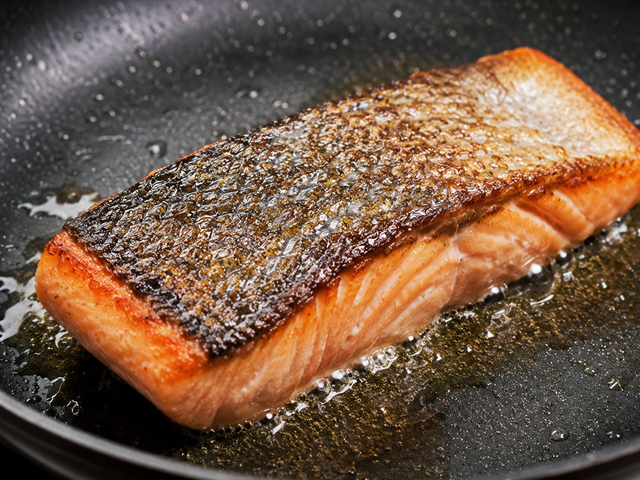
Salmon skin is rich in omega-3 fatty acids.
PHOTO: N. Quy created using AI
Collagen and omega-3
One of the most prominent components of fish skin is collagen. This is a protein that helps form skin, cartilage, tendons, and connective tissue in the body. Fish skin is particularly rich in type 1 collagen, the most common type of collagen in the human body. Therefore, many marine collagen products are now extracted from fish skin. In addition to collagen, fish skin also provides protein that helps maintain muscle mass and repair tissue.
In fatty fish like salmon, sardines, or mackerel, the skin often contains a significant amount of unsaturated fats, especially omega-3s. The skin typically retains a considerable amount of fat. Therefore, removing the skin completely may reduce the amount of omega-3s absorbed. Additionally, the skin contains vitamin D, vitamin E, selenium, and iodine.
Be aware of the mercury content.
One of the biggest concerns when eating fish skin is the risk of accumulating environmental pollutants. According to the U.S. Food and Drug Administration (FDA), almost all fish and seafood contain small amounts of organic mercury. However, most are not at levels harmful to adults when consumed in reasonable amounts.
Fat-soluble pollutants tend to accumulate more in the fat and skin of fish than in the lean meat. Therefore, large, long-lived fish such as swordfish, sharks, or king mackerel are often at higher risk of mercury contamination.
Conversely, smaller fish and those with low mercury levels, such as salmon, cod, tilapia, or sardines, are generally considered safer to eat with the skin on.
Choose reliable sources and process them properly.
If you want to eat fish skin, the most important thing is to choose a reliable source of fish and prepare it properly. Prioritize small fish or fish with low mercury levels, and limit your frequent consumption of large predatory fish, says nutritionist Maya Feller, a lecturer at New York University.
Additionally, fish skin needs to be thoroughly cleaned before cooking. The cooking method is also very important. Burnt fish skin at excessively high temperatures can create compounds that are harmful to health. Therefore, steaming, grilling, or pan-frying with little oil are generally considered better options than deep-frying, according to Eating Well .
Source: https://thanhnien.vn/da-ca-chua-nhung-duong-chat-gi-lieu-co-nen-an-185260527002410151.htm

![[Photo] The heat at the fireworks display site on the opening night of the Da Nang International Fireworks Festival 2026](https://vphoto.vietnam.vn/thumb/1200x675/vietnam/resource/IMAGE/2026/05/27/1779889741485_ndo_br_z7872039145157-fecaba5112f39e8352544099d7ef4738-5140-jpg.webp)



![[Photo] The courage of new recruits of Brigade 144 on the training ground.](https://vphoto.vietnam.vn/thumb/1200x675/vietnam/resource/IMAGE/2026/05/27/1779881651341_anh-man-hinh-2026-05-27-luc-18-32-52.png)































































![[Photo] The courage of new recruits of Brigade 144 on the training ground.](https://vphoto.vietnam.vn/thumb/402x226/vietnam/resource/IMAGE/2026/05/27/1779881651341_anh-man-hinh-2026-05-27-luc-18-32-52.png)




































Comment (0)