

A group of students from Da Nang used metal hydride materials and a heating technique involving hydrogen charging and discharging to create a device that stores over 20g of gaseous hydrogen.
The research was conducted by Vo Du Dinh, Le Anh Van, Lam Dao Nhon, Nguyen Hung Tam, and Mai Duc Hung from the Automotive Engineering Department, Faculty of Mechanical Engineering, University of Technology and Education – Da Nang University, starting in October 2023. The product focuses on solid-state hydrogen energy storage technology, applicable in energy management systems and green transportation.
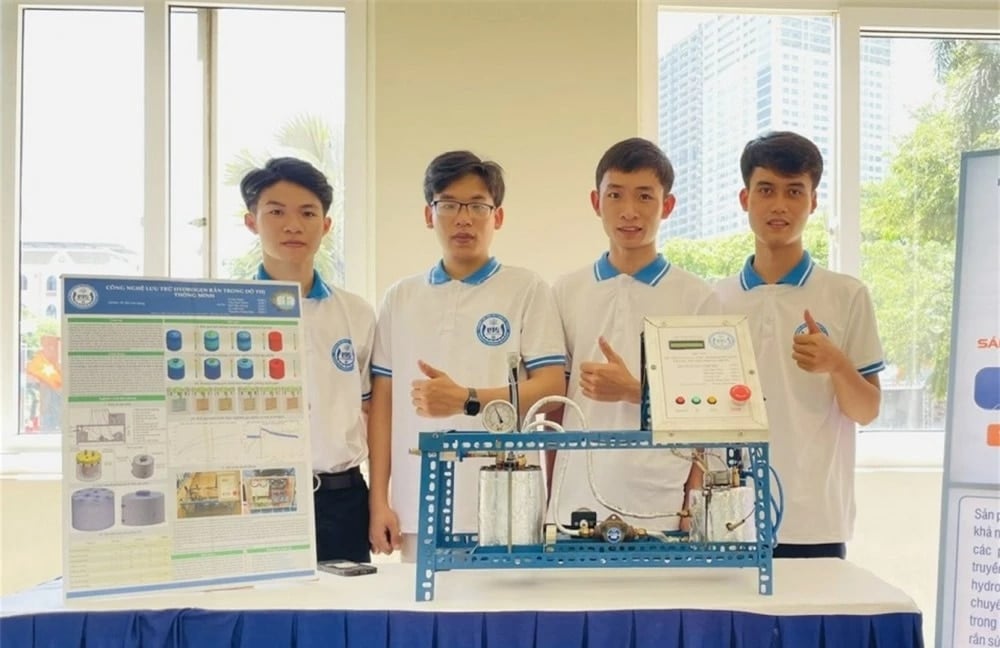
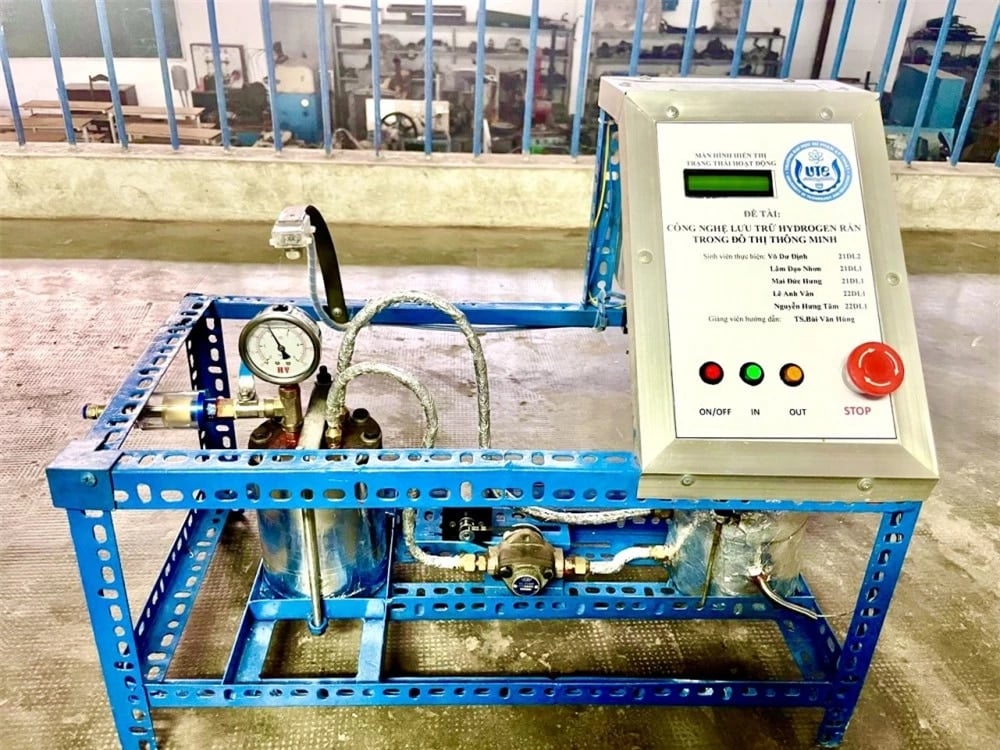
The product is designed with two main parts: a hydrogen storage tank and auxiliary components, and an intelligent control system. The operating principle of the tank is based on the reaction between magnesium metal in the tank and hydrogen to produce magnesium hydride (MgH₂). When heated to 250-350°C, hydrogen charging occurs under pressure above 1 bar. Conversely, hydrogen release occurs when the pressure is below 1 bar.
With an intelligent system comprising microcontrollers and sensors that monitor and control temperature and pressure, this ensures efficient and safe operation during the phase transition of the hydrogen storage compound.
According to team leader Vo Du Dinh, there are currently three technologies for storing hydrogen: compressed gas, liquefied gas, and solid. In compressed gas form, hydrogen is stored in high-pressure tanks, from 350 to 700 bar (5,000-10,000 psi). In liquid form, hydrogen is cooled down to -253°C to convert it to a liquid state, then stored in insulated tanks. In solid form, hydrogen is stored in metal hydride compounds or other absorbent materials such as metal-organic frameworks (MOFs), carbon nanotubes, etc.
According to Dinh, each storage method has different advantages and disadvantages. Therefore, the choice of technology depends on the purpose of use, such as for transportation, static storage, or mobile applications, taking into account factors such as cost, efficiency, and safety.
The assessment team noted that challenges in hydrogen storage require complex, high-cost technologies to ensure safety and efficiency. The lack of supporting infrastructure and low economic efficiency are major obstacles to the widespread application of hydrogen as a clean energy source.
In their research, the team members wanted to create a solid-state hydrogen storage device because this technology is safe and less prone to fire or explosion. This technology allows for easier storage as it does not require extremely high pressure or extremely low temperatures like gas or liquefied gas storage.
Theoretically, the group's product can store materials and, after the reaction, yield a maximum output of 20.74g of gaseous hydrogen. According to Dinh, this is an estimate due to limited research facilities and the lack of some specialized equipment, so the actual quantity has not yet been determined.
The team designs specialized pressure vessels in accordance with Vietnamese regulations and standards for pressure vessels. In the event of unforeseen incidents during operation, the indirect heating system completely shuts off the heat source, returning the equipment to its normal state to ensure safety.
Dr. Bui Van Hung, lecturer at the Faculty of Mechanical Engineering, University of Technical Education - Da Nang University, assessed that the research group is only in the stage of finding suitable storage materials capable of absorbing and releasing hydrogen. The group also built a simulation model of the capacity and conditions for storing this fuel.
He assessed that the amount of hydrogen in the group's product, estimated at around 20g, equivalent to about 0.66 kWh, is quite low. This energy level is suitable for small devices or experiments, but not enough to power vehicles such as cars or industrial equipment for extended periods.
To increase the amount of hydrogen stored, Dr. Hung suggested that the group should look for alloys or materials capable of absorbing more hydrogen without significantly increasing the material's mass. However, some materials with high hydrogen storage density require conditions and environments where phase transitions between charging and discharging are more difficult to occur. He believes that, based on this research, the group needs to conduct further experiments with materials that are difficult to transition between phases in the future.
According to Intellectual Property and Innovation
![[Image] Nearly 125,000 Hanoi students completed the Literature exam for the 10th grade entrance exam.](https://vphoto.vietnam.vn/thumb/1200x675/vietnam/resource/IMAGE/2026/05/30/1780117233041_ndo_br_thiet-ke-chua-co-ten-2-png.webp)































































































Comment (0)