


 |
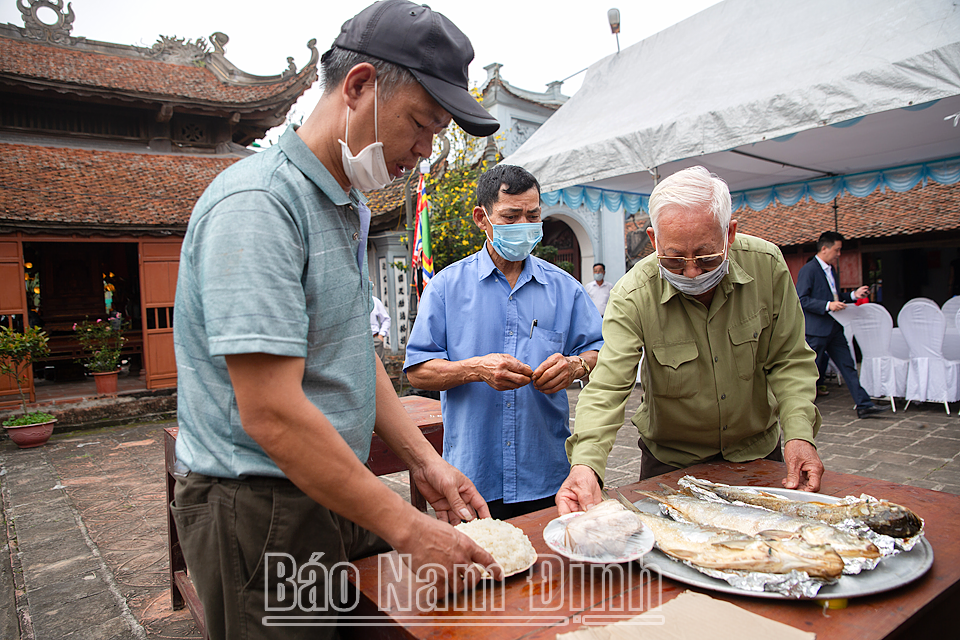
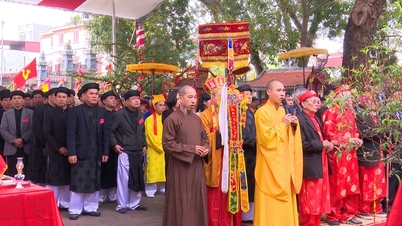
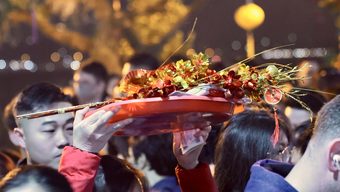
| Elderly people prepare fish offerings to the deities at the Gin Temple festival in Nam Duong commune (Nam Truc district). |
The finest pork sausage offered to the Saint
Gin Temple is a place of worship dedicated to the revered Long Kieu Linh Thanh Kieu Cong Han, who helped Ngo Quyen defeat the Southern Han army on the Bach Dang River in 938. The Gin Temple Festival takes place from the 8th to the 10th day of the 12th lunar month every year, attracting a large number of people from the two communes of Nam Duong and Binh Minh (Nam Truc district). The unique feature of the Gin Temple Festival lies in its elaborate offerings, including the indispensable savory dishes of eight traditional Vietnamese sausages: head sausage, leaf-wrapped sausage, leg sausage, flower-shaped sausage, offal sausage, pomegranate sausage, silk sausage, and sticky sausage. These sausages are meticulously prepared by skilled artisans from the Voc residential area, Phuc Thien village. Among them, three prominent artisans, Mr. Pham Van Minh, Mr. Tran Van Lang, and Mr. Tran Van Huan, are dedicated to preserving and passing down their family secrets. From selecting ingredients to arranging, marinating, boiling, and pressing the sausages, everything is done with great care and meticulousness. The secret to each type of Vietnamese sausage lies in the selection of ingredients and the family recipe. Pork head sausage (giò thủ) is made from the head of a pig. The craftsman thoroughly boils the meat, snout, and ears, then separates the skin and fat. When assembling the sausage, a boiled egg yolk is placed in the center, surrounded by alternating pieces of skin, creating a unique pattern. Similarly, pork offal sausage (giò lòng) uses pig's internal organs combined with minced lean meat; thanks to skillful arrangement, when sliced, the sausage has a central sausage (dồi) and heart and liver arranged around it, creating an attractive shape. Pork belly sausage (giò lấy) is made from tightly rolled fat and skin; when boiled and pressed, each block of sausage displays decorative patterns. Pork leg sausage (giò chân), pork sausage (giò lụa), and pork rind sausage (giò lựu) are all types of sausage made from lean meat. Pork leg sausage uses carefully deboned pork leg, pressed tightly into a firm block; pork sausage (giò lụa) is made from finely ground, white lean pork; pork rind sausage (giò lựu) uses finely chopped fat mixed with minced lean meat. After boiling and pressing, each type of sausage has a uniform color, a rich sweet flavor, and a pleasantly chewy texture. Though simple, each type of sausage embodies a refined taste, preserving the essence of the countryside in the sacred offerings.
Pork sausage wrapped in leaves and flower-shaped sausage are considered miniature works of art. When making pork sausage wrapped in leaves, artisans skillfully slice the meat into thin, even "leaf-shaped" pieces, interspersed with layers of golden-brown scrambled eggs; each slice has nine slices on each "leaf," symbolizing longevity and good fortune. When boiled and pressed, the sausage mold binds the layers of meat and eggs together to form a vibrant leaf shape at the center of each slice. Flower-shaped sausage stands out because the core is shaped into numbers representing the year of the festival; when sliced, the perfectly aligned patterns become clearly visible, marking the sacred time of the festival.
Before each festival season, artisans usually observe a period of fasting, thoroughly cleaning their utensils and meticulously preparing as a solemn ritual. Their skillful hands both preserve ancestral secrets and breathe life into the dish, transforming the processes of butchering, marinating, boiling, and wrapping the pork sausage in banana leaves into culinary works of art. In the reverent atmosphere of the festival, each piece of sausage offered to the deity is imbued with devotion, reflecting the principle of "remembering the one who planted the tree when eating the fruit," contributing to a cultural beauty preserved through generations.
Authentic taste of home
Besides its famous pork sausage platter, Phuong village in Nam Duong commune is also known for its traditional vermicelli and rice cracker making. Previously, this craft only helped villagers improve their daily income, but in recent years, making vermicelli and rice crackers has become the main source of livelihood for many families. The entire village has dozens of households producing vermicelli and rice crackers, creating jobs for hundreds of seasonal workers and providing stable income. The pristine white rice vermicelli, chewy cassava vermicelli, and crispy, fragrant rice crackers from Phuong village have become a popular brand throughout the Northeast and Northern coastal regions of Vietnam.
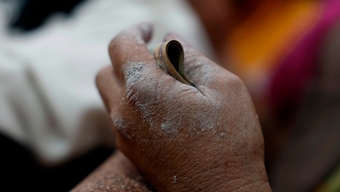
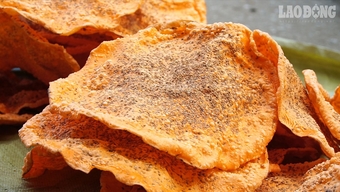
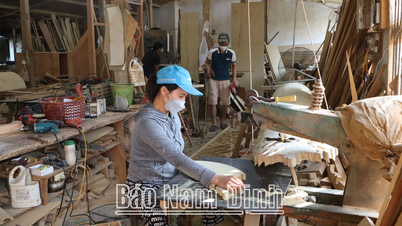
The process of making cassava vermicelli in Phuong village harmoniously combines tradition and modernity. Cassava starch (made from the cassava root), after soaking and washing, is put into a machine to form thin sheets, then steamed until cooked. The cooked vermicelli sheets are translucent white and are dried under intense sunlight to remove excess water; then, the workers put the sheets into a cutting machine to create long, even strands. Thanks to the traditional dough fermentation and drying process, the vermicelli strands have a smooth, translucent texture and a naturally chewy and crispy texture. In recent years, Phuong village has adopted technology to increase productivity. Many households have invested in automatic flour mills, sheeting machines, and cutting machines. Each vermicelli production workshop can produce 200-300 kg per day. As a result, income from vermicelli making has increased significantly, helping people improve their living standards. The saying "vermicelli in the early morning sun, vermicelli in the afternoon wind" has become a daily joy, as the fragrant, delicious vermicelli strands, dried to the perfect degree, create a unique flavor found nowhere else. Along with vermicelli, the rice cracker making craft in Phuong village also bears the distinct mark of the homeland. Unlike many places that add turmeric to the flour to create color, Phuong rice crackers only use pure rice flour and black sesame seeds. The artisans knead the dough, roll it thinly, and bake it over charcoal; when one side of the cracker turns golden brown and crispy, they flip it over to bake the other side. The finished rice crackers have a long-lasting crispness, with the nutty flavor of rice blended with the aroma of sesame. This crispy and fragrant flavor has become a local specialty, making Phuong rice crackers popular in many neighboring areas. Today, vermicelli and rice crackers from Phuong village are exported to various provinces and cities: Hanoi, Hai Phong, Thai Binh, Lang Son, Quang Ninh, and even some provinces in Central and Southern Vietnam. This traditional craft provides a significant source of income, contributing to poverty reduction and promoting local economic development. During the harvest season, hundreds of rural workers have stable jobs in the stages of dough preparation, cracker making, drying, and baking. In 2013, Phuong village was recognized as a provincial-level traditional craft village. The culinary essence of Nam Dinh, through its pristine white vermicelli noodles and crispy rice crackers, continues to be passed down from generation to generation, a testament to the unwavering loyalty and enduring aspirations of generations of people in Nam Dinh.
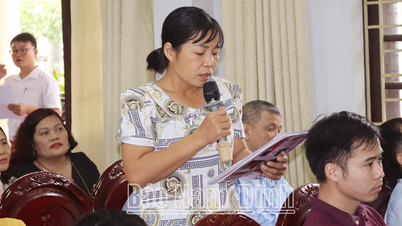
Comrade Pham Quang Khai, Chairman of the People's Committee of Nam Duong commune, said: "In recent years, the local Party committee and government have always paid attention to preserving and promoting traditional cultural values, including culinary heritage and traditional crafts such as making gio (a type of Vietnamese sausage) for offerings to the deities, making vermicelli, and making rice crackers. Besides supporting the recognition of craft villages and organizing activities to preserve the Gin Temple festival, the commune also creates conditions for production households to access loans, expand scale, apply machinery, and improve product quality. This is not only a way to preserve the identity of the homeland but also contributes to promoting socio-economic development in a sustainable direction."
Text and photos: Viet Du
Source: https://baonamdinh.vn/dat-nuoc-con-nguoi/202506/dac-sac-am-thuc-nam-duong-68445e6/



















































Comment (0)