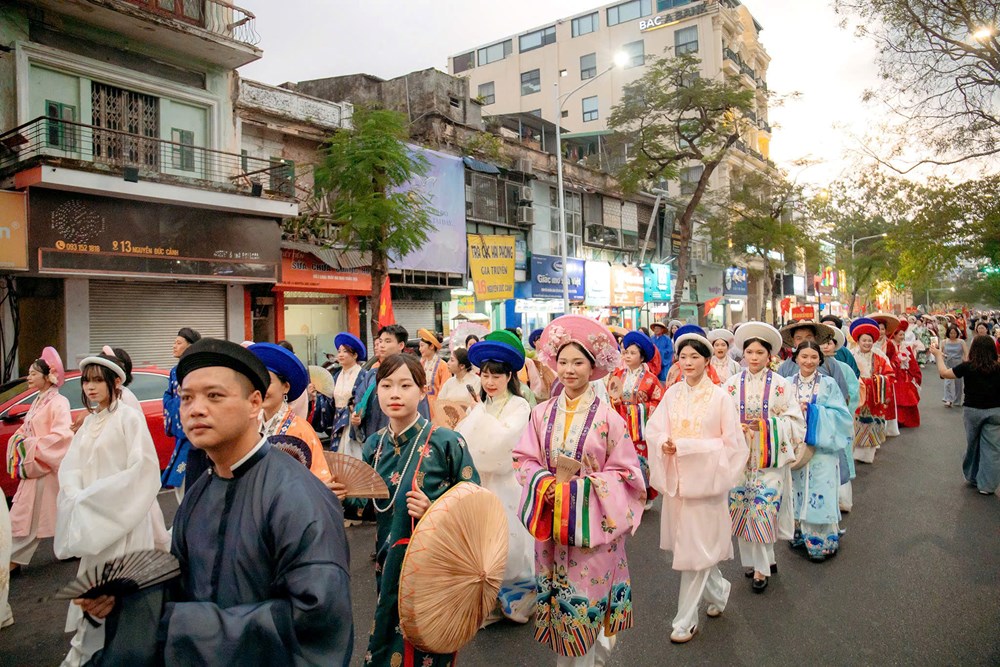
Resolution 80-NQ/TW of the Politburo is opening up new expectations regarding the mechanism for rewarding artists and artisans.
Artists and artisans in the context of new development requirements.
In grassroots cultural life, artists and artisans are not only performers or holders of traditional craft skills, but also the direct force maintaining the connection between heritage and the community.
In Hai Phong, this is quite evident through the presence of art forms such as ca trù, hát đúm, hát trống quân, water puppetry, the Do Son buffalo fighting festival, along with the activities of theater, chèo, cải lương, music and contemporary performing arts groups.
Based on that experience, the new directions in the Politburo 's Resolution 80-NQ/TW and the Government's Decree 215/2025/ND-CP are seen as a crucial shift, as cultural policy not only emphasizes the task of preserving heritage, but also addresses the issue of caring for those who create, practice, and transmit heritage. In other words, for heritage to have a sustainable life, it is first necessary to retain the people who are directly involved in the craft.
The team of artists and artisans currently working in Hai Phong is considered a significant cultural resource for the city, spanning many fields of performing arts and intangible cultural heritage.
This not only reflects the depth of local cultural life but also highlights the need for practical mechanisms to enable this workforce to continue contributing, passing on their skills, and spreading cultural values in contemporary life.
The activities honoring titles, organizing festivals, performances, and community service programs in recent times have contributed to creating more motivation for artists and artisans.
However, in the context of a rapidly changing entertainment market, preserving and developing traditional art forms cannot rely solely on spiritual recognition. What is more essential is the creation of a stable professional environment with mechanisms to support livelihoods, teaching, performances, and creative commissions, so that artists and artisans can remain committed to their craft in the long term.

The Hai Phong Traditional Theatre at the opening parade of the 2026 Hai Phong Expanded Puppet Festival.
It's not just a subsidy.
However, behind the performances and festivals, the majority of artists and artisans still operate primarily out of passion, while facing many economic and professional challenges.
Meritorious Artist Do Quyen, Head of the Hai Phong Ca Tru Guild, said that Ca Tru is an art form that is selective in terms of learners, requiring a long training period, while many artisans still have to find ways to fund the maintenance of their clubs and teach the younger generation for free. Relying solely on love of the profession will make it very difficult to retain the next generation of artists.
In the performing arts sector, Nguyen Thu Thuy, Director of the Hai Phong Traditional Theatre, believes that traditional arts and performing arts currently lack a stable professional environment. Art forms such as Cheo, Tuong, and Cai Luong face significant pressure from the competition of the modern entertainment market; many young, well-trained actors are forced to change professions due to low income and limited performance opportunities.
According to Ms. Nguyen Thu Thuy, the incentive policy needs to be viewed more broadly than mere subsidies, encompassing mechanisms for commissioning artworks, creating regular performance venues, expanding spaces for artistic practice, and bringing traditional art to schools, tourism activities, and communities. This is also the direction many localities are pursuing to create more opportunities for traditional art to reach younger audiences.
In reality, cultural preservation will be difficult to sustain if the people directly involved in creating and teaching it do not have stable conditions to commit to the profession in the long term.
Therefore, along with honoring them with titles, many believe that it is necessary to build a more stable support mechanism for the livelihoods, professional working environment, performance opportunities, and creative commissions for artists and artisans.
With a locality rich in folk culture and vibrant artistic life like Hai Phong, Resolution 80-NQ/TW and Decree 215/2025/ND-CP are expected to lay the foundation for specific policies for artists and artisans.
To preserve the heritage and vitality of art, it is essential to first retain the people who are directly creating, performing, and transmitting cultural values to the community today.
Source: https://baovanhoa.vn/van-hoa/dai-ngo-nghe-si-nghe-nhan-can-nhung-co-che-thuc-chat-230270.html




![[Image] Hanoi's urban life under the challenge of a "scorching hot" environment](https://vphoto.vietnam.vn/thumb/1200x675/vietnam/resource/IMAGE/2026/05/25/1779706979265_nang-nong-t5-2026-minh-duy-7-4636-jpg.webp)
























































Comment (0)