

Rifle bullets can leave the barrel at speeds exceeding 4,300 km/h, fast enough to travel the equivalent of 11 football fields in a second.
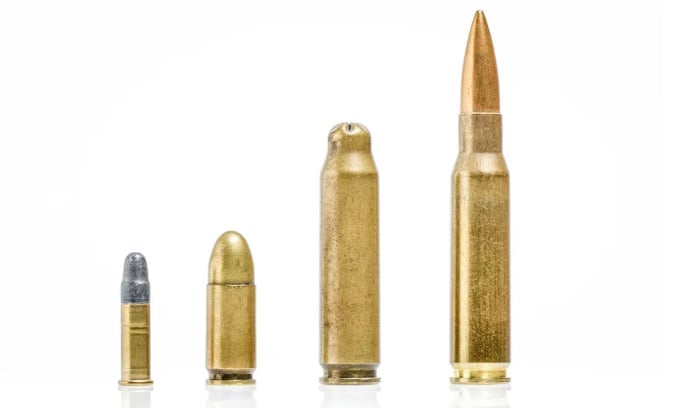
The design of the bullet, whether tapered or rounded, helps determine its rate of fire. Photo: Brais Seara/Getty
Many factors influence the speed of a bullet fired from a gun. These factors can be divided into two main categories: internal ballistics (including the type of propellant, the weight of the bullet, the shape and length of the barrel) and external ballistics (including the forces exerted by wind, gravity, and the trajectory of the bullet as it travels through the air). Both can be categorized under a third type, called terminal ballistics, which describes the bullet's behavior upon impact with its target.
According to forensic scientist Michael Haag, a bullet consists of a primer that ignites the propellant when struck by the gun's firing pin. This ignition creates pressure that propels the bullet forward. Most bullets are made of heavy metals like lead, coated in copper, because their mass helps them maintain momentum. To illustrate, Haag uses the example of throwing a table tennis ball and a golf ball. Both leave the thrower's hand at the same speed, but the mass of the golf ball allows it to travel further.
As soon as the ignition is complete, the gunpowder burns rapidly, creating a propellant that pushes the bullet down the barrel. As it travels toward the muzzle, the bullet rubs against the barrel walls, creating a slight friction. However, guns with longer barrels offer a much faster rate of fire.
"The barrel is really the biggest limiting factor with regard to velocity. The longer the barrel, the more room the air has to increase its velocity, and the faster the bullet leaves the barrel," explains Stephanie Walcott, a forensic scientist at Virginia Commonwealth University.
For this reason, rifles typically offer the highest velocity. Rifles are designed for long-range use. Rifle bullets can travel over 3 kilometers. To achieve such shots, rifle bullets are designed to be aerodynamic, longer, thinner, and heavier than handgun bullets. Gun manufacturers sometimes add spiral grooves in the barrel to make the bullet spin, thereby stabilizing its horizontal trajectory.
These characteristics allow rifle bullets, such as the Remington .223, to leave the barrel at speeds up to 4,390 km/h – fast enough to cover the equivalent of 11 football fields in a second. Meanwhile, a bullet from a 9 mm Luger pistol would only travel half that distance at a speed of 2,200 km/h.
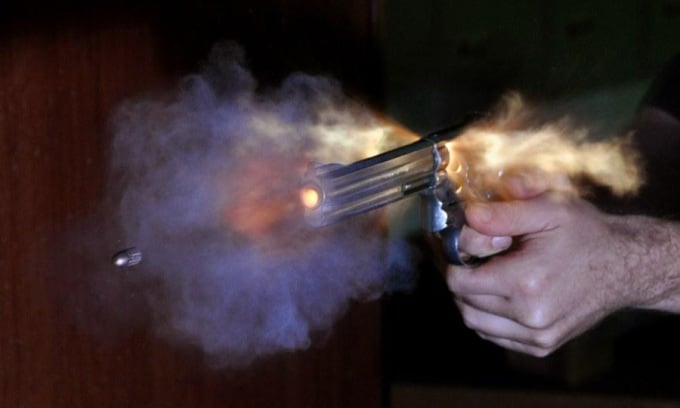
High-speed photograph shows bullets fired from a handgun. Photo: Wikimedia Commons/Niels Noordhoek
Walcott explained that as soon as the bullet leaves the barrel, it begins to decelerate. This is because, according to Newton's first law, a moving object will continue to move unless an external force acts upon it. Among the forces acting on the bullet as it is fired are air resistance, gravity, and gyroscopic motion. Over time, the first two overcome the tendency to maintain the bullet's stable spiral state, causing it to begin to fall. Every bullet has a ballistic coefficient—indicating its ability to overcome air resistance and fly forward—determined by its mass, area, drag coefficient, density, and length. The higher the ballistic coefficient, the better the bullet's ability to penetrate the air.
"But very quickly, gravity and air resistance will start to take over and slow the bullet down. The bullet will travel in a very straight line for a while, then begin to fall and become vulnerable to the surrounding environment," Walcott said.
Thu Thao (According to Live Science )
Source link
![[Photo] General Secretary and President To Lam presides over the meeting to approve the draft report on the results of the second inspection by the Politburo of the Standing Committee of the Hanoi City Party Committee.](https://vphoto.vietnam.vn/thumb/1200x675/vietnam/resource/IMAGE/2026/05/26/1779789811432_a2-bnd-4430-9620-jpg.webp)


















![[GALLERY] USB-C AA batteries are causing a sensation because they're so convenient for tech enthusiasts.](https://vphoto.vietnam.vn/thumb/402x226/vietnam/resource/IMAGE/2026/05/26/1779798818575_p-png.webp)






















































































Comment (0)