

Li Jiyan regretfully turned down two men in their twenties because their profiles didn't meet the criteria to find a wife for a wealthy family with an estimated net worth of around $4.4 million.
A seasoned matchmaker who has brought together 1,000 couples has identified a potential candidate for a zhuixu , a term referring to men who live with their wives' families and have children bearing their mothers' surnames.
However, Li Jiyan promised he would try to find his wife's family some houses or total assets worth around $1.5 million.
The marriage market has changed over the past 30 years, forcing Li Jiyan to shift her focus to finding wives for men who want to live with their husbands' families. This is the opposite of traditional marriage in China, where women live with their husbands' families.
For them, marrying a financially secure woman, without having to buy a house, car, or spend money on a dowry, is a good opportunity. In the event of divorce, they also have a chance to receive a share of the assets, provided the husband takes responsibility for childcare.
Both men who approached Li had good backgrounds and were from Shandong province. One owned an arts and crafts business in Zhejiang province, and the other was a department head at a technology company in Beijing.
However, the standards for becoming a son-in-law are also very high. Mr. Li said that women and their families want a man who is educated and healthy. Applicants must provide information about their financial situation, credit reports, and undergo background checks and health examinations.
Li often flatly refused men who appeared physically weak. Some even did push-ups in Li's office to prove their fitness.
Li's clients also have specific requirements. One family rejected a prospective son-in-law who graduated from Peking University because of his tattoos. Those with administrative jobs or who frequently do volunteer work are given extra points.
"The number of men wanting to live with their wives' families increases every year," Li said. After the two men left Li's office, the six phones on his desk rang incessantly.
They currently have over 170 families and 50 men seeking to become sons-in-law. Most of the bride's families are looking for candidates aged 25-30. They frequently welcome university students who are looking for a shortcut to career advancement.
"It's already difficult for recent graduates to find good jobs, let alone buy property," Li said. Housing prices in Xiaoshan, Hangzhou, are currently $5,000 per square meter. A man without property has virtually no chance in the marriage market.
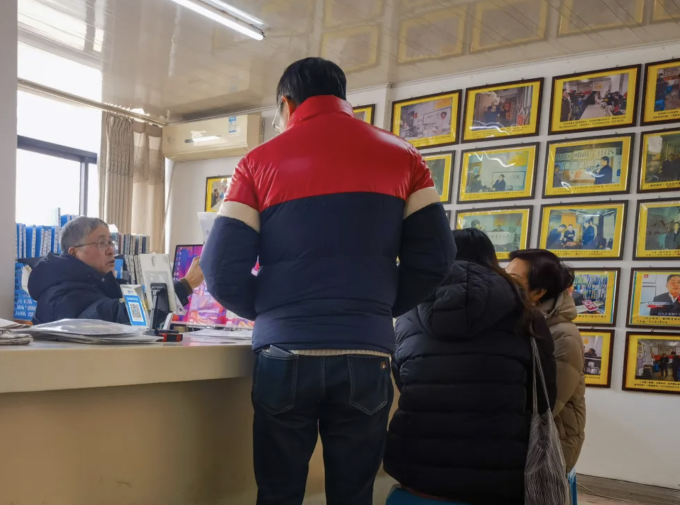
Li Jiyan is chatting with prospective sons-in-law. Photo: Sixth Tone
At a matchmaking center in Hangzhou, the walls are plastered with profiles of men seeking wives. For example, a cheerful, handsome architect born in 1994, who owns a 108-square-meter house in Shandong, is looking for a financially stable woman, considering divorce but without children. The man doesn't specify any requirements regarding the woman's height, appearance, or education.
Mr. Lin Zuwen and his wife are parents actively seeking a son-in-law for their daughter. They own a machinery factory with assets worth $10 million, three properties, and four cars, and are looking for a husband for their 28-year-old daughter.
The matchmaking company connected his family with three candidates, but all were rejected. Lin said the reasons were usually their attitudes or unreasonable demands.
This year, Lin lowered the acceptance criteria, requiring applicants to have only a bachelor's degree but from a top university. "We want our children to inherit their father's intelligence genes," Mr. Lin said.
According to tradition, each family is only allowed to have one son-in-law living with his wife's family. Mr. Chen Guoqiang in Shandong said his eldest daughter has dated at least six men but still hasn't found the right one.
"Some are bald, others are too thin or weak, making it difficult for them to have children," Chen complained. Candidates refused to live with their in-laws for fear of losing face with relatives or bringing shame to their ancestors.
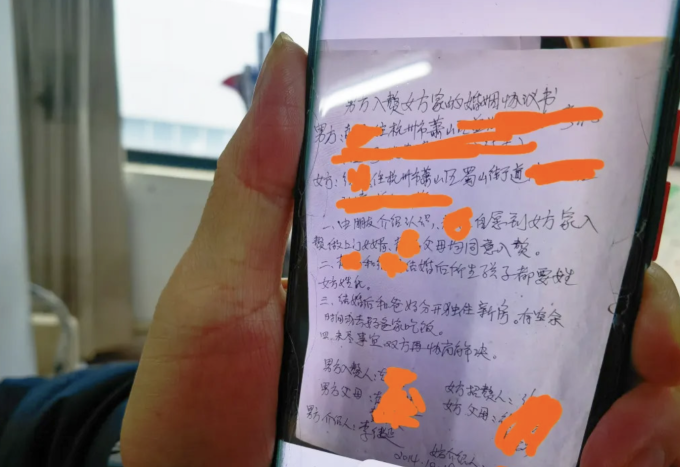
A handwritten marriage agreement for a man living with his wife's family, signed at a matchmaking agency. Photo: Sixth Tone
Gu Shunze, 26, a civil servant in Hangzhou, doesn't see it that way. He was born into a farming family with four brothers in Hebei province. Gu graduated from a top university and has a stable income, but buying a house and a car is still beyond his means.
In 2022, he discovered he met the criteria to enter the marriage market. He submitted copies of his ID card, diplomas, and employment contract to the matchmaking company.
Within a short time, he found a girlfriend whose family was involved in the auto parts business. They dated for three months and got married. His wife's family gave Gu a wedding gift of $44,000 and a BMW. The bride's family arranged everything for the wedding.
Later, they moved into a three-bedroom apartment. Gu said he was happy with his life, and began helping out his wife's family. In January, his wife gave birth to twins, and the children both bear their mother's surname, in accordance with their prenuptial agreement. Since getting married, Gu hasn't visited his hometown, and his parents have only seen their grandchildren in photographs.
However, not all marriages where the wife lives with her husband's family are successful. The Legal News in Xiaoshan reported that the court has reviewed 20 divorce cases related to this type of marriage, mostly initiated by the woman. The most common reasons were personality conflicts, gambling, or infidelity.
Ngoc Ngan (According to Sixth Tone )
Source

![[Photo] General Secretary and President To Lam presides over the meeting to approve the draft report on the results of the second inspection by the Politburo of the Standing Committee of the Hanoi City Party Committee.](https://vphoto.vietnam.vn/thumb/1200x675/vietnam/resource/IMAGE/2026/05/26/1779789811432_a2-bnd-4430-9620-jpg.webp)





















































































Comment (0)