

Currently, there are 3 sets of textbooks from 3 different publishers (Vietnam Education Publishing House, Hanoi University of Education Publishing House, and Ho Chi Minh City University of Education Publishing House) being used for teaching in schools from grade 1 to grade 12.
Reporters have observed that many texts in textbooks need revision because they are no longer relevant to the reality of the merger into 34 provinces and cities as of July 1st.
For example, the 8th grade history and geography textbook (Connecting Knowledge with Life), page 99, the extended section provides information about Phong Nha - Ke Bang cave (formerly Quang Binh province), which is no longer relevant to the current reality because after the merger, the name Quang Binh province no longer exists.
The 4th grade history and geography subject, from the "Connecting Knowledge" textbook series (Vietnam Education Publishing House), consists of 6 topics. Almost all lessons within these 6 topics require corrections to either data, maps, charts, or administrative boundary names.
Alternatively, the data charts and area figures for many provinces and cities will have to be changed because after the merger of provinces and cities, the data on the old maps is no longer accurate. For example, Ho Chi Minh City was over 2,000 km2, but after the merger, its area is nearly 6,800 km2; the population increased from over 9 million to over 14 million.
The place names Lung Cu, Dong Van, and Ha Giang will have to be adjusted to reflect the new administrative boundaries after the merger.
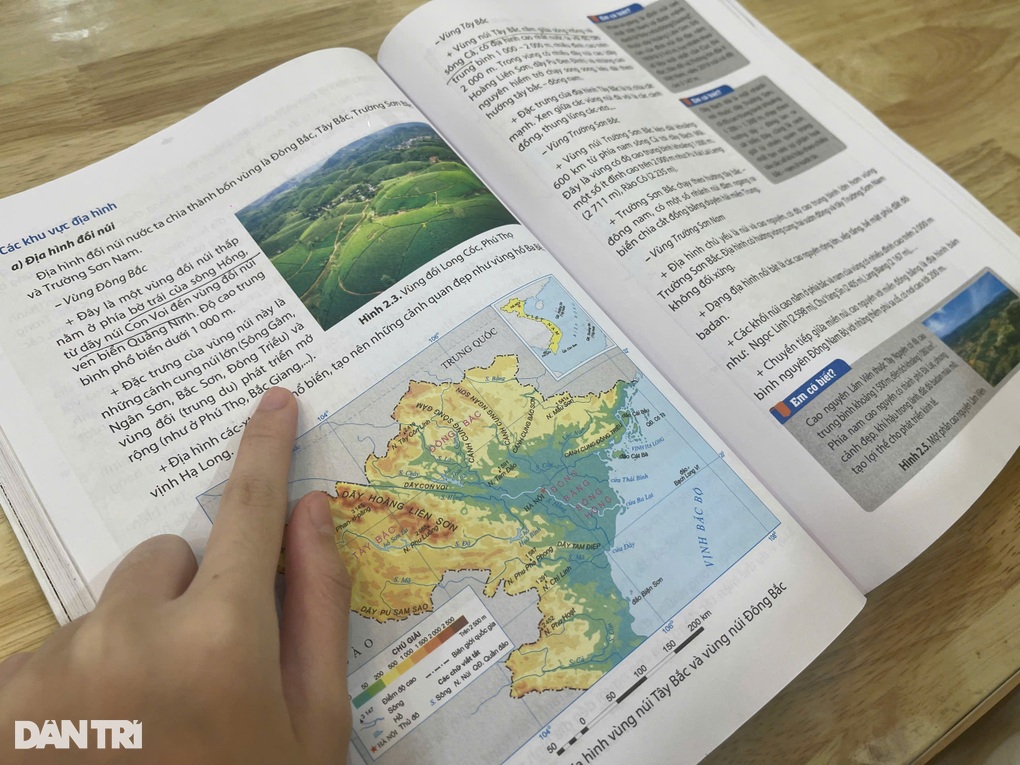
After the merger, the province of Bac Giang was no longer named, and the area of Phu Tho province changed (Photo: My Ha).
Responding to a reporter from Dan Tri newspaper on July 1st, Associate Professor Dr. Nguyen Van Tung - a member of the Board of Directors and Deputy Editor-in-Chief of the Vietnam Education Publishing House (NXBGDVN) - stated that NXBGDVN has instructed its member units to organize the drafts and the editorial boards to review and compile the content regarding required learning outcomes, knowledge, data, place names, maps, charts, socio-economic information related to changes in administrative boundaries and the two-level government, and report to the Ministry of Education and Training for guidance on revisions.
"After the Ministry of Education and Training issues the revised and updated content for the curriculum of some subjects, as announced by the Ministry of Education and Training on June 14th, Vietnam Education Publishing House will proceed with revising the textbooks and submitting them to the Ministry of Education and Training for appraisal and approval according to the correct procedure," Associate Professor Dr. Nguyen Van Tung stated.
According to Associate Professor Dr. Nguyen Van Tung, the principle of revising textbooks must closely adhere to and update the required learning outcomes, knowledge, data, place names, maps, charts, socio-economic information, etc., while minimizing the need for revisions to the textbook content.
"While waiting for textbooks to be revised and updated according to administrative boundaries and the two levels of government, as directed by the Ministry of Education and Training, teachers and students will continue to use the current textbooks."
The Ministry of Education and Training will issue specific guidelines on this matter. The spirit is that schools and teachers will proactively adjust teaching materials, lesson content, and teaching topics based on local realities and the needs of both levels of government.
"From the perspective of Vietnam Education Publishing House, we will actively support schools and teachers in using current textbooks in accordance with the directives of the Ministry of Education and Training," said Associate Professor Dr. Nguyen Van Tung.
A representative from the Vietnam Education Publishing House added that textbooks for the 2025-2026 school year are currently being printed and stored in warehouses for distribution to schools. It is expected that by around July, the textbook needs of students and teachers for the new school year will be largely met.

After the merger, the province of Quang Binh no longer exists (Photo: My Ha).
Previously, on the evening of June 14th, the Ministry of Education and Training announced that the curriculum for some subjects would be revised and updated to include required learning outcomes, knowledge, place names, data, maps, charts, and socio-economic information, which will serve as the basis for revising textbooks.
The Ministry has identified several subjects that will be directly impacted by the changes in administrative boundaries, including: history and geography (grades 4, 5, and 9); geography (grade 12); history (grade 10); and economic and legal education (grade 10).
The curriculum for these subjects will be revised and updated to include required learning outcomes, knowledge, place names, data, maps, charts, and socio-economic information, serving as the basis for revising textbooks.
According to the Ministry of Education and Training, textbooks concretize the content of the general education curriculum and are identified as important learning materials and resources for schools to choose from when organizing teaching and learning.
Teachers and schools are given the autonomy to arrange learning topics, update and supplement content to suit the students, teaching conditions, and practical circumstances.
"Therefore, in the 2025-2026 school year, teachers and schools will continue to use the current curriculum and textbooks, while also being responsible for proactively selecting and adjusting teaching materials, lessons, and topics to suit local realities and the two-tiered government model," the Ministry of Education and Training instructed.
Source: https://dantri.com.vn/giao-duc/dang-dieu-chinh-chuong-trinh-sua-sgk-sau-sap-nhap-tinh-thanh-17-20250701115919133.htm

![[Image] The tenacious fighting spirit of Vietnamese women's football](/_next/image?url=https%3A%2F%2Fvphoto.vietnam.vn%2Fthumb%2F1200x675%2Fvietnam%2Fresource%2FIMAGE%2F2025%2F12%2F17%2F1765990260956_ndo_br_4224760955870434771-copy-jpg.webp&w=3840&q=75)
![[Image] Leaked images ahead of the 2025 Community Action Awards gala.](/_next/image?url=https%3A%2F%2Fvphoto.vietnam.vn%2Fthumb%2F1200x675%2Fvietnam%2Fresource%2FIMAGE%2F2025%2F12%2F16%2F1765882828720_ndo_br_thiet-ke-chua-co-ten-45-png.webp&w=3840&q=75)
![[Photo] Prime Minister Pham Minh Chinh receives Lao Minister of Education and Sports Thongsalith Mangnormek](/_next/image?url=https%3A%2F%2Fvphoto.vietnam.vn%2Fthumb%2F1200x675%2Fvietnam%2Fresource%2FIMAGE%2F2025%2F12%2F16%2F1765876834721_dsc-7519-jpg.webp&w=3840&q=75)
![[Live] 2025 Community Action Awards Gala](/_next/image?url=https%3A%2F%2Fvphoto.vietnam.vn%2Fthumb%2F1200x675%2Fvietnam%2Fresource%2FIMAGE%2F2025%2F12%2F16%2F1765899631650_ndo_tr_z7334013144784-9f9fe10a6d63584c85aff40f2957c250-jpg.webp&w=3840&q=75)
![[Photo] Prime Minister Pham Minh Chinh receives the Governor of Tochigi Province (Japan)](/_next/image?url=https%3A%2F%2Fvphoto.vietnam.vn%2Fthumb%2F1200x675%2Fvietnam%2Fresource%2FIMAGE%2F2025%2F12%2F16%2F1765892133176_dsc-8082-6425-jpg.webp&w=3840&q=75)




































![[Live] Closing Ceremony and Award Presentation for the "Impressive Vietnam Tourism" Video/Clip Creation Contest 2025](https://vphoto.vietnam.vn/thumb/402x226/vietnam/resource/IMAGE/2025/12/17/1765974650260_z7273498850699-00d2fd6b0972cb39494cfa2559bf85ac-1765959338756946072104-627-0-1338-1138-crop-1765959347256801551121.jpeg)












Comment (0)