

After years of experimenting with crops and livestock, Mr. Dao Duy Toan found suitable animals to raise: wild boars and red-fleshed dragon fruit. From there, a pristine, hilly area in Trung Son Street, Dong Son Ward, Bim Son Town, has become a model for effective ecological farm development.
 The rugged and wild Tam Diep mountain range is where Mr. Dao Duy Toan's farm's wild boars come to forage daily.
After winding our way for dozens of minutes along a gravel road bordering the majestic Tam Diep mountain range, we finally arrived at Mr. Dao Duy Toan's semi-wild boar farming model. From afar, the sounds of revolutionary songs emanating from the small house dispelled the desolation of this area bordering Ninh Binh province. According to the officials from the Gardening and Farming Association of Bim Son town who accompanied us, this is one of the most remote areas of Bim Son town; just a few years ago, students and residents still received the 135 program for mountainous regions.
Having been notified in advance by phone, the farm owner had already prepared tea. The stories of reclaiming and establishing a livelihood in this difficult-to-cultivate mountainous region further demonstrate the owner's determination and innovative mindset for production development. The eastern part of the industrial town is mostly hilly and rocky, making cultivation challenging, especially in the Truong Son area. However, with a daring and proactive spirit, in 2012 Mr. Dao Duy Toan boldly bid for 2.6 hectares of land, considered barren and unsuitable for cultivation, to reclaim.
“In the early years, the family faced many difficulties. We lacked experience in large-scale commercial crop cultivation and livestock farming, and we also lacked capital for infrastructure development, so we could only produce on a limited scale. Furthermore, because we hadn't applied science and technology to production, the crops and livestock we experimented with didn't yield high productivity or economic value. Several crop and livestock crops failed, and many people advised me to give up,” Mr. Toan shared.
However, with a strong will to get rich and a passion for agriculture , he gradually restructured his production, slowly finding suitable crops. Along with many trips to learn from and gain experience at various integrated farm models inside and outside the province, he steadfastly chose wild boar farming and dragon fruit cultivation as his main development direction.
According to him, without willpower and determination, it would be impossible to transform a small, flat area with many steep rocky mountains and dense bushes into the prosperous economic model it is today. Using short-term gains to fund long-term growth, he reinvested the annual profits in improving and perfecting the production infrastructure, and to date, the total investment has exceeded 3 billion VND.
After saying that, he led the guests to visit the purebred wild boar farm and showed them the entire production area. Explaining the long, empty pens, Mr. Toan pointed to the rolling mountains and valleys behind the house, saying: "Those wild mountain ranges are where the pigs live and forage. Every morning, I wake up and feed them chopped banana stalks and corn kernels, then chase them up the mountains to graze. In the late afternoon, I scatter food in the pens and tap on things to call them back."
According to Mr. Toan, for many years, successive generations of pigs have become accustomed to the habit and biological rhythm of going to the forest to forage in the morning and returning to the pigsty in the evening. They then grow and reproduce almost wildly. On average, his family maintains 300 to 400 pigs. Among them, there are always about 40 sows, each giving birth to two litters per year, providing nearly 400 piglets. He sells half of the piglets, and continues to raise the rest into market pigs, thus saving money on purchasing breeding stock compared to other farming models.
These pigs, originally from the wild, have been domesticated, resulting in good resistance to disease and virtually no significant illnesses. They are allowed to roam and exercise as they would in their natural habitat, and are not fed industrial feed, leading to delicious and flavorful meat. Every month, traders from Ninh Binh province bring trucks directly to the farm to purchase pigs, supplying them to restaurants in many northern provinces and cities.
 The livestock pens and fish ponds at Mr. Dao Duy Toan's family farm attract many visitors who come to observe and learn from his experience.
Despite maintaining a herd of hundreds of pigs, Mr. Toan's family enjoys a relatively relaxed life thanks to their innovative farming methods. Unlike many places that prioritize rapid weight gain, they avoid industrial feed and effectively reduce farming costs.
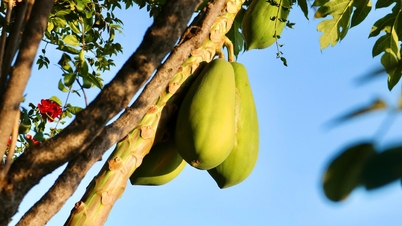
To supplement his income, the Party branch secretary and head of Truong Son neighborhood also built a pigeon breeding farm, maintaining a flock of 12,500 birds. Around his house, he has renovated land to grow 1,600 red-fleshed dragon fruit trees, 50 pomelo trees, and many other fruit trees such as Thai jackfruit, persimmon, and late-ripening longan. He also dug a 7,000m² pond in the low-lying hillside at the foot of the mountain to raise fish, utilizing agricultural and livestock by-products.
After more than a decade of dedicated effort, Mr. Toan's family's eco-friendly production model has proven its effectiveness and sustainable development. According to his calculations, in 2023, this integrated farm generated approximately 1.57 billion VND in revenue, including 1.2 billion VND from 10 tons of commercial wild boar meat. The remainder came from pigeons, 25 tons of dragon fruit, and various types of fish. Not only do the three permanent workers have additional employment, but seven seasonal workers from the local area also find work, earning an average of 7 million VND per person per month.
In recent years, while many pig farmers, especially those raising pigs on a large, industrial scale, have reported losses and had to abandon their farms, this model has yielded high profits due to its low investment requirements. Persisting with clean production methods, Mr. Toan's family farm has become a small ecological zone in the eastern part of Bim Son town. Although he is already 72 years old, he still harbors the ambition to one day complete the necessary procedures, raise ostriches, peacocks, deer, and other animals, and invest in infrastructure to transform the area into an eco-tourism destination.
According to officials from the Bim Son Town Gardening and Farming Association, the organic ecological farm model of member Dao Duy Toan is a new and unique direction in local economic development. Its sustainability is demonstrated through a production process that yields clean, safe, and hygienic food products, which have earned the trust of customers.
Text and photos: Linh Truong
Source


































































Comment (0)