

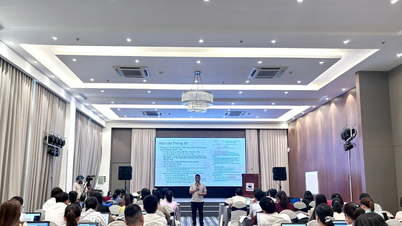
At the program "Exploring Vietnam's Indigenous Resources: When Grass Leaves Become 'Green Gold' on Global Shelves," organized by the Association of High-Quality Vietnamese Goods Businesses, the Business Research and Support Center (BSA), and the High-Quality Vietnamese Goods for Integration (BSAS) project on August 24th, businesses shared valuable "real-world" experiences.
Follow the trends and innovate continuously.
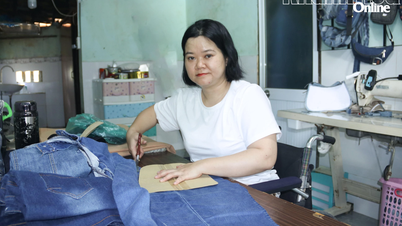
Ms. Tran Hoang Phu Xuan, founder of Faslink Joint Stock Company and Vice President of the Ho Chi Minh City Textile and Garment Association, stated that the fast fashion industry has a 30-40% oversupply and is the second-largest polluter in the world. Therefore, Faslink is proactively developing sustainable fashion, even though this is a difficult path because the products are often expensive. Furthermore, relying solely on product sustainability for marketing is not enough to attract consumers.
"When we tested products made from pandan leaf fibers, we were surprised by their outstanding natural antibacterial properties. This is what makes consumers willing to pay a higher price for the product," Ms. Xuan shared her experience.
According to data from the Ministry of Agriculture and Environment , Vietnam's pineapple cultivation area is currently around 52,000 hectares, with a target of increasing to 55,000-60,000 hectares by 2030 due to the expanding import market. As a result, the supply of pineapple leaves for the textile industry is quite abundant, meeting the localization needs of the industry in the face of new competitive pressures. However, most textile businesses still engage in low-value processing, and many are hesitant to change.
"Through trade promotion, we've seen that Vietnamese businesses are very weak and lack investment to expand globally. Only through self-research and development (R&D) can products have good prices, and from there, reinvest in raw material areas," Ms. Xuan suggested.
Mr. Lai Tri Moc, General Director of Vietnam Housewares Joint Stock Company, said that the elephant grass plant has strong vitality and is a good, inexpensive material for businesses producing handicrafts, while also providing farmers with additional income instead of simply discarding it as before, causing waste. "We just sold a batch of household goods made from elephant grass that had been in storage for 3 years, and the quality is still good, without fading or molding like other materials," Mr. Moc revealed.
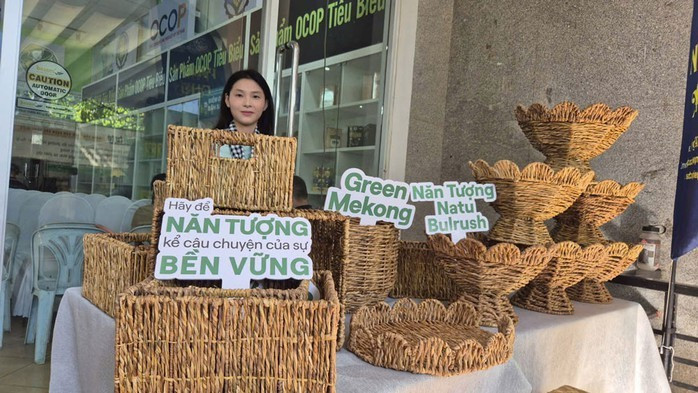
The General Director of Vietnam Housewares concluded that the key to bringing products to the international market is to follow trends and constantly change designs. Simply changing the design details—raising or lowering the height, adding decorative bows, or adding curves—can significantly influence consumer purchasing decisions. "Many traditional craft villages have declined because they haven't changed their products for years, resulting in poor sales," Mr. Moc cited as an example.
According to Mr. Do Dang Khoa, founder of Green is Gold Co., Ltd. (Lang Muop brand), using only loofah fiber as the raw material, the company can tell a story to customers every day about its applications as a replacement for plastic materials. "For loofah dishwashing sponges alone, we have 30 designs for customers to choose from. Today's consumers choose goods not only for their functionality but also for their green, clean, and beautiful appearance," Mr. Khoa explained.
Lang Muop has also recently launched a livestream sales channel and has reached the maximum number of orders allowed by the e-commerce platform in the initial phase, which is 200 orders per day.
Great potential, but a breakthrough is needed.
According to the Department of Cooperative Economics and Rural Development - Ministry of Agriculture and Environment, Vietnam produces approximately 156 million tons of agricultural by-products annually, including straw, rice husks, and sugarcane bagasse. Of these, only 10%-35% are used in production, while the remainder is released into the environment, causing pollution.
Although there are currently many initiatives utilizing agricultural waste, their application remains small-scale and fragmented, failing to form a trend, create a large market, or establish a circular economy product chain. Towards the goal of carbon neutrality by 2050 (Net Zero), Vietnam aims to increase the recycling and reuse rate of agricultural by-products to 70% by 2030 in key sectors such as rice, coffee, and livestock.
In an interview with a reporter from the Nguoi Lao Dong newspaper, Ms. Vu Kim Hanh, President of the Association of High-Quality Vietnamese Goods Businesses, frankly pointed out the weakness in developing products from agricultural by-products: the commercialization stage. Ms. Kim Hanh cited the example of a company that, five years ago, produced pandan leaf fiber but failed because it lacked connection to post-production stages. She also mentioned that while scientists have shown that the use of the sedge plant for handicraft production has been promising since 2002, its use has only recently been promoted.
"Previously, product lines made from agricultural by-products were only at the experimental stage or for small-scale souvenir production. Many by-products that were once considered 'waste' are now becoming raw materials and components for some new industries thanks to technological advancements," said Ms. Kim Hanh.
According to the Chairman of the Association of High-Quality Vietnamese Goods Businesses, enterprises wishing to explore these new "gold mines" need systematic investment across multiple stages – from designing new, modern products that attract customers with competitive prices to developing and maintaining a stable supply of raw materials without interruption. Simultaneously, they need to shift from researching new products to actual business operations, selling products to larger markets, generating added value, and providing fair compensation to people in the raw material producing regions to ensure sustainability.
Text and photos by: NGOC ANH (NLDO)
Source: https://baogialai.com.vn/danh-thuc-tai-nguyen-ban-dia-post564692.html
![[Photo] The courage of new recruits of Brigade 144 on the training ground.](https://vphoto.vietnam.vn/thumb/1200x675/vietnam/resource/IMAGE/2026/05/27/1779881651341_anh-man-hinh-2026-05-27-luc-18-32-52.png)
![[Photo] The heat at the fireworks display site on the opening night of the Da Nang International Fireworks Festival 2026](https://vphoto.vietnam.vn/thumb/1200x675/vietnam/resource/IMAGE/2026/05/27/1779889741485_ndo_br_z7872039145157-fecaba5112f39e8352544099d7ef4738-5140-jpg.webp)












































![[Photo] The courage of new recruits of Brigade 144 on the training ground.](https://vphoto.vietnam.vn/thumb/402x226/vietnam/resource/IMAGE/2026/05/27/1779881651341_anh-man-hinh-2026-05-27-luc-18-32-52.png)

















Comment (0)