

(NLĐO) - While idly reviewing "Dai Nam Nhat Thong Chi" and "Dai Nam Nhat Thong Toan Do," I realized just how vast Vietnam was during the reign of Emperor Minh Mang.
A vast country requires the best possible governance to ensure its development. To achieve the best governance, one must have the best administration. King Minh Mạng implemented administrative reforms in 1831. Later generations consider this one of the two best administrative reforms in Vietnamese history. The first was implemented by King Lê Thánh Tông in 1466.
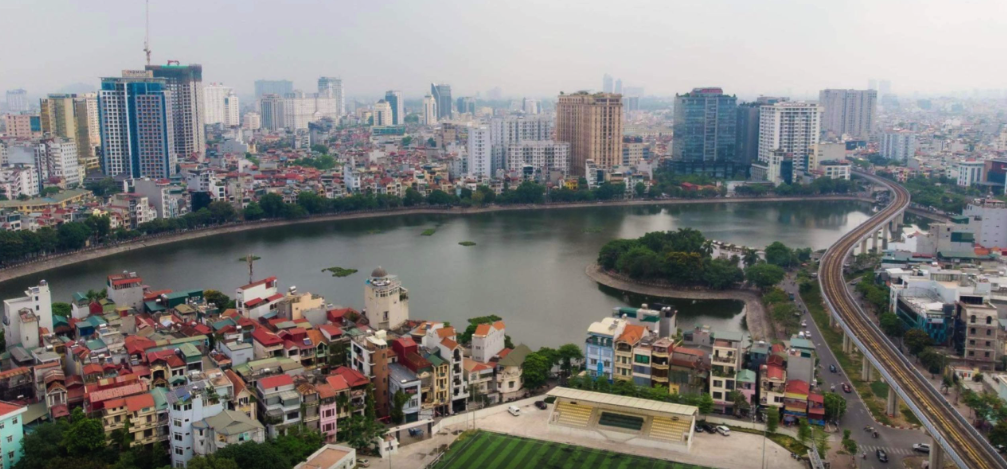
The naming of the new administrative unit after the merger has attracted considerable public attention. Photo: HUU HUNG
During the reforms, following the reorganization of the central government, King Minh Mạng reorganized the local government. The entire country was divided into 30 provinces and one Thừa Thiên prefecture to manage the capital region. Northern Vietnam had 13 provinces, Central Vietnam 11 provinces and one prefecture, and Southern Vietnam 6 provinces. The provincial-level administrative unit in Vietnam has existed since that time.
In 1858, the French fired the first shots of their invasion of our country. From that day on, the French forced the Nguyen Dynasty to sign numerous treaties, gradually selling off our country to France. The final treaty was the Patenôtre Treaty of 1884. According to these treaties, Cochinchina was a colony, Tonkin a protectorate, and Annam an autonomous territory.
The six southern provinces of Vietnam were divided into many smaller provinces by the French according to French regulations.
Central Vietnam was an autonomous region, so the French did not interfere much. The provinces basically remained unchanged, only ceding large parts of Thanh Hoa, Nghe An, Ha Tinh , Quang Binh, and Quang Tri provinces to other countries according to the decree on the three-country border demarcation by the Governor-General of Indochina, and transferring Ninh Thuan prefecture of Binh Thuan province to Ninh Thuan province.
Northern Vietnam was the most turbulent region. It witnessed numerous uprisings by all ethnic groups against the French colonialists, both Kinh and mountain people, such as the rebellions led by Hoang Hoa Tham, Doc Ngu, and Doc Tit. Therefore, initially, the French used military rule, establishing five military districts. After suppressing the resistance, they began to reorganize the provinces. Through their "divide and conquer" policy, they divided the 13 provinces of Northern Vietnam into more than 30. At one point, Nguyen Khuyen counted as many as 36 provinces, as reflected in a couplet celebrating the French mother Tu Hong:
"There are canopies, incense burners, and altars dedicated to the king; her fame resounds throughout 36 provinces." The old man wanted to convey the widespread fame of the French woman at that time throughout Northern Vietnam.
The division of Northern Vietnam into over 30 provinces at almost the same time inevitably led to inadequacies, impositions, and arbitrariness in naming. At that time, some provincial names sounded quite ridiculous and had to be revised, but others are still in use today. The French at that time had a method of naming provinces based on the location of the residence of the provincial governor.
In 1896, when Hanoi's inner city and surrounding areas became a French concession, the French decided to move the administrative offices of the remaining part of the former Hanoi province to Do village in Thanh Oai district. This village had a beautiful tiled bridge over the Nhue River, which people called Do Bridge. The provincial headquarters was located next to Do Bridge, so the French named the remaining area of the former Hanoi province Do Bridge Province! Later, the educated Governor-General of Do Bridge Province requested that it be renamed Ha Dong Province!
The old name of Hoa Binh province sounds quite amusing. The French, finding Hung Hoa province too vast, decided to divide it into several smaller provinces. Upon surveying the area, they discovered that many districts were predominantly inhabited by the Muong people, and that Lac Son and Lac Thuy districts of Ninh Binh province were also inhabited by the Muong. They decided to merge these areas to form a new province, initially named Muong Province. The provincial headquarters was initially located in Cho Bo, but to maintain consistency with the naming convention, the province was renamed Cho Bo Province. The provincial capital, situated in a remote mountain town, was attacked by Doc Tit's rebel forces, who seized the headquarters and killed the French deputy commissioner. The French authorities had to move the provincial headquarters further south, to Hoa Binh commune, about 30 km away. The name Hoa Binh (meaning "peaceful") originated from this event. Fortunately, Hoa Binh is a beautiful name and was not changed!
The name of Lao Cai province is also a subject of much debate. Even now, some people say Lao Cai, others call it Lao Cai, and some even say it's Lao Kay or Lao Kay. The reason for this is the origin of its name!
During the French colonial period, Lao Cai province was part of Quy Hoa and An Tay prefectures of Hung Hoa province during the reign of Minh Mang. The French recognized this as a strategically important area and established a military outpost stretching along the border from Simacai to Phong Tho. After the situation stabilized, it was civilianized and renamed Lao Cai province (Lao Cai, Lao Kay, Lao Kay).
The name originates from a settlement established by Chinese immigrants at the confluence of the Red River and the Nam Thi stream within the territory of Dai Viet (Vietnam). Shortly after, some Vietnamese, Tay, and Nung people also migrated and established a market downstream of the Red River, a few kilometers away. The residents of the settlement at the Nam Thi confluence mostly spoke Mandarin Chinese, proudly proclaiming themselves the first settlers, calling themselves "lao nhai" (meaning "old street" in Sino-Vietnamese), while those who settled later were called "tan nhai," or "new street," hence the name Pho Moi (New Street) as it is known today.
The word "lão nhai" in the Quan Hoa, Tay Nung, and Mong languages became Lao Cai and its variations as above. When the military district was established and transformed into a province, the provincial capital was located in the old hamlet, so the province's name was also taken from the old hamlet, Lao Cai province (Lao Cai, Lao Kay, Lao Kay, Lao Nhai). That name was used to refer to a vast border region that our ancestors had given beautiful and meaningful names to in the past. The name given by the French was only suitable for naming a neighborhood or town.
That's a very arbitrary, haphazard, and impulsive way of naming things by the French.
That naming convention was also adopted by the French for many other provinces and cities in the former Tonkin and Cochinchina! Many of these names are still in use today.
Our government is undertaking a truly monumental administrative reform to usher in a new era for Vietnam, a new period of national development. Hopefully, history will record this as the third successful administrative reform in Vietnam. Hopefully, the name of this new province will inherit the national traditions and cultural heritage of our ancestors, discarding the inappropriate remnants of the colonial era, and reflecting the upward momentum of the new era!
Looking forward to a new era.
Source: https://nld.com.vn/dat-ten-tinh-o-ta-xua-va-nay-196250327183351058.htm




















































































Comment (0)