

 |
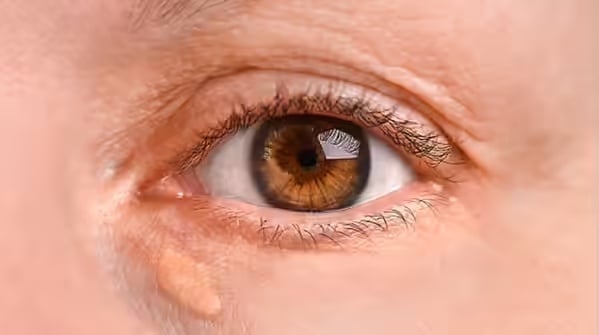
Hard, yellowish nodules that often appear on the eyelids are a sign of high cholesterol. |
High cholesterol has long been dubbed the "silent killer." Right now, your blood fat levels may be dangerously high even without any warning signs like chest pain or shortness of breath. It silently thickens the walls of arteries, causing blood vessel blockages and stealthily preparing for a heart attack or stroke years later.
The dangers of rejuvenation
Data from the U.S. National Health and Nutrition Examination Survey (2021–2023) shows that approximately 11.3% of adults aged 20 and older have high blood lipid levels. This means that nearly 25 million people are living with cholesterol levels above 240 mg/dL – a red flag.
More worryingly, this condition is becoming increasingly common as early as the age of 20-30. According to Dr. Ashish Kumar Govil (Max Super Speciality Hospital, India), early detection is crucial because high blood lipid levels often don't cause noticeable symptoms until they lead to heart disease or stroke.
Signs from the eyes and skin
Although it progresses silently, the body still reveals signs that, if we pay close attention, we can recognize:
A ring around the cornea: A grayish-white ring surrounding the iris, known as the corneal arcus . A 2021 study in the Journal of Translational Medicine indicated that people under 50 who exhibit this sign have a significantly higher risk of coronary artery disease. This is a result of cholesterol leaking from blood vessels and depositing in the cornea.
Xanthomas: These are hard, yellow nodules that often appear on the eyelids, elbows, knees, or Achilles tendon. Essentially, these are pockets of cholesterol that have no more room in the blood and accumulate under the skin.
Alarmingly, a recent study documented the case of a 12-year-old boy from China who developed these nodules all over his body with a terrifyingly high cholesterol level of 752.1 mg/dL due to an uncontrolled genetic factor.
Formulas that lead to early cardiovascular disease.
Dr. Govil emphasized that for young people, the main culprit often lies in their lifestyle. The "recipe" for early cardiovascular disease includes:
- A diet high in processed and fatty foods.
- Sedentary lifestyle and smoking habits.
- Prolonged stress.
In addition, factors such as obesity, type 2 diabetes, and family history play a crucial role. If your parents have a history of high cholesterol, your risk doubles.
The only way to defend yourself.
Don't wait until your body sends out distress signals because by then the damage may already be very serious. Initial symptoms are often subtle, such as fatigue, mild shortness of breath, or dull chest pain. Many people often mistake these for lack of sleep or poor physical condition. However, these signs usually only appear when arteries have become blocked after years of damage.
You can't guess your blood lipid levels by feeling them. The only way is through a blood test (lipid profile) to determine the following indicators: total cholesterol, LDL (bad), HDL (good), and triglycerides.
Health experts recommend that adults have their cholesterol checked at least every 4-6 years, starting at age 20. If you have any of the risk factors or signs mentioned above, get tested immediately because in this battle, complacency is a deadly mistake.
Source: https://znews.vn/dau-hieu-canh-bao-mo-mau-cao-post1649777.html



![[Photo] General Secretary and President To Lam receives Amazon's Senior Vice President David Zapolsky](https://vphoto.vietnam.vn/thumb/1200x675/vietnam/resource/IMAGE/2026/05/22/1779466547770_a1-bnd-3513-6601-jpg.webp)





















































































Comment (0)