

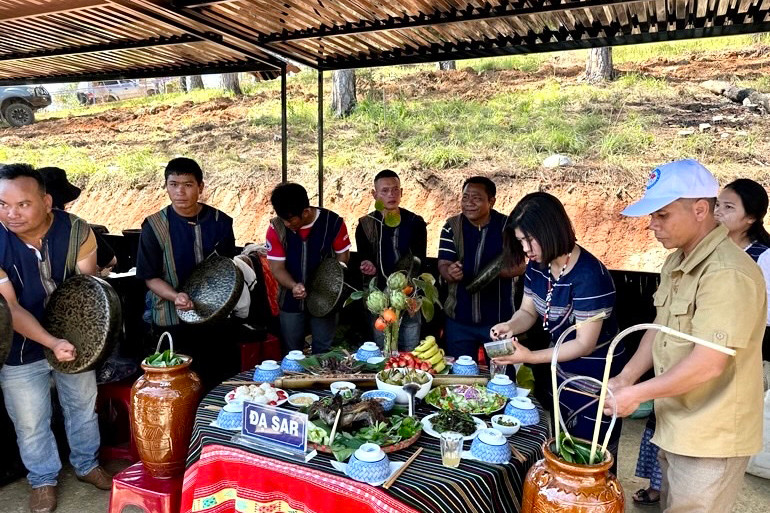
Like other ethnic groups in the Central Highlands, when discussing the traditional culture of the K'ho-Lach people, one cannot ignore the culture of making and using rice wine. Since ancient times, every K'ho household at the foot of Lang Biang mountain (Lang Biang ward - Da Lat) has had several jars of fragrant, fermented rice wine to entertain honored guests or for important family events.
In Bon Đưng I residential area, Mrs. Pang Ting Mồk is one of the long-time rice wine makers in the locality. Mrs. Mồk began learning to make rice wine from her grandmother and mother at the age of 15. Having been involved in the rice wine making profession for over 45 years, according to Mrs. Mồk, making a delicious jar of rice wine requires very elaborate preparation. The ingredients are entirely natural, such as rice, rice husks, corn, cassava, etc., combined with yeast made from forest leaves, and fermented with dried banana leaves for about 1.5 to 2 months to produce fragrant, strong wine ready to drink. To achieve the delicious and distinctive aroma and taste of rice wine, the most important ingredient is the yeast. “Previously, the K’ho people in the village used to go into the forest to collect leaves, bark, and roots of medicinal herbs to make yeast for rice wine, but now some plants around the house can also be used to make yeast, so people don’t have to go far. Some people also make it using yeast bought from the market, but the taste can’t compare to yeast made from forest leaves,” Mrs. Mồk said.
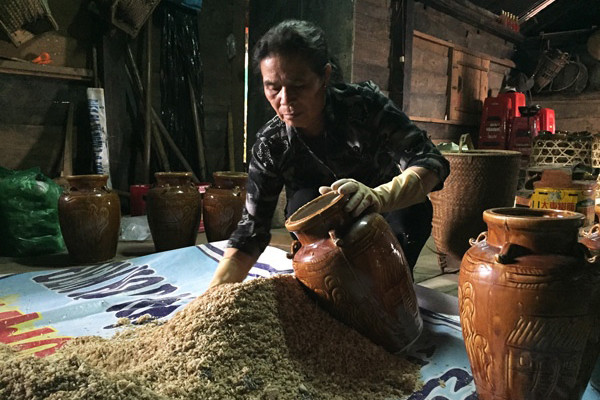
The traditional rice wine-making craft of the K'ho people at the foot of Lang Biang mountain has been passed down through many generations. This craft is considered a supplementary occupation during the agricultural off-season, primarily serving family and village needs during festivals, holidays, weddings, and other celebrations. However, since the tourism industry began developing in the area, the local people have quickly introduced their rice wine to tourists, providing a relatively stable income. Currently, in the ethnic minority communities of Lang Biang ward, Da Lat, there are approximately 200 households producing rice wine, many of which operate regularly, with hundreds of jars of ready-made rice wine displayed in their homes. The rice wine is supplied to tourist areas and attractions for cultural exchanges, gong performances, and bonfires. This has become a distinctive cultural feature of the K'ho people in the area, and many tourists visiting Lang Biang, Da Lat, want to experience it.
To preserve and promote this unique cultural feature, the Lac Duong district (now Lang Biang ward - Da Lat) established a cooperative for the production and sale of rice wine under the brand "Lang Biang Rice Wine," which is well-known to domestic and international tourists. Lang Biang Rice Wine has been granted intellectual property rights by the Intellectual Property Office. In addition, in 2015, the Provincial People's Committee recognized the Bon Lang Biang rice wine making village as a traditional craft village.
Mr. Cil Poh, Vice Chairman of the People's Committee of Lang Biang Ward, Da Lat, said that rice wine is a unique cultural feature of the K'ho ethnic group that the locality is preserving and developing. In particular, incorporating rice wine into tourism in the area not only helps preserve and spread traditional cultural values but also creates opportunities for people to participate in tourism activities, increase their income, and develop a sustainable economy .
In the ethnic minority area of Lang Biang ward, Da Lat, there are approximately 200 households producing rice wine, many of which are regular producers. This rice wine is mainly supplied to tourist areas and attractions to serve visitors during cultural exchanges, gong performances, bonfires, etc.
Source: https://baolamdong.vn/thom-nong-ruou-can-lang-biang-443566.html














































































Comment (0)