

Proactively manage seasonal schedules.
From Vinh Xuong commune to Chau Phong commune, Tan Chau ward, and Long Phu ward, farmers not only adhere strictly to the planting schedule and effectively avoid pests, but also strongly shift towards producing high-quality rice, reducing costs and increasing value right from the first crop of the year. “The upstream area of the Tien River is uniquely affected by floods, water resources, and the planting schedule. Given the increasingly evident changes in climate, organizing production in a proactive and scientific manner is no longer a temporary solution but a mandatory requirement, clearly demonstrating a shift in thinking in agricultural production,” shared Bui Thai Hoang, Chairman of the People's Committee of Vinh Xuong commune.

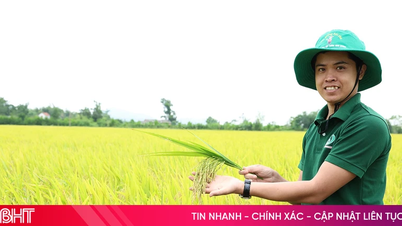
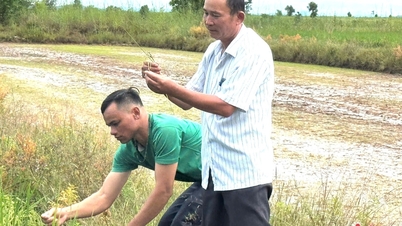
Farmers share their production experiences. Photo: MINH HIEN
Over the years, implementing the province's policy of flexible planting schedules, early and concentrated planting to avoid pests and drought, and reduce risks, upstream localities have agreed on a production model of "5 crops in 2 years," combined with flexible flood release to replenish alluvial soil and restore natural fertility. According to Mr. Phan Hong Khanh, Chairman of the People's Committee of Long Phu Ward, strict adherence to the planting schedule is a key factor determining the effectiveness of the crop. The ward government proactively coordinates with specialized departments and farmers to agree on a planting framework, plant crops simultaneously, and operate the sluice gates, sluices, and pumping stations rationally to ensure water supply and minimize risks from weather and pests.
The 2025-2026 winter-spring crop season shows that this proactive approach has proven effective not only in Long Phu ward but also in Tan Chau ward. Tan Chau ward planted 1,022 hectares of rice, with an expected average yield of 7.5 tons/ha, resulting in a total production of approximately 7,665 tons. The planting schedule was concentrated from December 10th to 25th, 2025, ensuring simultaneous planting and avoiding pest infestations from the beginning of the season.

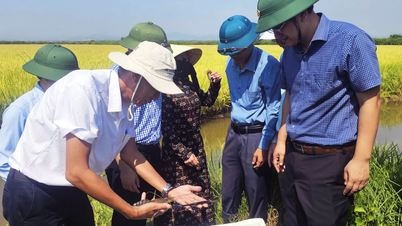
Farmers visit rice fields in Chau Phong commune. Photo: THANH TIEN
In Chau Phong commune, this year's winter-spring crop was implemented on an area of 3,737 hectares, achieving 100% of the plan. This is a key rice production area in the upstream region of the Tien River. The rice is currently 30 days old, and pests are being closely monitored, with timely guidance provided to farmers on pest control, creating a foundation for the entire production season. According to Mr. Tong Phuoc Dieu, Vice Chairman of the People's Committee of Chau Phong commune, adhering to the planting schedule not only helps reduce production costs but also gives farmers peace of mind. "We consider proactively managing the planting schedule, regulating water, and avoiding pests as important solutions to adapt to climate change and ensure stable and sustainable production for the upstream region."
Improving rice grain quality
The shift in mindset regarding rice production in the upstream areas of the Tien River begins with concrete actions, closely linked to the fields and the natural conditions of each locality. Beyond simply striving for a bountiful harvest, this year's winter-spring crop sees a strong focus on improving rice grain quality, reducing input costs, and increasing added value. This represents a clear shift in production thinking, aligning with the restructuring of the rice industry and the goal of increasing export value as envisioned by the Ministry of Agriculture and Environment .

Farmers in Tan Chau ward are stepping up mechanization in land preparation. Photo: MINH HIEN
In Tan Chau ward, by 2026, the locality will implement the Sustainable Development Project of 1 million hectares of high-quality, low-emission rice. On this area, advanced farming processes will be applied synchronously, helping to reduce the amount of seeds, fertilizers, pesticides, and irrigation water by 20%; 100% of the area will have consumption linkages, increasing profits for farmers by over 40%.
Chau Phong commune has identified high-quality rice as the main direction in its agricultural production structure. By 2026, the total rice cultivation area in the commune will be approximately 9,000 hectares, with high-quality rice varieties accounting for over 97%, and an average yield of 6-7 tons/ha. In the winter-spring crop alone, the estimated production is over 28,000 tons, further affirming its role as a key production area in the upstream region. Mr. Trinh Van Dut, Director of Tan Phu A1 Agricultural Cooperative, believes that the shift in mindset regarding rice farming must be linked to linkages. “When farmers participate in cooperatives, production follows a unified process, reduces seed usage and costs, and businesses guarantee purchase, resulting in higher economic efficiency compared to the fragmented methods of the past,” Mr. Dut stated. Mr. Khuu Ba Phu, residing in Chau Phong commune, shared: "Nowadays, rice farming is no longer about chasing quantity like before, but about focusing on quality and reducing costs. By following proper techniques and schedules, and having a stable market for the produce, farmers feel secure."
The practical experience in Tan Chau and Long Phu wards, as well as Vinh Xuong, Chau Phong, and Tan An communes, shows that the general trend in the upstream Tien River region is to cultivate rice not only for higher yields but also for lower risks, cleaner production, and greater efficiency. The 2025-2026 winter-spring crop will not only usher in a prosperous season for farmers but also lay an important foundation for the sustainable agricultural development goals and flexible adaptation to climate change for the entire region in the coming years.
MINH HIEN
Source: https://baoangiang.com.vn/dau-vu-vung-mua-lua-ben-a475831.html
![[Image] "Journey of Hope" promotes the organ and tissue donation movement in Vietnam.](https://vphoto.vietnam.vn/thumb/1200x675/vietnam/resource/IMAGE/2026/05/20/1779294400833_1-8910-jpg.webp)
![[Photo] General Secretary and President To Lam works with the Party Committee of the Ministry of Health on the work of Vietnamese traditional medicine.](https://vphoto.vietnam.vn/thumb/1200x675/vietnam/resource/IMAGE/2026/05/20/1779294323718_a1-bnd-2978-3319-jpg.webp)















































Comment (0)