ACADEMIC IN-DEPTH, FINANCIAL RESOURCES, ALUMNI…
Dr. Vo Van Tuan, Vice Rector of Van Lang University, assessed: "Looking back over the past 30 years, it is clear that the private university sector in Vietnam has made remarkable progress. From being considered merely a supplement to the public system, many universities now have tens of thousands of students, possess modern facilities, have strong internationalization capabilities, their brands are increasingly recognized by society, and they are making increasingly significant contributions to higher education ."

After 30 years, private universities in Vietnam have developed significantly, boasting large-scale training programs, modern facilities, and international standards.
PHOTO: XD
However, if the goal is to build a strong reputation, Dr. Tuan believes that Vietnamese private universities are still lacking some strategic elements.
First and foremost is academic depth. Over the years, many universities have invested heavily in facilities, technology, student experience, and recruitment. However, a university's long-term reputation is not determined by campus size or student numbers, but by the intellectual contributions it makes to society.
Secondly, there is the issue of long-term academic financial resources. Currently, most private universities in Vietnam still operate primarily based on tuition fees. This puts them under constant pressure to recruit students, maintain scale, and secure revenue to operate.
Next, there is a lack of sufficiently strong alumni ecosystems. Large universities around the world often have hundreds of thousands of successful alumni holding leadership roles in politics , economics, science, and society. This community not only builds the university's prestige but also contributes financial resources, career opportunities, research, and social influence. Meanwhile, most private universities in Vietnam have only developed strongly in the last 2-3 decades. Many have not had enough time to form a network of influential alumni.
Not to mention that many universities are currently in the process of expanding into multiple disciplines and developing in scale, so they haven't really formed a distinctive academic identity to differentiate themselves on the map of higher education. And finally, a strong university needs not only good quality education but also to build long-term trust with society, students, parents, businesses, and scientists .
Dr. Nguyen Quoc Anh, Vice Rector of Ho Chi Minh City University of Technology, believes that private universities in Vietnam are in a very positive stage of development and are increasingly asserting their important and indispensable role in the national higher education system.
"In terms of advantages, the most prominent feature is their ability to adapt quickly. Private schools can boldly open new training programs that meet social needs, invest heavily in technology, promote the internationalization of programs, and proactively cooperate with businesses to enhance practical job opportunities for students immediately after graduation. Flexible governance mechanisms also help schools quickly implement innovative training models, continuously improve the learner experience, and invest systematically in modern facilities and learning environments," Dr. Quoc Anh assessed.



According to Mr. Quoc Anh, the biggest challenge currently facing the private school system remains societal perception. The preference for public schools still persists among some parents and students, despite significant changes in reality. Furthermore, most private universities are relatively young compared to long-established public universities, and therefore need more time to accumulate academic traditions, research achievements, leading experts, and a sufficiently large and strong alumni network to create a real impact on society.
Dr. Tran Duc Canh, former member of the National Council for Education and Human Resource Development (2016-2021 term) and a research expert on private higher education, believes that the country is entering a new phase of development with high growth requirements, along with the explosion of technology and global integration. If Vietnamese private universities know how to take advantage of these opportunities, they will develop very rapidly.
"Vietnam has the advantage of a large population and a dynamic workforce, but needs sound macroeconomic policies and a well-functioning organizational structure to achieve rapid breakthroughs. During the period 2021-2045, the private education system will be perfected, standardized, and stratified, improving quality, investing in research, and better managing and administering," Dr. Canh stated.
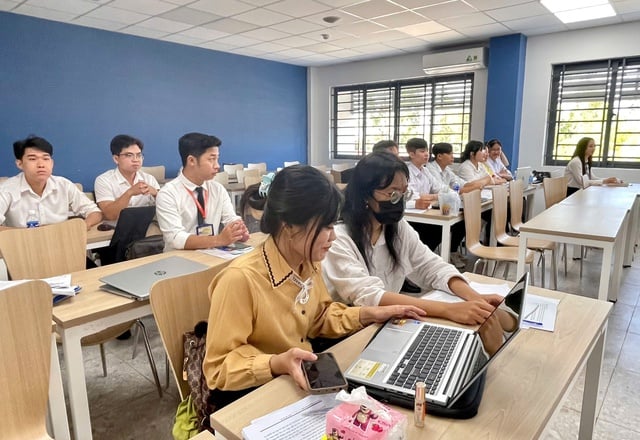
Vietnam has the advantage of a large population and a dynamic workforce, but needs sound macroeconomic policies and a well-functioning organizational structure to achieve rapid breakthroughs.
Photo: My Quyen
CREATING A FAIR AND EQUAL PLAYING FIELD FOR PUBLIC AND PRIVATE INDIVIDUALS
Associate Professor Nguyen Huy Vi, former Vice Rector of Phu Yen University and former senior lecturer at the Faculty of Education, University of Social Sciences and Humanities (Vietnam National University Ho Chi Minh City), believes that the current relationship between the state and private higher education in Vietnam contains many paradoxes, such as: The legal framework still has many constraints and bottlenecks that hinder the development of private higher education. "The legislative efforts over the past nearly three decades aimed at opening up private higher education are commendable, but in reality, the results achieved have not been commensurate with the potential of this field," Professor Vi stated.
According to Mr. Vi, the legal documents are also unclear, not in line with Vietnam's reality and the trend of international integration, and difficult to understand not only for private higher education institutions but also for the public, especially students and parents.
"Besides that, there are strict regulations on opening schools and majors... At the same time, the advantages of public higher education, largely created by policy, have made investors feel insecure when wanting to participate in the private higher education sector," Associate Professor Dr. Nguyen Huy Vi observed.
Drawing on practical experience in private higher education worldwide, Mr. Vi proposed adjusting the relationship between the state and private higher education by shifting the state's role from control to supervision and support. "The state plays the role of designing policy tools; influencing and regulating higher education through framework policies; and creating a fair and equal playing field for both public and private higher education. The relationship between the state and private higher education will never achieve its expected goals without a clear legal basis. We can derive guiding principles to more clearly institutionalize the goals of private higher education, such as clearly distinguishing between for-profit and non-profit private universities," Mr. Vi shared.



According to Associate Professor Dr. Nguyen Huy Vi, private higher education institutions must also commit to the state regarding the fulfillment of their mission to serve the common interests of the nation, sharing and cooperating responsibly with public higher education. At the same time, they must establish and effectively operate mechanisms for transparency; autonomy and accountability; quality assurance and accreditation; and stratification and ranking.
Dr. Tran Duc Canh stated that the private university development model in Malaysia shares many similarities with Vietnam. However, to achieve a growth model similar to Malaysia's, Vietnamese private universities must genuinely improve their quality and build trust within society. Furthermore, the governance and management model must be better and more professional, minimizing instability caused by excessive interference or control by individuals, families, or shareholder groups, which is driven by financial factors and short-term profits.
Furthermore, according to Dr. Canh, Vietnam needs a policy of investing in leading schools, regardless of whether they are public or private. The role of the state is to formulate policies and manage at the macro level, helping to create an environment and incentives for innovation, as well as transparency for schools through quality accreditation, reducing mechanical criteria, cumbersome procedures and requirements.
In particular, Mr. Canh argued that Vietnam must develop a truly non-profit model, creating a clear distinction between "education business" and "investment in school facilities for educational purposes".
Source: https://thanhnien.vn/de-viet-nam-xay-dung-truong-dh-tu-thuc-dang-cap-185260623212735495.htm





![[Photo] Prime Minister Le Minh Hung presides over the thematic session on promoting science and technology development and innovation.](https://vphoto.vietnam.vn/thumb/1200x675/vietnam/resource/IMAGE/2026/06/23/1782207872934_ndo_br_dsc-1724-jpg.webp)